In spirulina businesses, profitability is rarely determined by how little capital is spent upfront. Instead, long-term success depends on how capital expenditure (CAPEX) decisions influence operating expenditure (OPEX) over the life of the farm.
Many spirulina projects fail not because CAPEX was too high, but because CAPEX was deliberately suppressed, pushing complexity, labour, inefficiency, and risk into OPEX. Over time, these operating costs compound and erode margins.
This article explains how CAPEX and OPEX trade-offs actually work in spirulina businesses, where poor decisions shift cost rather than reduce it, and how serious operators evaluate investments through a lifecycle lens.
Understanding CAPEX and OPEX in Spirulina Operations
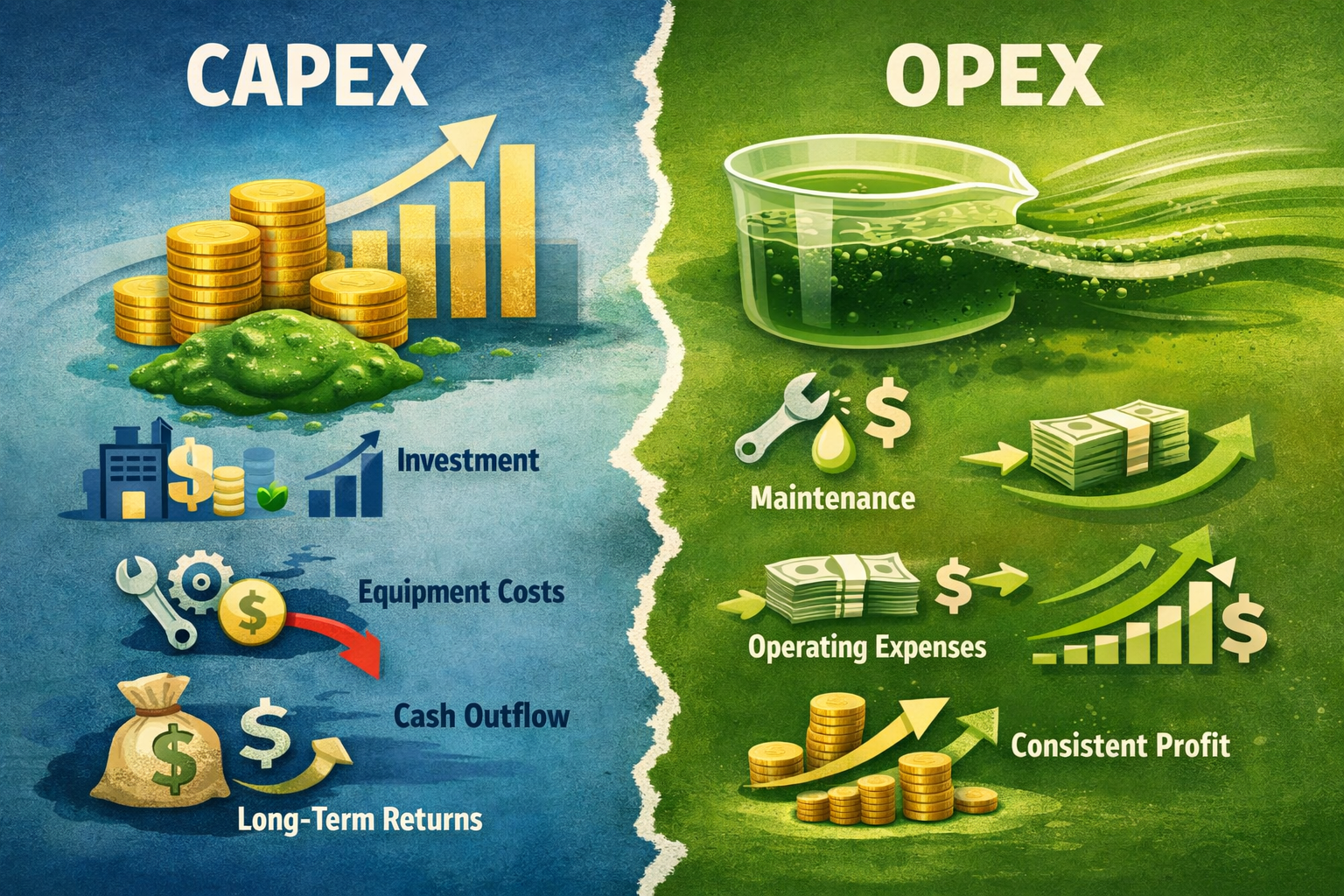
CAPEX in spirulina farming includes one-time investments in infrastructure and systems such as:
- Raceway ponds and civil works
- Efficient agitator systems
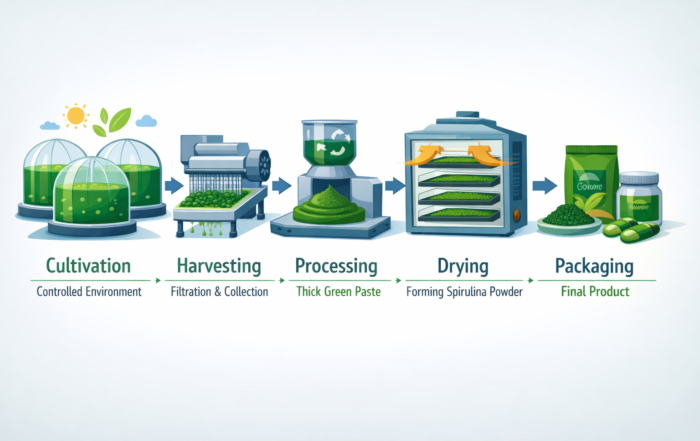
- Harvesting and dewatering equipment
- Drying technologies
- Packing and storage infrastructure
OPEX includes recurring costs such as:
- Labour and supervision
- Nutrients and consumables
- Power and water
- Maintenance and replacements
- Quality testing and compliance
The relationship between CAPEX and OPEX is inverse only on paper. In practice, under-investing in CAPEX usually inflates OPEX.
The Most Common CAPEX Suppression Mistake
The most frequent mistake in spirulina projects is designing systems to minimise upfront spend without accounting for operational consequences.
Typical CAPEX cuts include:
- Manual agitation instead of engineered agitators
- Labour-intensive harvesting instead of mechanised harvesting equipment
- Basic dewatering instead of assisted dewatering systems
- Sun drying instead of controlled spirulina drying equipment
Each of these choices reduces initial cost but increases labour dependency, variability, and loss rates.
How Low CAPEX Drives High OPEX Over Time
Low-control systems require constant intervention to maintain output. This manifests as:
- Higher staffing requirements
- Increased training and supervision costs
- Greater culture crash frequency
- More batch rejections and reprocessing
- Rising compliance and audit expenses
These costs are rarely visible in early projections but dominate financial performance over time.
Drying Decisions: The Largest CAPEX–OPEX Lever
Drying represents the single most influential CAPEX decision in a spirulina business.
Low-CAPEX drying approaches such as sun drying or basic hot-air systems reduce upfront spend but create downstream OPEX through:
- Nutrient degradation and price discounts
- Shelf-life instability and returns
- Increased testing and rework
- Lost access to premium markets
Investments in controlled systems such as RWD drying systems or vacuum dryers increase CAPEX but stabilise moisture activity, preserve nutrients, and reduce long-term operating losses.
Labour vs Automation: A Hidden Cost Curve
Labour-heavy systems appear cheaper during setup but scale poorly.
As production increases:
- Labour costs rise non-linearly
- Error rates increase
- Output consistency declines
- Management overhead grows
Automation embedded at the CAPEX stage – particularly in agitation, harvesting, dewatering, and packing – keeps OPEX predictable and scalable.
CAPEX vs OPEX Comparison Across Key Functions
| Function | Low CAPEX Approach | Resulting OPEX Impact | High-Control CAPEX Approach | OPEX Outcome |
| Agitation | Manual / basic | High labour, instability | Efficient agitators | Stable, low labour |
| Harvesting | Manual | High losses, variability | Mechanised harvesting | Predictable throughput |
| Dewatering | Basic filtration | Rework, contamination | Assisted systems | Lower risk |
| Drying | Sun / hot air | Rejections, spoilage | Controlled drying | Stable shelf life |
| Packing | Basic packaging | Returns, oxidation | High-barrier systems | Predictable storage |
Investor Perspective: Lifecycle Cost Matters More Than Entry Cost
Experienced investors evaluate spirulina projects based on lifecycle economics.
Key questions include:
- What happens to margins at 2× or 3× scale?
- How does labour scale relative to output?
- Are compliance costs embedded or reactive?
- Where does variability create hidden losses?
Projects with balanced CAPEX typically outperform low-cost builds over a five- to seven-year horizon.
How Greenbubble Balances CAPEX and OPEX
Greenbubble approaches spirulina project design by allocating CAPEX where it permanently reduces OPEX. Investments are prioritised in system elements that stabilise production – raceway ponds, efficient agitator design, harvesting equipment, assisted dewatering systems, drying technologies, and packing systems.
Rather than minimising initial cost, Greenbubble focuses on minimising lifetime cost through disciplined system engineering. This philosophy underpins both spirulina farming consultancy and [spirulina farming turnkey solutions](https://spirulinafarming.com/solutions/spirulina-farming-turnk.
FAQs
Q1. Is higher CAPEX always better in spirulina farming?
No. CAPEX should be targeted, not excessive.
Q2. Why do low-cost farms struggle financially?
Because suppressed CAPEX shifts cost into labour, losses, and compliance failures.
Q3. Which CAPEX decision has the biggest OPEX impact?
Drying and automation choices.
Q4. Can OPEX issues be fixed later?
Only partially, and usually at higher cost.
Q5. How do investors evaluate CAPEX-heavy projects?
By assessing whether CAPEX reduces long-term risk and operating cost.
Conclusion: CAPEX Is a Tool, Not a Burden
In spirulina businesses, CAPEX is not a burden to be avoided – it is a tool for controlling OPEX. Projects that understand this trade-off build systems that remain profitable, compliant, and scalable long after initial commissioning.
Make us your source on Google
Table Of Contents