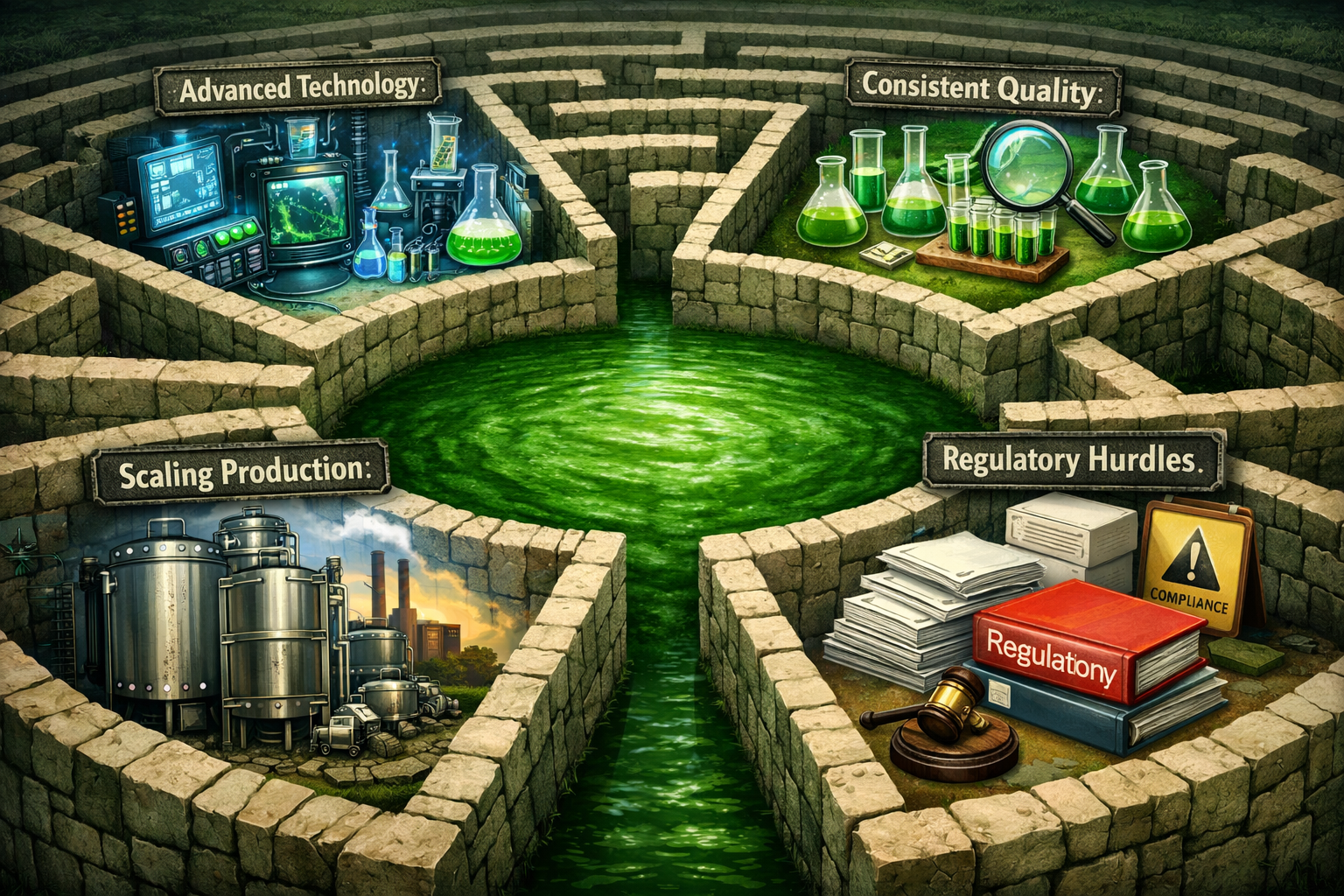
Spirulina farming is often marketed as a “high-margin superfood opportunity.” What is rarely discussed are the structural market entry barriers that determine whether a new producer survives beyond the first 18 months.
Many entrants focus on cultivation techniques while underestimating capital intensity, compliance depth, automation requirements, and buyer qualification standards.
At Greenbubble, we consistently observe that early-stage failure is rarely due to poor biology. It is due to underestimated structural barriers.
Understanding these barriers before investment is the difference between a hobby operation and a scalable commercial enterprise.
Capital Intensity Is Higher Than Expected
New producers frequently assume that spirulina farming can be started with minimal infrastructure. While small ponds can be built cheaply, commercial viability requires significantly more.
Serious market entry requires:
- Engineered pond systems
- Controlled harvesting infrastructure
- Hygienic dewatering and drying units
- In-house laboratory setup
- Certification and documentation systems
- Working capital buffer
Engineered raceway ponds alone represent a structural investment, particularly when designed for long-term durability and contamination control.
Underestimating capital requirements leads to underbuilt facilities that cannot scale.
Certification Is Not Optional
Many new entrants assume certification can be pursued after production begins.
In reality, export and nutraceutical buyers expect:
- HACCP alignment
- GMP zoning
- Heavy metal validation
- Microbial testing per batch
- Organic certification where applicable
Retrofitting compliance is far more expensive than integrating it during design.
Structured planning through spirulina farming turnkey solutions embeds certification architecture into the facility layout from inception.
Farms built without compliance foresight often remain trapped in low-margin local markets.
Automation Is a Competitive Barrier
Manual production may work at micro-scale. It collapses under commercial demand.
New producers underestimate:
- Labor intensity in harvesting
- Variability in manual drying
- Contamination risk from human contact
- Documentation gaps
Commercial buyers expect reproducibility.
Automated systems such as structured harvesting equipment solutions and assisted dewatering systems reduce variability and improve audit performance.
Automation is not an upgrade. It is an entry barrier to serious markets.
Quality Consistency Requirements
New producers often focus on yield per square meter.
Buyers focus on:
- Protein stability (NLT 60%)
- Phycocyanin concentration
- Moisture consistency
- Heavy metal margins
- Microbial safety
Uncontrolled drying methods reduce pigment retention and increase moisture variability.
Export-grade facilities use controlled spirulina drying equipment to preserve nutrient integrity and ensure batch consistency.
Consistency is what allows price stability.
Buyer Qualification Cycles
Another underestimated barrier is buyer onboarding.
Large nutraceutical buyers typically require:
- Sample validation
- Multiple batch testing
- Audit visits
- Documentation review
- Trial orders
This qualification process can take months.
New producers expecting immediate large orders often face liquidity stress.
Greenbubble advises aligning production scaling with buyer qualification timelines to prevent inventory accumulation and cash-flow pressure.
Working Capital Buffer Requirements
Even after securing buyers, payment terms may extend 30 to 60 days post-shipment.
New producers underestimate the need to cover:
- Nutrient procurement
- Power consumption
- Salaries
- Lab consumables
- Packaging and freight
A 2–3 month operating buffer is often necessary to maintain stable operations during receivable cycles.
Under-capitalized farms struggle despite having confirmed orders.
Market Saturation in Commodity Segment
Low-barrier entry into small-scale production creates oversupply in bulk local markets.
Commodity spirulina competes on price.
Without differentiation through:
- Certification depth
- Automation
- Export readiness
- COA strength
new producers are forced into price wars.
Price wars compress margins rapidly.
Technical Knowledge Gap
Spirulina cultivation requires continuous monitoring of:
- pH trends
- Temperature stability
- Carbon dosing
- Salinity balance
- Contamination risk
Mismanagement in any of these areas reduces yield and pigment quality.
Professional advisory support through structured spirulina farming consultancy bridges the gap between theoretical cultivation and commercial-grade production.
Technical discipline itself is a market entry barrier.
Infrastructure Scalability Constraint
Many new farms are built without future scalability planning.
Common limitations include:
- Inadequate space for expansion
- Insufficient power infrastructure
- No room for additional drying capacity
- Lab designed only for small batch volumes
Scaling later becomes expensive and disruptive.
Greenbubble’s design philosophy emphasizes expansion-ready infrastructure to avoid bottlenecks as demand grows.
Summary of Underestimated Entry Barriers
Below is a simplified overview:
| Barrier Category | What New Producers Assume | Market Reality |
| Capital Cost | Can start small and scale later | Retrofitting is expensive and limits certification |
| Certification | Can apply after production | Buyers require compliance before contracts |
| Automation | Manual is sufficient | Automation is required for consistency |
| Buyer Access | Orders come quickly | Qualification cycles are lengthy |
| Working Capital | Revenue covers expenses | Payment delays require liquidity buffer |
| Quality | Yield is enough | Consistency determines pricing power |
Market entry in spirulina is not biologically complex – it is structurally demanding.
Frequently Asked Questions
Q1. Is spirulina farming easy to start?
Small-scale cultivation is technically simple, but entering commercial or export markets requires significant infrastructure, certification, and financial planning.
Q2. Why do many new spirulina farms fail within two years?
Failure typically results from underestimating capital needs, compliance costs, working capital requirements, and buyer qualification timelines.
Q3. Is automation mandatory for commercial production?
For export-grade and nutraceutical markets, yes. Automation improves consistency, reduces contamination risk, and strengthens audit performance.
Q4. How important is certification for new producers?
Certification is critical for accessing premium markets. Without it, producers are limited to low-margin local segments.
Q5. What is the most underestimated barrier?
Working capital and compliance depth are the most underestimated barriers. Production may be successful, but liquidity gaps and certification delays often restrict growth.
Conclusion
The spirulina industry rewards disciplined, well-capitalized, compliance-focused producers.
New entrants who underestimate structural entry barriers often struggle to compete beyond local commodity markets.
At Greenbubble, we design spirulina operations with full awareness of these barriers – integrating automation, certification readiness, financial planning, and scalability from the outset.
Market entry is not about starting production.
It is about building a system capable of surviving global competition.
Make us your source on Google
Table Of Contents