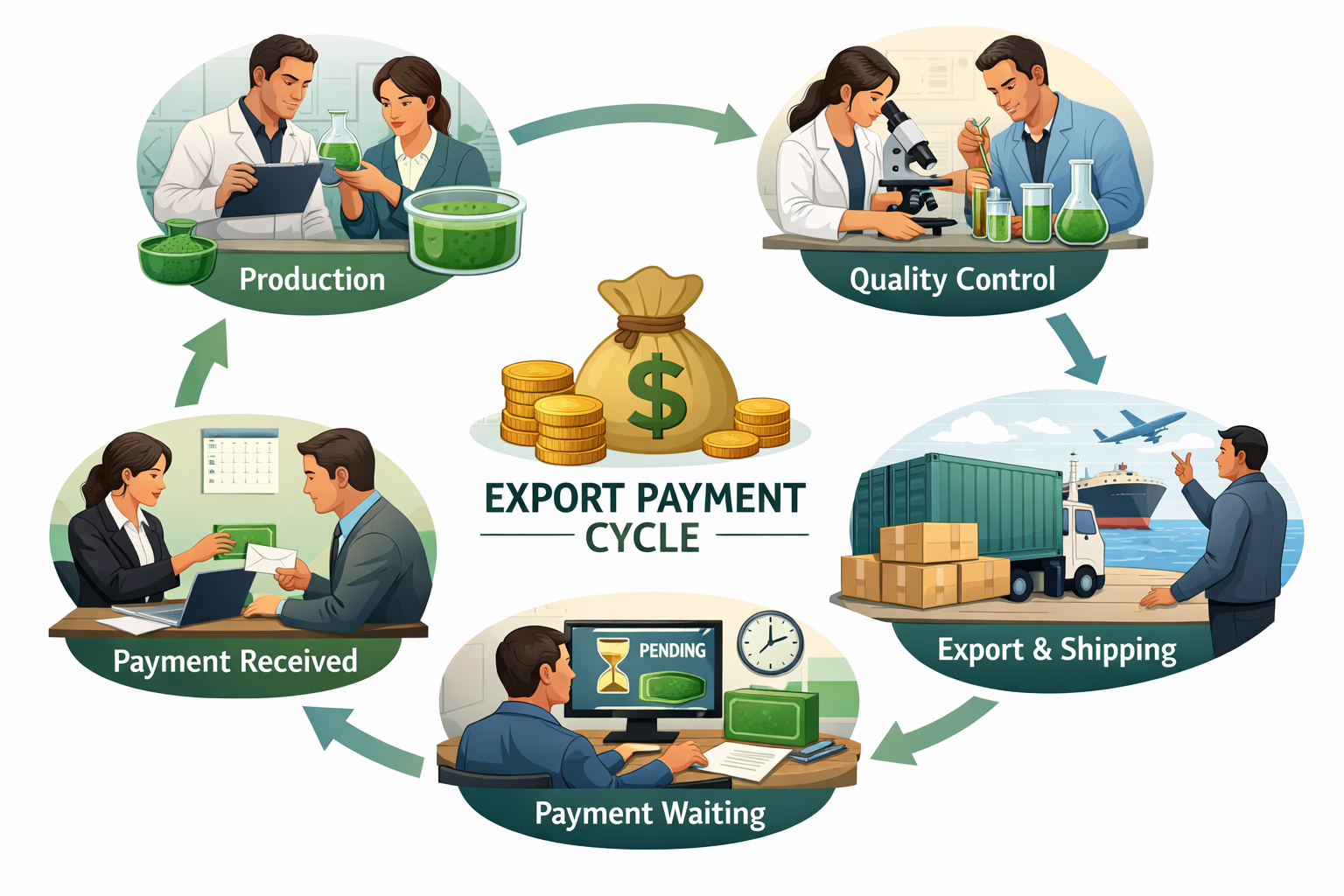
Exporting spirulina can significantly improve revenue realization compared to local commodity markets. However, export sales introduce a new financial reality – delayed payment cycles.
Many spirulina businesses underestimate the impact of payment terms on working capital. Even profitable farms can experience liquidity stress if cash-flow planning is weak.
At Greenbubble, we emphasize that export readiness is not only about quality and certification. It is equally about financial structuring and cash-flow resilience.
Understanding export payment cycles is critical for sustainable scaling.
Understanding Typical Export Payment Terms
International spirulina buyers commonly operate on:
- 30-day payment terms after shipment
- 45-day or 60-day credit cycles
- Documents Against Acceptance (DA)
- Letters of Credit (LC)
- Partial advance with balance post-delivery
In many cases, payment is received 45–75 days after production begins.
This creates a working capital gap between:
- Nutrient procurement
- Labor and power expenses
- Harvesting and drying operations
- Packaging and logistics
- Final payment realization
Farms that do not plan for this gap risk operational disruption.
Production Cycle vs Payment Cycle Mismatch
A typical spirulina production cycle may run continuously, especially in commercial-scale facilities.
Costs are incurred daily for:
- Nutrient dosing
- Power consumption
- Salaries
- Lab testing
- Packaging materials
Revenue, however, may arrive months later.
This mismatch creates cash-flow pressure even when gross margins are strong.
Structured infrastructure such as engineered raceway ponds and automated harvesting equipment solutions reduce per-unit production cost, helping stabilize cash burn during delayed receivables.
Working Capital Requirements for Export Farms
Export-oriented spirulina farms must maintain sufficient working capital to cover:
- 2 to 3 months of operating expenditure
- Certification renewals and audit fees
- Lab consumables and testing panels
- Inventory holding costs
- Freight and export documentation charges
Without this buffer, even short payment delays can disrupt nutrient procurement and harvesting schedules.
Greenbubble advises clients to model working capital cycles before commissioning the plant – not after the first export order.
Inventory Holding Risk
Export buyers often demand batch validation before dispatch. This means finished goods may remain in inventory while:
- COA is generated
- Microbial and heavy metal reports are cleared
- Buyer documentation is reviewed
Holding inventory ties up capital.
Automated processing systems such as assisted dewatering systems and controlled spirulina drying equipment reduce batch rejection risk and shorten validation cycles, improving inventory turnover.
Lower rejection rates directly improve cash-flow velocity.
Certification and Audit Costs Impact Liquidity
Export markets require:
- HACCP compliance
- GMP zoning
- Organic certification (if applicable)
- Periodic third-party audits
These expenses occur regardless of payment realization.
Farms that delay certification planning often face unexpected liquidity strain.
Integrated planning through spirulina farming turnkey solutions ensures compliance infrastructure is budgeted into capital expenditure rather than treated as unpredictable operating shocks.
Freight, Insurance, and Documentation Timing
Export shipments involve:
- Freight booking and container charges
- Marine insurance
- Port handling fees
- Customs documentation
In many cases, these expenses are paid before buyer payment is received.
Cash-flow modeling must incorporate logistics lead time and payment clearance cycles.
Greenbubble’s advisory approach includes aligning production scheduling with shipment batching to minimize freight frequency and optimize receivable timing.
Mitigating Cash-Flow Risk in Export Spirulina
Effective strategies include:
- Negotiating partial advance payments
- Securing working capital credit lines
- Using Letters of Credit for large shipments
- Diversifying buyer portfolio to stagger receivables
- Maintaining 90-day liquidity buffer
Automation plays a structural role here. Solutions such as automated packing systems reduce dispatch delays and improve documentation accuracy, accelerating buyer approval and payment release.
Consistency speeds payment.
Scaling Without Liquidity Shock
Rapid scaling increases:
- Nutrient purchase volume
- Labor cost
- Power consumption
- Inventory size
If receivables remain on 60-day cycles, growth amplifies working capital demand.
This is why Greenbubble emphasizes phased scaling with financial modeling support through structured spirulina farming consultancy.
Scaling production without scaling liquidity planning is a common failure point in export businesses.
Cash-Flow Discipline vs Profit Illusion
A farm can show positive annual profit on paper while experiencing monthly liquidity stress.
This occurs when:
- Sales are booked
- Inventory is shipped
- Receivables remain outstanding
Profit does not equal cash.
Export-focused spirulina businesses must track:
- Days Sales Outstanding (DSO)
- Inventory turnover ratio
- Operating expense coverage months
- Certification renewal calendar
Financial discipline is as critical as cultivation discipline.
Frequently Asked Questions
Q1. How long does it typically take to receive payment for export spirulina shipments?
Most export transactions operate on 30 to 60 day payment terms after shipment, though some contracts extend beyond this depending on documentation and buyer approval cycles.
Q2. Why do profitable spirulina farms still face cash-flow problems?
Because production expenses are immediate while export payments are delayed. Without adequate working capital, liquidity gaps can occur even in profitable operations.
Q3. How much working capital should an export-oriented farm maintain?
Ideally, farms should maintain at least 2 to 3 months of operating expenditure as liquidity buffer to manage receivable cycles and certification expenses.
Q4. Does automation help improve cash flow?
Yes. Automation reduces rejection rates, speeds batch validation, minimizes labor inefficiency, and accelerates dispatch timelines – all of which shorten receivable cycles.
Q5. What is the biggest financial risk in exporting spirulina?
The biggest risk is underestimating receivable delays and scaling production without securing sufficient working capital support.
Conclusion
Export markets offer higher pricing potential for spirulina businesses, but they also introduce structured payment delays.
Without disciplined cash-flow planning, even technically strong farms can face liquidity pressure.
At Greenbubble, we design spirulina operations with both engineering strength and financial realism – because export success depends on quality, compliance, and liquidity resilience.
In international trade, cash flow stability determines whether growth is sustainable.
Make us your source on Google
Table Of Contents