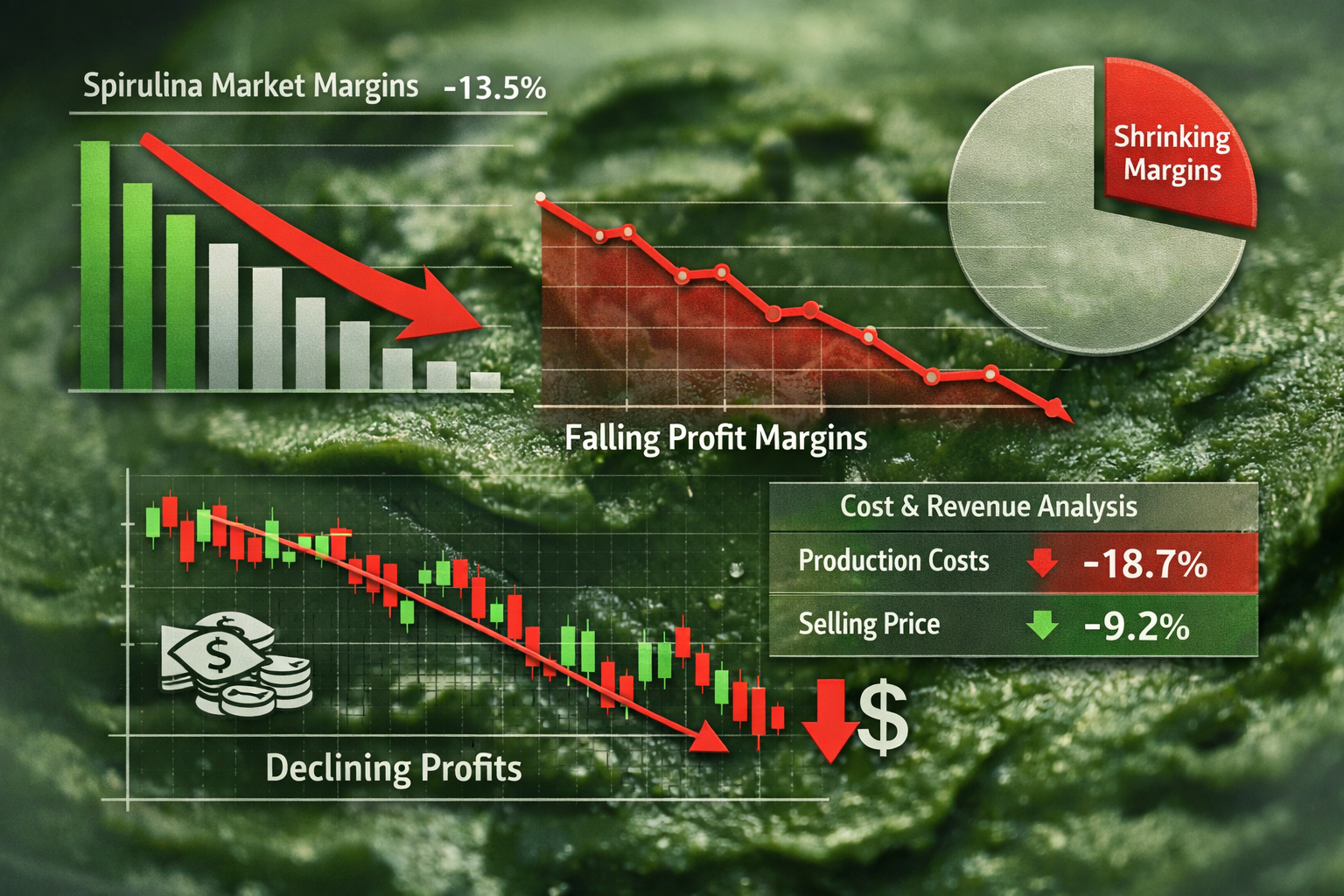
Spirulina demand is growing globally. Yet paradoxically, many producers are experiencing shrinking margins.
This phenomenon is known as margin compression – when selling prices decline while production and compliance costs continue to rise.
Commodity spirulina – bulk powder sold without differentiation, certification strength, or technical positioning – is increasingly vulnerable to this pressure.
At Greenbubble, we consistently observe that farms operating without automation, certification discipline, and export-grade quality controls are the first to experience price erosion. Across multiple commercial projects, the pattern is consistent: commoditized positioning weakens pricing power.
Understanding why this happens is critical for investors and operators planning commercial-scale production.
What Is Commodity Spirulina?
Commodity spirulina typically refers to:
- Undifferentiated bulk powder
- Inconsistent phycocyanin levels
- Limited documentation or COA depth
- Minimal brand positioning
- Local market sales without export compliance
In such markets, buyers compete primarily on price.
When spirulina becomes a price-only product, margins inevitably shrink.
The Global Supply Effect
As more small-scale farms enter the industry using manual or semi-manual methods, total supply increases. However, quality does not increase proportionally.
Large buyers respond by:
- Negotiating lower bulk rates
- Switching suppliers based purely on price
- Demanding stronger documentation at the same cost
Without technical differentiation, producers are forced into price wars.
Price wars compress margins.
From a systems-design perspective, this is why Greenbubble emphasizes structural differentiation rather than incremental improvements. Competing on engineering strength protects pricing power; competing on price alone does not.
Rising Operating Costs vs Flat Selling Prices
While commodity pricing declines, operational costs continue to rise.
Major cost drivers include:
- Nutrient inputs
- Power consumption
- Labor
- Certifications and audits
- Lab testing per batch
- Packaging compliance
Farms without automation experience even higher labor intensity in harvesting and processing.
This is where structured systems such as engineered raceway ponds and automated harvesting equipment solutions create operational efficiency that protects margins.
In commercial facilities designed by Greenbubble, process flow is optimized to reduce per-unit production cost while maintaining export-grade compliance.
Without efficiency, commodity farms absorb rising costs directly into shrinking profit.
Quality Variability Drives Price Discounting
Commodity producers often rely on inconsistent drying methods such as sun drying or uncontrolled hot air systems.
This results in:
- Lower phycocyanin retention
- Higher moisture variation
- Microbial instability
- Batch-to-batch inconsistency
Buyers compensate for risk by demanding discounts.
Export-grade farms use controlled spirulina drying equipment to maintain stable protein levels (NLT 60%), strong pigment retention, and validated moisture control.
Consistency commands price stability.
Inconsistency forces discounting.
This is precisely why Greenbubble integrates temperature-controlled drying architecture into commercial farm design rather than leaving it to post-harvest improvisation.
Certification Inflation in Global Markets
International buyers increasingly demand:
- HACCP compliance
- GMP alignment
- Heavy metal testing
- Microbial validation
- Organic certification where applicable
Commodity producers often attempt to compete without investing in structured compliance.
The result is limited access to premium buyers.
Complete infrastructure planning through spirulina farming turnkey solutions integrates compliance into farm design rather than adding it later as a cost burden.
Farms that ignore certification pressure find themselves trapped in low-margin local markets.
Greenbubble’s turnkey model is structured specifically to prevent this trap by embedding documentation, lab planning, and audit-readiness from inception.
Oversupply in Low-Barrier Segments
Small farms under one acre often enter the market attracted by simplified ROI narratives.
However, these farms:
- Lack economies of scale
- Face higher per-unit operating costs
- Struggle with contamination control
- Cannot sustain export documentation
When many such producers enter simultaneously, bulk local markets become oversupplied.
Oversupply reduces price realization.
Without scale and automation, profitability collapses.
Commercial-scale farms engineered with long-term positioning in mind are structurally insulated from this volatility.
The Role of Automation in Margin Protection
Automation directly influences margin resilience.
Automated systems reduce:
- Labor dependency
- Contamination losses
- Batch rejection risk
- Documentation gaps
Solutions such as assisted dewatering systems and automated packing systems standardize processing and minimize quality variation.
When rejection rates drop and consistency improves, pricing power strengthens.
Automation is not a luxury – it is a margin defense mechanism.
Greenbubble’s approach prioritizes automation not as a feature, but as a structural requirement for maintaining export competitiveness.
Differentiation vs Commoditization
Commodity spirulina competes on price.
Export-grade spirulina competes on:
- Verified COA strength
- High phycocyanin percentage
- Stable protein profile
- Heavy metal safety margins
- Organic traceability
- Audit-readiness
Consultancy-led positioning through structured spirulina farming consultancy helps farms design for premium markets instead of competing in commodity segments.
The difference between a commodity farm and a premium producer is structural – not cosmetic.
Greenbubble’s advisory philosophy centers on building structural differentiation rather than reactive upgrades.
Margin Compression Is Structural, Not Temporary
Many operators assume falling prices are temporary.
In reality, margin compression is structural when:
- Supply growth exceeds differentiated demand
- Buyers consolidate purchasing power
- Compliance costs increase annually
- Global competition intensifies
Only farms with scale, automation, and certification discipline can sustain pricing power.
How to Avoid Commodity Trap
To avoid margin compression, farms must:
- Design engineered infrastructure from inception
- Automate harvesting and processing
- Implement in-house laboratory testing
- Maintain strict documentation discipline
- Target export and nutraceutical markets
- Invest in brand and quality differentiation
Competing solely on price is unsustainable.
Competing on compliance, consistency, and performance builds long-term resilience.
At Greenbubble, our design philosophy is rooted in preventing commoditization before it begins.
Frequently Asked Questions
Q1. Why are spirulina prices falling in some markets?
Prices decline when supply increases faster than differentiated demand. In bulk local markets, undifferentiated producers compete on price, leading to margin compression.
Q2. Is small-scale spirulina farming profitable long term?
Small-scale farms may generate limited revenue locally, but without automation, certification, and scale, margins remain vulnerable to price fluctuations and contamination risks.
Q3. How does automation protect profitability?
Automation reduces labor costs, minimizes contamination losses, improves batch consistency, and strengthens audit performance – all of which protect pricing power.
Q4. Does organic certification improve margins?
Organic certification can command premium pricing, but only when supported by strong documentation, traceability, and consistent quality.
Q5. What is the biggest risk of selling spirulina as a commodity?
The biggest risk is entering a price war where production costs continue rising while selling prices decline, resulting in shrinking or negative margins.
Conclusion
Commodity spirulina faces margin compression because it competes on price alone in an increasingly regulated and oversupplied market.
Farms that invest in automation, infrastructure discipline, laboratory validation, and export positioning build structural resilience against price erosion.
At Greenbubble, we design spirulina operations that compete on quality, compliance, and scalability – not price alone.
In a commoditizing market, differentiation is not optional.
It is the foundation of sustainable profitability.
Make us your source on Google
Table Of Contents