For export-grade spirulina, shelf life is not an assumed number printed on a label – it is a validated claim supported by structured testing. Regulatory authorities, global buyers, and certification bodies increasingly expect shelf-life declarations to be backed by documented protocols rather than historical averages or industry norms.
This article outlines how shelf-life testing for export-grade spirulina is designed, what parameters are monitored, and how testing outcomes align with audit and market expectations.
Why Shelf-Life Testing Matters in Export Markets
Export markets operate on extended logistics timelines, multiple climate zones, and prolonged storage periods. Under these conditions, even small stability weaknesses can escalate into compliance issues.
Shelf-life testing serves three critical purposes:
- Verifying nutritional and microbiological stability over time
- Demonstrating due diligence during audits
- Supporting defensible expiry and best-before claims
Without structured testing, shelf life remains an assumption rather than a validated attribute.
Core Stability Parameters Monitored
Shelf-life testing for spirulina typically tracks a combination of chemical, biological, and physical indicators:
- Moisture content and water activity ($\boldsymbol$)
- Microbial load (TPC, yeast, mould)
- Pigment stability (phycocyanin, chlorophyll)
- Sensory attributes (colour, aroma, flowability)
- Oxidative markers (off-odours, colour shift)
These parameters collectively define whether the product remains within specification throughout storage.
Real-Time vs Accelerated Shelf-Life Studies
Two complementary testing approaches are commonly used.
Real-Time Shelf-Life Testing
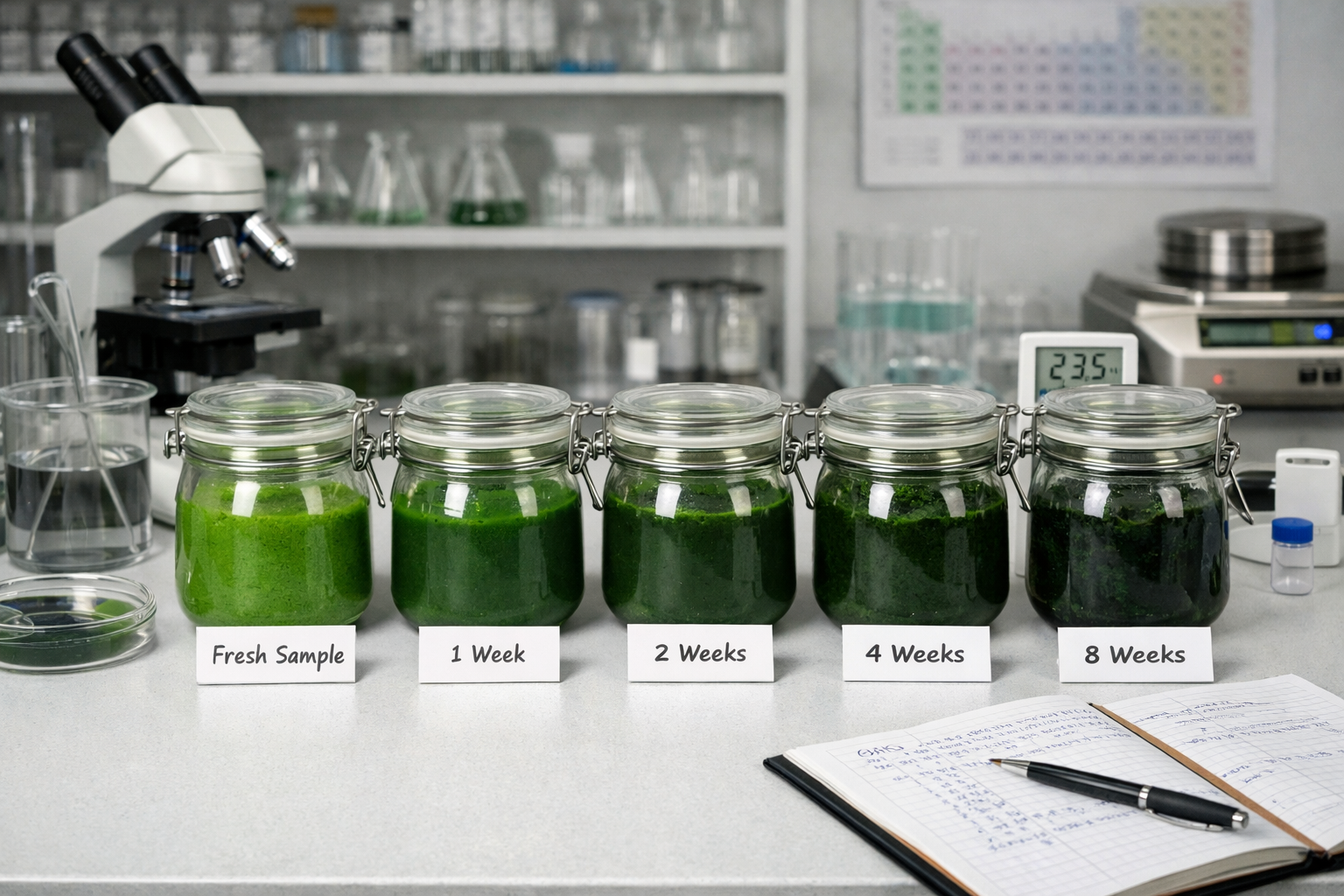
Real-time studies store spirulina under recommended storage conditions and test samples at defined intervals (e.g., 0, 3, 6, 9, 12 months). This method provides the most reliable data but requires time and planning.
Accelerated Shelf-Life Testing
Accelerated studies expose samples to elevated temperature and humidity to simulate long-term storage effects in a shorter timeframe. While useful for early insights, accelerated results must be interpreted carefully and validated against real-time data.
Export-grade validation often combines both approaches.
Designing a Shelf-Life Testing Protocol
A robust protocol defines testing conditions clearly before trials begin. Key elements include:
- Defined storage conditions (temperature, RH, light exposure)
- Packaging format and atmosphere under test
- Sampling frequency and test duration
- Acceptance criteria for each parameter
- Documentation and traceability requirements
Consistency in protocol design is essential for audit credibility.
Role of Packaging in Shelf-Life Outcomes
Packaging strongly influences shelf-life test results. Barrier properties, seal integrity, and headspace conditions determine exposure to oxygen and moisture during storage.
Export-oriented operations often evaluate shelf life in conjunction with final packaging using validated packing systems to ensure that test outcomes reflect real-world distribution conditions.
Integration with Drying and Processing Controls
Shelf-life stability begins upstream. Inconsistent drying or residual moisture gradients can invalidate even the most carefully designed testing protocol.
Low-temperature, uniform drying methods such as RWD drying systems or enclosed vacuum dryers help ensure that shelf-life tests evaluate storage effects rather than latent processing defects.
Typical Shelf-Life Validation Matrix
| Parameter | Test Frequency | Acceptance Criterion | Audit Relevance |
| Water activity ($\boldsymbol$) | Every interval | Within validated range | High |
| Total plate count | Start, mid, end | Within spec limits | High |
| Colour stability | Every interval | No significant drift | Medium |
| Aroma / sensory | Every interval | No off-notes | Medium |
| Packaging integrity | Periodic | No seal failure | High |
This matrix demonstrates how testing outputs map directly to compliance expectations.
Storage Condition × Shelf-Life Failure Risk Matrix
Shelf-life failures are rarely caused by a single parameter drifting out of range. Instead, they emerge from the interaction between storage environment, packaging performance, and time. The matrix below illustrates how common storage conditions translate into shelf-life failure risk for export-grade spirulina:
| Storage Condition | Temperature Control | Humidity Control | Packaging Performance | Shelf-Life Failure Risk | Typical Failure Mode |
| Climate-controlled warehouse | Stable | Controlled | High-barrier, intact | Very low | Product remains within spec |
| Ambient warehouse (dry climate) | Moderate | Moderate | High-barrier, intact | Low–moderate | Gradual colour or aroma drift |
| High-humidity storage | Stable | Poor | Moderate-barrier | Moderate | Moisture uptake, $\boldsymbol$ drift |
| Non-climate-controlled storage | Fluctuating | Poor | Moderate-barrier | High | Oxidation and microbial risk |
| Reopened bulk packs | Variable | Uncontrolled | Compromised | Very high | Rapid quality and compliance failure |
This matrix reinforces that shelf-life risk is cumulative and environment-driven, making realistic storage assumptions essential during protocol design.
How Greenbubble Aligns Shelf-Life Testing with System Design
Across export-oriented spirulina projects, Greenbubble approaches shelf-life testing as an extension of system design rather than a standalone laboratory exercise. Drying parameters, packaging selection, and storage assumptions are aligned so that test results reflect realistic operating conditions.
This integrated approach reduces the risk of shelf-life failures emerging only after market entry.
Common Pitfalls in Shelf-Life Testing
Producers often encounter issues due to:
- Testing loose powder instead of final packed product
- Ignoring light exposure during testing
- Over-reliance on accelerated data alone
- Changing packaging after validation
Avoiding these pitfalls is critical for defensible shelf-life claims.
FAQs
Q1. Is accelerated shelf-life testing sufficient for exports?
Accelerated tests are useful, but real-time data is usually required for audit acceptance.
Q2. How long should shelf-life studies run?
They should cover the full claimed shelf life plus an appropriate safety margin.
Q3. Does shelf-life testing need to be repeated after packaging changes?
Yes. Packaging changes alter exposure conditions and invalidate prior results.
Q4. Are sensory tests acceptable for audits?
Yes, when supported by documented protocols and objective criteria.
Q5. Who is responsible for defining shelf life – the lab or the producer?
The producer remains responsible, even when tests are outsourced.
Conclusion: Shelf Life Must Be Proven, Not Assumed
For export-grade spirulina, shelf life is a claim that must withstand regulatory scrutiny, buyer evaluation, and real-world distribution stress. Structured shelf-life testing protocols provide the evidence needed to support that claim. In Greenbubble-supported systems, shelf-life validation is treated as a logical outcome of disciplined processing, packaging, and storage design – ensuring confidence from production floor to international market.
Make us your source on Google
Table Of Contents