In retail environments, spirulina powder faces a stress factor that is often underestimated: light. While oxidation and moisture are widely discussed, light exposure – particularly during shelf display – can quietly degrade pigments, vitamins, and functional compounds. For retail-ready spirulina, light is not merely a cosmetic concern; it is a chemical trigger that shortens shelf life and erodes nutritional credibility.
This article examines how light-induced degradation occurs in spirulina products and explains why packaging and retail display decisions play a critical role in preserving nutritional integrity.
Why Light Exposure Matters After Packaging
Once spirulina is sealed and stabilised, it enters a distribution and retail phase where exposure to ambient and artificial light becomes continuous. Unlike oxygen or moisture ingress, light penetration often goes unnoticed because it does not alter packaging integrity.
However, photons interacting with sensitive compounds initiate photo-oxidative reactions that degrade nutrients even in otherwise well-controlled environments.
Light-Sensitive Components in Spirulina
Several key spirulina constituents are inherently photosensitive:
- Phycocyanin: Highly susceptible to photobleaching, leading to colour loss and antioxidant reduction
- Chlorophyll: Degrades under prolonged light exposure, reducing visual freshness
- Vitamins (B-complex): Light accelerates breakdown, especially in powdered form
- Polyunsaturated fatty acids: Light-induced oxidation contributes to off-odours
These losses often occur without microbial growth or moisture changes, making them difficult to detect early.
Mechanisms of Light-Induced Degradation
Light-driven degradation in spirulina primarily follows photo-oxidative pathways. When light energy is absorbed by pigments, it excites molecular states that generate reactive oxygen species. These reactive intermediates then attack nearby lipids, proteins, and vitamins.
Unlike thermal degradation, this process can occur at room temperature and progresses steadily under continuous illumination.
Retail Display as a High-Risk Phase
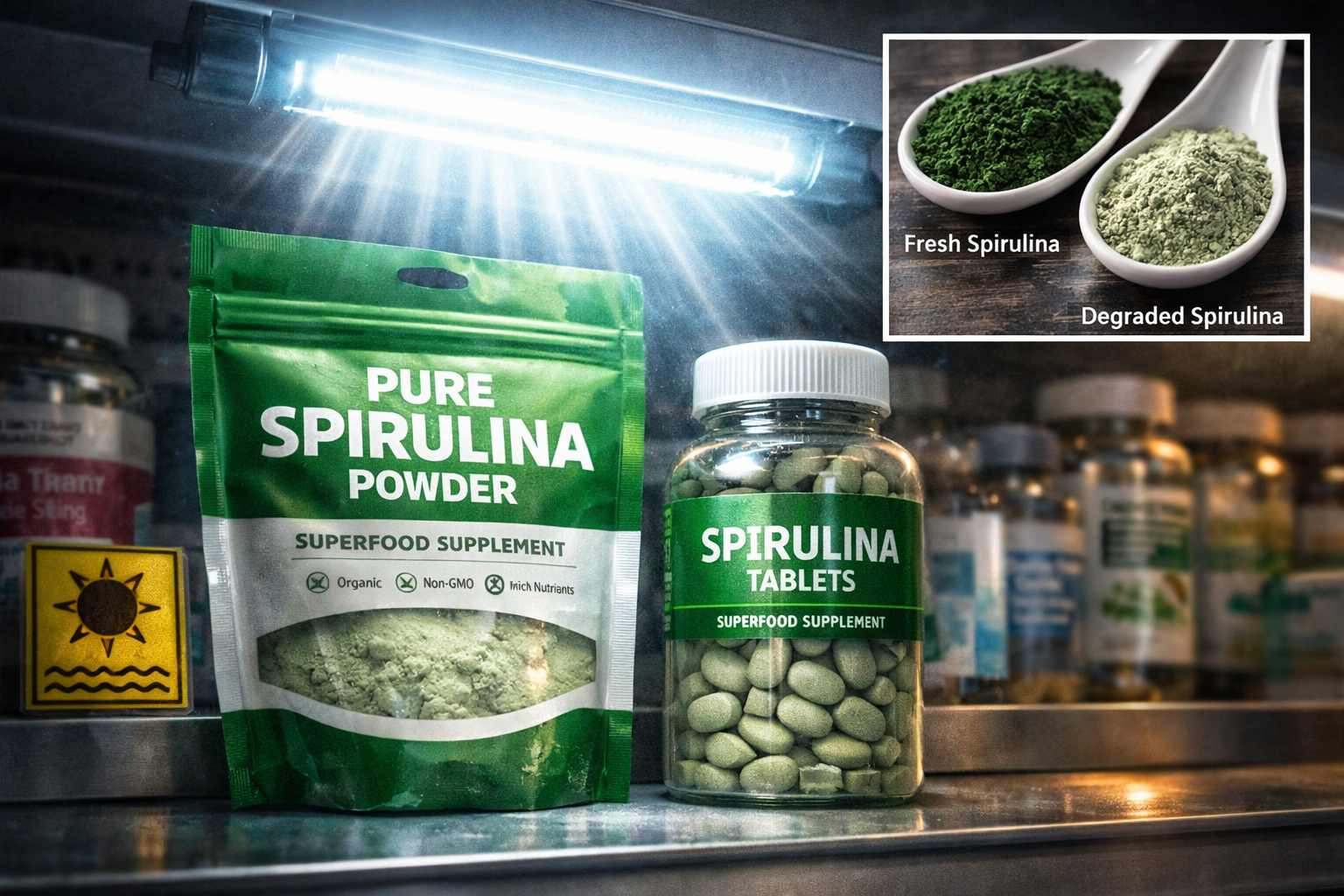
Retail shelves expose spirulina products to repeated cycles of fluorescent or LED lighting. Clear or translucent packaging allows light penetration that accelerates degradation long before expiry dates are reached.
Products positioned near store lighting or window displays experience the highest cumulative exposure, making retail handling a significant determinant of nutritional retention.
Packaging Design as the Primary Defence
Light-induced degradation is best addressed through packaging design rather than storage intervention. Effective strategies include:
Light-induced degradation is best addressed through packaging design rather than storage intervention. Effective strategies include:
- Opaque or multi-layer laminates that block visible and UV light
- Matte finishes to reduce internal reflection
- Printed inner layers that shield powder from direct illumination
- Tight control of package headspace to limit photo-oxidative synergy
Export- and retail-oriented operations commonly integrate these controls through advanced packing systems to ensure consistent light protection across batches. These systems are often paired with upstream drying choices – such as RWD drying systems or vacuum dryers – to minimise pigment stress before the product ever reaches retail shelves.
Interaction Between Light and Oxygen
Light and oxygen act synergistically in spirulina degradation. Even low residual oxygen levels can become highly reactive under light exposure, accelerating pigment and lipid breakdown.
This interaction explains why nitrogen-flushed packs can still experience colour fading if light barriers are inadequate – a reminder that atmosphere control and light shielding must work together. In practice, this linkage is evaluated alongside downstream handling and final pack integrity within integrated spirulina farming turnkey solutions.
Light and oxygen act synergistically in spirulina degradation. Even low residual oxygen levels can become highly reactive under light exposure, accelerating pigment and lipid breakdown.
This interaction explains why nitrogen-flushed packs can still experience colour fading if light barriers are inadequate – a reminder that atmosphere control and light shielding must work together.
Light Protection vs Packaging Type
Different packaging formats offer very different levels of protection against light-induced degradation. The comparison below highlights how common packaging choices perform under retail lighting conditions:
| Packaging Type | Light Protection Level | Typical Retail Use | Risk Profile for Spirulina |
| Clear PET / transparent pouches | Very low | Visual merchandising, impulse retail | High risk of pigment and vitamin degradation |
| Semi-transparent laminates | Low–moderate | Domestic retail with short turnover | Gradual colour fading over shelf life |
| Opaque multi-layer laminates | High | Export and premium retail | Strong protection, slow nutrient loss |
| Foil-based barrier packs | Very high | Long shelf-life and export markets | Minimal light-induced degradation |
| Secondary boxed packs (inner pouch + carton) | Very high | Global retail and e-commerce | Excellent protection if inner pack is sealed |
This comparison shows that light protection is primarily determined by packaging architecture rather than atmosphere alone.
Diagnostic Indicators of Light Damage
Early signs of light-induced degradation include:
| Indicator | Likely Cause | Commercial Impact |
| Gradual colour fading | Pigment photobleaching | Reduced shelf appeal |
| Loss of blue-green intensity | Phycocyanin breakdown | Nutritional devaluation |
| Subtle off-odours | Photo-oxidised lipids | Consumer rejection |
| Vitamin assay drift | Light-driven vitamin loss | Label non-compliance |
These indicators often precede laboratory non-conformance.
How Greenbubble Addresses Light Stability
Across retail- and export-focused spirulina projects, Greenbubble treats light protection as a downstream design requirement rather than a packaging afterthought. By aligning drying quality, packaging materials, and retail-readiness considerations, light-induced nutrient loss is mitigated at the system level.
This approach ensures that nutritional stability achieved during processing is preserved through distribution and shelf display.
What Producers Can Do Differently
Key operational shifts to reduce light-induced degradation include:
- Selecting packaging based on retail exposure, not just storage
- Auditing light transmission of packaging materials
- Avoiding clear packs for pigment-rich spirulina
- Aligning atmosphere control with light shielding
Retail stability must be engineered, not assumed.
FAQs
Q1. Does artificial light damage spirulina more than sunlight?
Both can cause degradation, but prolonged artificial lighting in retail environments is often more damaging due to continuous exposure.
Q2. Can clear packaging ever be used safely?
Only for short shelf-life or rapid turnover products with strong light barriers, which is rare for spirulina.
Q3. Does light affect all spirulina products equally?
Powders and fine particles are more vulnerable due to higher surface exposure.
Q4. Can nitrogen flushing prevent light damage?
It reduces oxidation but cannot prevent photodegradation without light barriers.
Q5. Are light-induced losses detectable in routine QC tests?
Often not immediately. Sensory changes appear before analytical failures.
Conclusion: Retail Light Is a Chemical Stressor
Light exposure is an active chemical stressor for retail-ready spirulina, capable of degrading nutrients even in sealed, dry packs. By recognising light as a design variable – and addressing it through packaging architecture and retail-aware planning – producers can protect nutritional value and brand credibility. In Greenbubble-supported systems, retail stability is approached as an integrated outcome of processing, packaging, and market intent.
Make us your source on Google
Table Of Contents