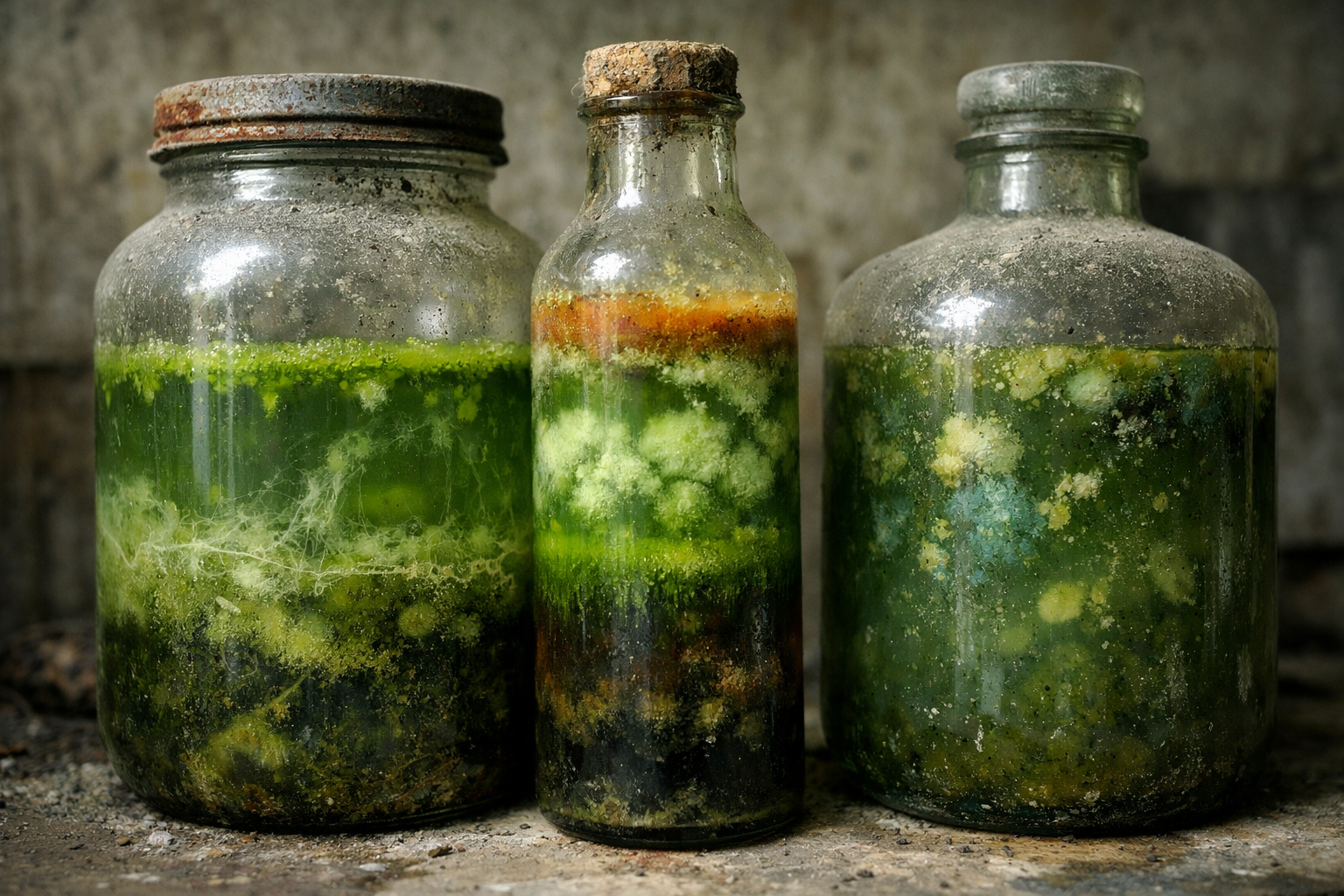
Spirulina powder is widely perceived as microbiologically stable once dried. While this assumption holds under correct conditions, improper storage can quietly reverse that stability. Microbial reactivation – rather than fresh contamination – is one of the most misunderstood risks in spirulina post-processing. It often occurs without visible spoilage, emerging instead as gradual quality drift, off-odours, or audit non-compliance.
This article explores how microbial reactivation occurs in spirulina powder, the storage conditions that trigger it, and how system-level design decisions prevent downstream failures.
Why Dried Spirulina Is Not Biologically Inert
Drying significantly reduces microbial activity, but it does not sterilise spirulina. Dormant microbial populations, enzyme fragments, and spores may remain inactive as long as water activity and temperature stay below critical thresholds.
Reactivation occurs when storage conditions reintroduce sufficient moisture and thermal energy to allow these dormant elements to resume metabolic or enzymatic activity.
Common Triggers for Microbial Reactivation
Microbial reactivation is almost always storage-driven. Key triggers include:
- Moisture ingress through permeable packaging or seal failure
- Condensation due to temperature cycling
- High ambient humidity during storage or transport
- Repeated opening of bulk containers
- Long storage durations without environmental monitoring
These factors often combine, making reactivation a cumulative risk rather than a single-point failure.
Role of Moisture and Water Activity
Water activity aw, not just moisture percentage, determines microbial viability. Even small increases in aw can enable enzymatic reactions and limited microbial growth.
Spirulina powders that remain stable below critical aw levels can rapidly deteriorate once moisture equilibrates with humid storage environments.
Temperature Effects on Dormant Microorganisms
Elevated temperatures accelerate enzymatic kinetics and reduce the energy barrier for microbial activity. Storage environments that fluctuate between cool and warm conditions – such as non-climate-controlled warehouses – pose a higher risk than consistently warm or cool spaces.
Temperature cycling also increases condensation risk inside packaging, compounding moisture exposure.
Packaging Integrity as the Primary Barrier
Packaging is the first and last defence against microbial reactivation. Oxygen control alone is insufficient if moisture barriers fail.
High-performance packing systems designed for nutraceutical products prioritise:
- Low water vapour transmission rates (WVTR)
- Seal integrity under temperature variation
- Controlled headspace environments
- Compatibility with desiccants where required
Without these controls, even well-dried spirulina becomes vulnerable during storage.
Interaction Between Drying and Reactivation Risk
Improper drying leaves behind uneven moisture pockets that act as microbial microenvironments. Slow or inconsistent drying increases the probability that some regions retain higher aw.
Low-temperature, uniform drying approaches such as RWD drying systems or enclosed vacuum dryers reduce reactivation risk by achieving tighter moisture distribution and limiting thermal damage that can later attract moisture.
Storage Condition vs Microbial Risk Matrix
Different storage environments create very different microbial risk profiles for spirulina powder. The matrix below illustrates how moisture, temperature, and handling conditions interact to influence reactivation risk:
| Storage Condition | Moisture Exposure | Temperature Stability | Microbial Reactivation Risk | Typical Outcome |
| Climate-controlled warehouse, sealed packs | Very low | Stable | Very low | Long-term microbiological stability |
| Dry warehouse, occasional temperature swings | Low | Moderate | Low–moderate | Gradual quality drift over time |
| High-humidity storage, sealed packs | Moderate | Stable | Moderate | Clumping and enzymatic activity |
| Non-climate-controlled storage | Moderate–high | Fluctuating | High | Reactivation and audit non-compliance |
| Reopened bulk packs in humid environments | High | Variable | Very high | Rapid microbial and quality failure |
This matrix highlights that microbial risk is driven by combined storage stresses rather than any single parameter.
Diagnostic Indicators of Microbial Reactivation
Microbial reactivation is often detected indirectly. Common warning signs include:
| Indicator | Likely Cause | Commercial Impact |
| Musty or earthy odour | Enzymatic activity | Consumer rejection |
| Clumping or caking | Moisture absorption | Reduced flowability |
| Rising total plate count | Reactivated microbes | Audit failure |
| Colour dulling | Secondary biochemical reactions | Perceived staleness |
These indicators may appear before overt microbial spoilage is evident.
How Greenbubble Designs for Microbial Stability
Across commercial and export-oriented spirulina projects, Greenbubble approaches microbial stability as a storage-system outcome rather than a drying-only objective. Moisture targets, drying uniformity, packaging selection, and warehouse assumptions are evaluated together.
By designing spirulina systems where drying, packaging, and storage conditions reinforce each other, microbial reactivation risks are minimised without reliance on preservatives or post-facto corrections.
Preventive Strategies for Producers
Producers can significantly reduce reactivation risk by:
- Monitoring water activity, not just moisture percentage
- Using moisture-barrier packaging suited to storage climate
- Avoiding bulk pack reopening without environmental control
- Auditing warehouses for humidity and temperature cycling
Microbial control extends well beyond the dryer.
FAQs
Q1. Can microbes grow in dry spirulina powder?
Not actively, but dormant microbes can reactivate if moisture and temperature increase.
Q2. Is microbial reactivation the same as contamination?
No. Reactivation involves existing microbes becoming active again, not new contamination.
Q3. Does nitrogen flushing prevent microbial growth?
It reduces oxidation but does not prevent moisture-driven microbial reactivation.
Q4. Are microbial issues always visible or odorous?
No. Many failures are first detected through lab testing or audits.
Q5. Can proper storage eliminate microbial risk entirely?
It can reduce risk to negligible levels but requires consistent environmental control.
Conclusion: Storage Stability Is Biological as Well as Chemical
Microbial reactivation in spirulina powder is a consequence of storage design failures rather than processing errors alone. By understanding how moisture, temperature, and packaging integrity interact, producers can prevent dormant microorganisms from reawakening. In Greenbubble-supported systems, microbial stability is treated as an integrated outcome of drying precision, packaging architecture, and realistic storage assumptions – ensuring spirulina remains safe, stable, and audit-ready throughout its shelf life.
Make us your source on Google
Table Of Contents