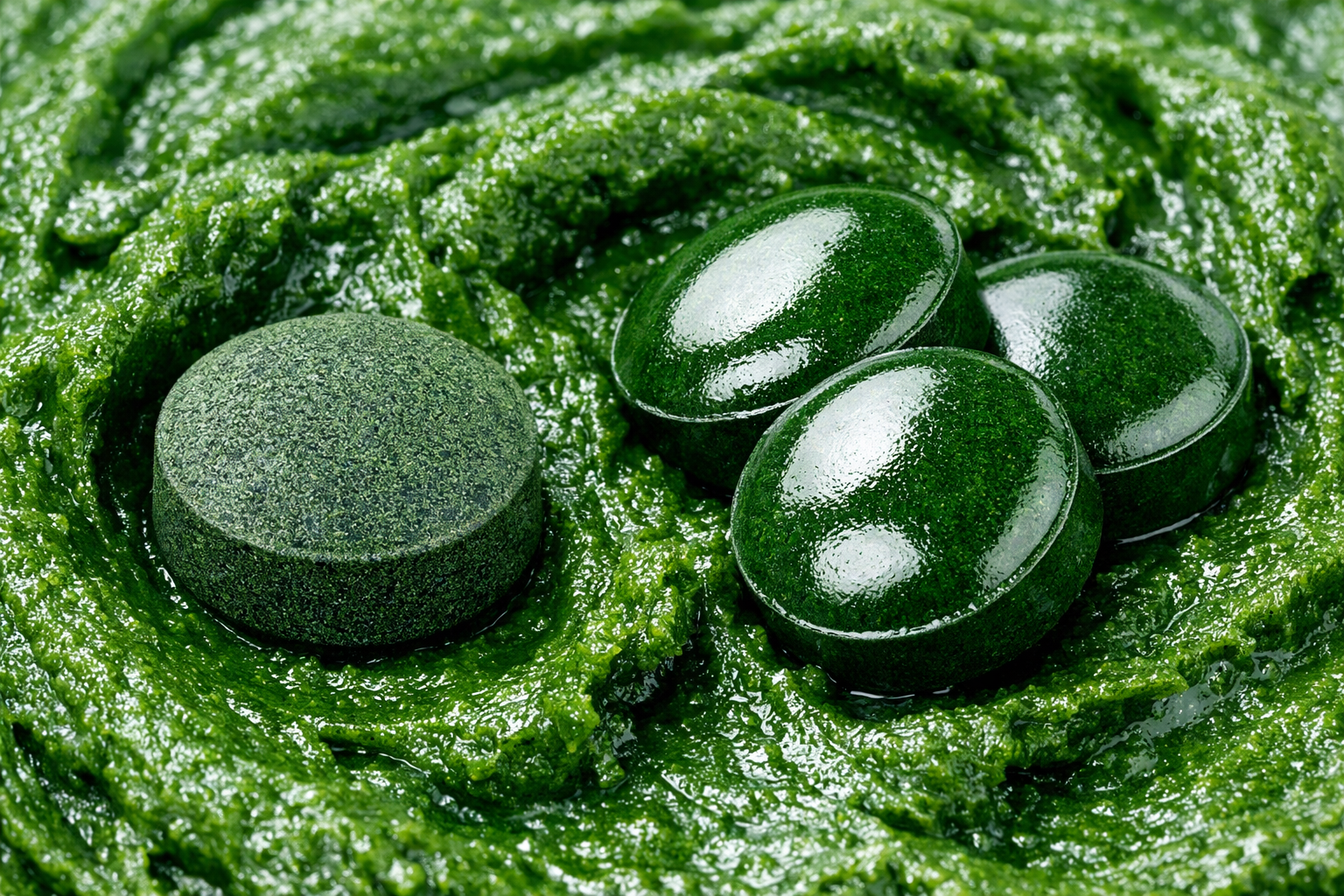
In spirulina supplements, tablet coating is often treated as a cosmetic or consumer-facing choice. In reality, coating plays a decisive role in stability, shelf life, sensory acceptability, and regulatory compliance. For nutraceutical-grade spirulina tablets – especially those intended for retail and export markets – coating is a functional engineering layer rather than a visual enhancement.
This article explains why tablet coating matters in spirulina supplements, what risks uncoated tablets face, and how coating design influences long-term product performance.
The Unique Challenges of Spirulina Tablets
Spirulina presents formulation challenges that are uncommon in many botanical supplements. Its high pigment load, hygroscopic nature, and characteristic aroma make it particularly sensitive to environmental exposure.
Uncoated spirulina tablets are prone to:
- Rapid moisture absorption
- Oxidation-driven colour changes
- Strong odour release during handling
- Surface cracking and friability
Tablet coating acts as the first defensive barrier against these risks.
Coating as a Moisture and Oxygen Barrier
Moisture ingress is one of the primary triggers for both chemical degradation and microbial reactivation in spirulina tablets. Even when internal moisture content is within specification, external humidity can rapidly destabilise unprotected tablets.
Properly designed coatings reduce:
- Water vapour transmission
- Oxygen diffusion into the tablet core
- Surface condensation during temperature cycling
This barrier function directly supports shelf-life performance.
Impact on Oxidation and Nutrient Retention
Spirulina pigments such as phycocyanin are highly sensitive to oxygen and light. Tablet coatings limit direct exposure, slowing pigment oxidation and preserving colour intensity.
By reducing oxygen availability at the tablet surface, coatings also help retain:
- Antioxidant capacity
- Fatty acid integrity
- Vitamin stability
This is particularly important for retail products with extended shelf-life expectations.
Sensory Control and Consumer Compliance
One of the most overlooked roles of tablet coating is sensory management. Spirulina’s natural aroma and taste, while acceptable to experienced users, can be a barrier for first-time consumers.
Coatings help by:
- Masking odour during bottle opening
- Reducing aftertaste
- Improving swallowability
- Enhancing perceived product quality
From a compliance perspective, consistent consumer usage supports correct dosage adherence.
Mechanical Protection During Handling and Transport
Tablet coatings improve mechanical robustness. During bottling, transport, and retail handling, uncoated tablets are more susceptible to abrasion, chipping, and dust generation.
Coated tablets exhibit:
- Reduced friability
- Lower dust formation
- Improved visual uniformity
These factors influence both audit outcomes and brand perception.
Coating Types Commonly Used for Spirulina
Different coating strategies serve different functional goals:
- Film coatings: Thin polymer layers for moisture and odour control
- Enteric coatings: Protection against gastric degradation (used selectively)
- Natural coatings: Plant-based systems aligned with clean-label positioning
The choice depends on market intent, regulatory requirements, and shelf-life targets.
Coating Type × Failure Risk Matrix
The table below compares common coating types against typical failure risks observed in spirulina tablets during storage, handling, and retail exposure:
| Coating Type | Moisture Protection | Oxidation Control | Mechanical Protection | Failure Risk Profile |
| Uncoated tablets | Very low | Very low | Very low | High risk of clumping, odour release, colour loss |
| Basic film coating | Moderate | Moderate | Moderate | Low–moderate risk under controlled storage |
| High-barrier film coating | High | High | High | Low risk when paired with good packaging |
| Natural / plant-based coating | Moderate | Low–moderate | Moderate | Moderate risk; sensitive to humidity |
| Enteric coating | High (acid protection) | Moderate | High | Context-specific; not primarily for storage stability |
This matrix highlights that coating selection directly influences tablet failure modes and must be aligned with storage conditions and market expectations.
Interaction with Packaging Systems
Tablet coating does not replace good packaging – it complements it. Coated tablets still require moisture-barrier packaging and controlled headspace conditions.
Export-grade tablet lines often pair coated tablets with high-performance packing systems to ensure stability from production to retail shelf.
Diagnostic Indicators of Inadequate Coating
Early signs that tablet coating is insufficient include:
| Indicator | Likely Cause | Commercial Impact |
| Tablet sticking or clumping | Moisture ingress | Handling and dosing issues |
| Colour fading on surface | Oxidation | Reduced shelf appeal |
| Strong odour on opening | Poor barrier performance | Consumer rejection |
| Chipping or dust | Mechanical weakness | Audit and quality failures |
These indicators often emerge well before expiry dates.
How Greenbubble Approaches Tablet Stability
In nutraceutical-focused spirulina projects, Greenbubble evaluates tablet coating as part of an integrated stability system. Drying precision, tablet formulation, coating selection, and packaging design are aligned to ensure that tablet performance remains consistent throughout its shelf life.
This systems-based approach reduces reliance on corrective actions later in the product lifecycle.
FAQs
Q1. Is tablet coating mandatory for spirulina supplements?
Not legally, but it is strongly recommended for stability and consumer acceptance.
Q2. Does coating affect spirulina bioavailability?
Properly designed coatings do not reduce bioavailability and may improve consistency.
Q3. Can coated tablets still degrade?
Yes. Coating slows degradation but must be paired with good packaging and storage.
Q4. Are natural coatings effective for spirulina?
Yes, when properly formulated and validated.
Q5. Does tablet coating impact shelf-life claims?
Yes. Coating performance directly influences validated shelf life.
Conclusion: Tablet Coating Is Functional Engineering
In spirulina supplements, tablet coating is not a cosmetic afterthought – it is a functional engineering layer that protects nutrients, improves consumer experience, and supports regulatory compliance. When combined with disciplined processing and packaging design, coating enables spirulina tablets to perform reliably in real-world retail conditions. In Greenbubble-supported systems, tablet coating decisions are aligned with shelf-life validation, ensuring stability from factory floor to consumer use.
Make us your source on Google
Table Of Contents