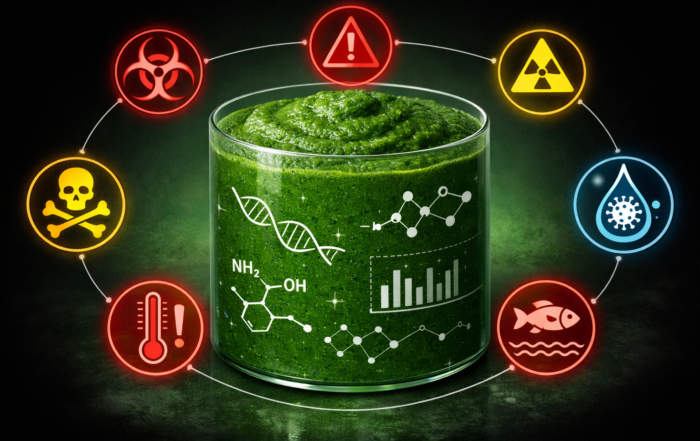
Cold-chain storage is frequently discussed in nutraceutical logistics, but in the case of spirulina, it is often misunderstood. For companies attempting to build export-grade spirulina operations, storage decisions are not isolated logistics choices – they are outcomes of how the farm, processing line, and quality systems are engineered end to end. This is precisely why storage strategy must be evaluated in the context of integrated spirulina farming systems rather than treated as a standalone requirement. Many producers assume refrigeration is either mandatory or entirely unnecessary. In reality, whether spirulina requires cold-chain storage depends on its physical form, drying method, moisture activity, packaging integrity, and intended market.
This article explains when cold-chain storage is genuinely required for spirulina, when ambient storage is technically sufficient, and how incorrect assumptions around storage lead to shelf-life failures, microbial risk, and export rejections.
Understanding Spirulina Stability Beyond Temperature
Temperature alone does not define spirulina stability. Stability is the outcome of multiple interdependent variables:
- Moisture content and water activity
• Residual oxygen exposure
• Drying method and thermal history
• Packaging barrier performance
• Storage humidity and temperature cycling
Cold-chain storage cannot compensate for poor drying, inadequate dewatering, or weak packaging. It only slows degradation mechanisms that already exist.
Spirulina Forms and Their Storage Sensitivity
Not all spirulina products behave the same under storage conditions.
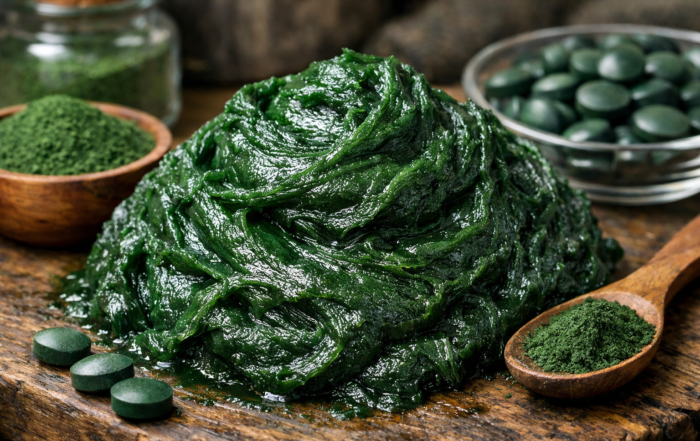
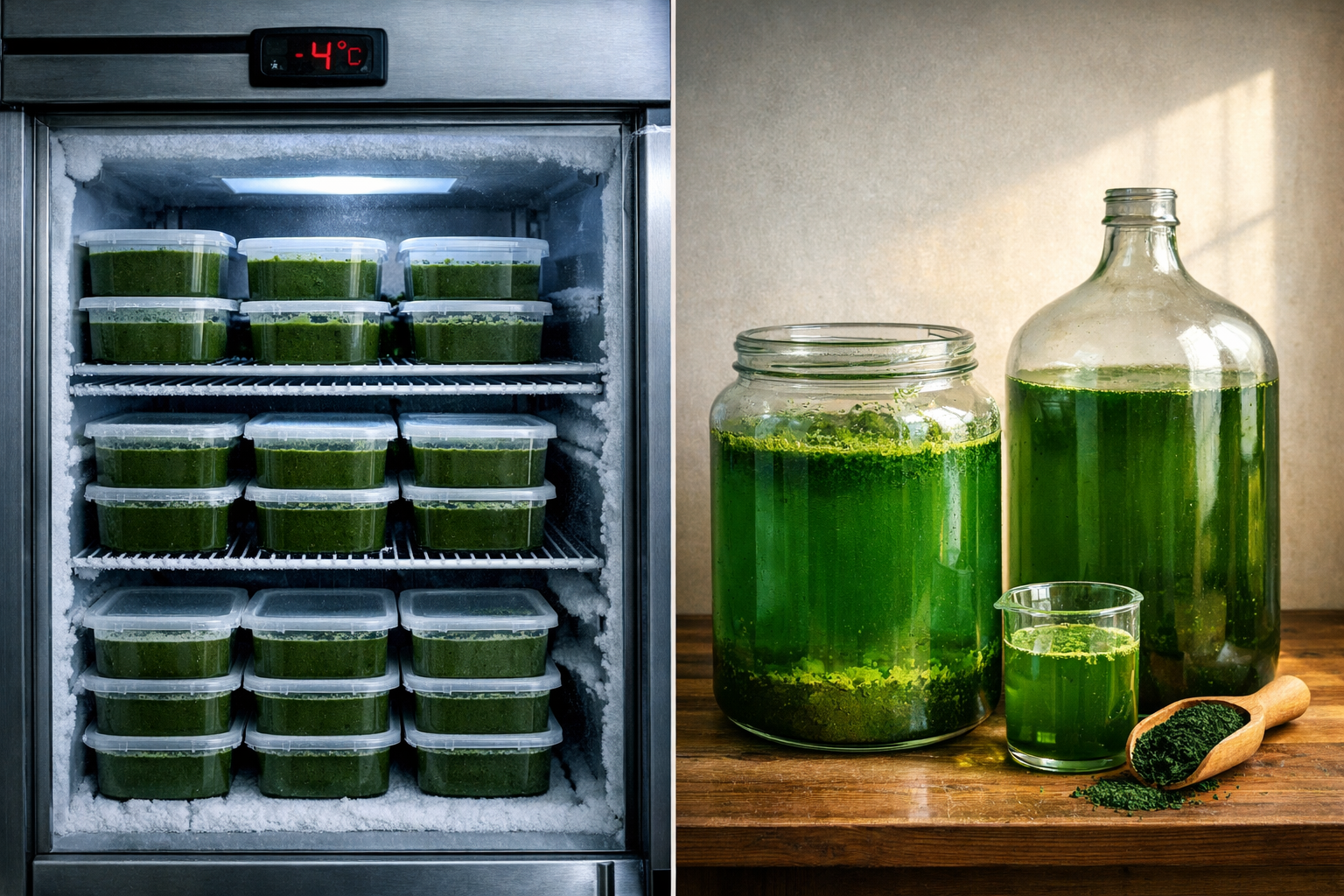
Fresh and wet spirulina biomass has extremely high water activity and active microbial potential. At this stage, stability is governed by how efficiently biomass moves from raceway ponds into harvesting equipment and assisted dewatering systems, with minimal residence time and human exposure. It requires immediate processing or cold storage to prevent spoilage. This stage is tightly linked to harvesting and assisted dewatering systems that minimise microbial exposure and time-to-dry.
Dried spirulina powder, when properly processed, behaves as a low-moisture, shelf-stable material. At this stage, ambient storage is generally sufficient if moisture activity, oxygen exposure, and packaging are controlled.
Cold-Chain Storage: Where It Is Actually Required
Cold-chain storage is justified in the following scenarios:
- Fresh or semi-dewatered biomass awaiting drying
• Intermediate slurry stages before final dehydration
• High-moisture pilot batches or R&D samples
• Spirulina concentrates intended for liquid formulations
• Products with unstable excipients or unvalidated coatings
In these cases, refrigeration slows microbial growth but does not eliminate contamination risk. In professionally designed projects, cold-chain is used only as a short buffering step before biomass enters validated spirulina drying equipment. It is a temporary risk-mitigation measure, not a substitute for rapid drying using controlled spirulina drying equipment.
Ambient Storage: The Default for Export-Grade Spirulina
For export-grade spirulina powder produced using controlled drying technologies such as RWD drying systems or validated vacuum dryers, ambient storage is the industry norm. These systems are typically deployed as part of integrated spirulina farming turnkey solutions, where storage performance is validated alongside drying, packing, and quality control.
Ambient storage works when:
- Moisture content is ≤ 6%
• Water activity is ≤ 0.30
• Drying temperatures are kept below nutrient-degradation thresholds
• Packaging provides strong oxygen and moisture barriers
• Storage humidity and temperature are monitored
In such cases, cold-chain storage offers no additional shelf-life advantage and introduces unnecessary logistical cost.
Why Cold-Chain Is Often Misused in Spirulina Logistics
Cold-chain is frequently adopted to compensate for upstream process weaknesses:
- Inadequate drying leaving residual moisture
• Poor dewatering leading to microbial load carryover
• Weak packaging systems allowing humidity ingress
• Lack of validated shelf-life data
This reactive use of cold-chain masks problems temporarily but fails during longer storage or export transit.
Interaction Between Drying Method and Storage Needs
Drying history directly determines storage sensitivity.
Spray drying, despite industrial throughput, exposes spirulina to high temperatures and oxidative stress. While spray dryers are used in certain industrial contexts, they often require additional downstream controls to achieve comparable storage stability. This often results in faster pigment degradation during ambient storage, prompting unnecessary cold-chain use.
Refractive window drying preserves pigments and proteins while achieving low moisture activity, making ambient storage reliable when paired with proper packing systems.
Vacuum drying offers similar benefits for small-scale or specialised batches but still requires robust packaging to maintain stability.
Packaging as the Deciding Factor
Storage requirements are ultimately dictated by packaging performance.
High-barrier, vacuum-sealed or nitrogen-flushed packs protect spirulina from moisture ingress and oxygen exposure, enabling stable ambient storage across export timelines. This level of control is typically achieved using engineered packing systems designed specifically for nutraceutical powders.
Low-barrier packaging such as plastic jars, single-layer pouches, or loosely sealed containers invalidate ambient storage assumptions and increase reliance on cold-chain.
Cold-chain without high-performance packaging remains ineffective.
Cold-Chain vs Ambient Storage: Risk Comparison
| Storage Mode | Primary Benefit | Limitations | Suitable For |
| Cold-chain | Slows microbial and chemical activity | High cost, condensation risk, does not fix poor processing | Wet biomass, unstable intermediates |
| Ambient (controlled) | Cost-effective, scalable, export-friendly | Requires validated drying and packaging | Export-grade powders, tablets, capsules |
Operational and Compliance Implications
From a regulatory perspective, reliance on cold-chain for dried spirulina raises questions during audits:
- Why ambient stability was not achieved
• Whether shelf-life validation is complete
• Whether packaging performance is adequate
Export buyers expect ambient-stable spirulina unless explicitly justified otherwise. Cold-chain logistics increase landed cost and complicate supply chains without improving compliance if fundamentals are weak.
How Greenbubble Evaluates Storage Strategy
Greenbubble approaches spirulina storage as the final validation point of a much larger system. Rather than recommending cold-chain by default, Greenbubble evaluates storage requirements only after assessing upstream elements such as raceway ponds, efficient agitator design, harvesting equipment, dewatering architecture, drying systems, and final packing systems.
In Greenbubble-supported projects, cold-chain is applied selectively during high-risk intermediate stages, while finished spirulina products are deliberately engineered for ambient stability. This approach ensures that storage performance is predictable, auditable, and economically scalable – particularly for export-oriented operations supported through spirulina farming consultancy and turnkey delivery models.
In integrated spirulina projects, storage decisions are made after evaluating cultivation systems such as raceway ponds, harvesting equipment, drying technologies, and final packing systems as a unified stability chain.
Cold-chain is used selectively during intermediate stages, while finished products are engineered for ambient stability through process control and validation.
FAQs
Q1. Does spirulina powder need refrigeration?
No, if it is properly dried, packed, and validated, ambient storage is sufficient.
Q2. Is cold-chain safer for exports?
Not necessarily. Export buyers prefer ambient-stable products with validated shelf life.
Q3. Can cold-chain fix poor drying?
No. It only slows failure; it does not correct underlying instability.
Q4. Do tablets require cold-chain storage?
Usually no, but formulation and coating design influence storage needs.
Q5. Does cold-chain extend shelf life indefinitely?
No. It delays degradation but does not prevent it.
Conclusion: Storage Is an Outcome, Not a Solution
Cold-chain storage is not a default requirement for spirulina. It is a targeted tool used when process constraints demand it. For export-grade spirulina, stability must be engineered through cultivation discipline, efficient dewatering, validated drying, and robust packaging. When these elements are in place, ambient storage is not only sufficient but preferred. Cold-chain should support good systems, not compensate for weak ones.
Make us your source on Google
Table Of Contents