One of the most critical strategic decisions in spirulina farming is determining the balance between automation and manual labour. Small and mid-scale producers often assume that manual operations reduce initial capital expenditure. While this may be true at setup stage, the long-term cost curve tells a very different story.
Automation is not merely a technological upgrade – it fundamentally reshapes the operating cost structure, risk exposure, compliance readiness, and scalability of a spirulina enterprise.
Understanding the real cost curve requires moving beyond upfront investment comparisons and examining lifetime operating expenditure, productivity consistency, yield volatility, and market access implications.
At Greenbubble, automation is evaluated not as an expense, but as a structural efficiency multiplier that stabilizes production economics over time.
1. The Initial Capital Illusion
Manual farms typically require:
- Lower upfront equipment investment
- Basic paddle systems
- Simple drying arrangements
- Limited monitoring instruments
This creates the perception of affordability. However, lower capital expenditure often transfers cost into recurring operational burdens.
Automated or semi-automated farms require:
- Engineered pond systems
- Precision agitation control
- Controlled drying infrastructure
- Monitoring and documentation systems
While capital investment is higher, operating efficiency improves significantly.
2. Labour-Driven Cost Escalation
Manual spirulina farms rely heavily on labour for:
- Nutrient dosing
- Culture monitoring
- Harvest scheduling
- Dewatering adjustments
- Drying control
- Cleaning and sanitation
Hidden labour costs include:
- Productivity inconsistency
- Training and retraining
- Supervisory overhead
- Human error leading to batch loss
- Compliance documentation burden
Over time, cumulative labour expense often exceeds the cost of structured automation.
3. Yield Stability and Culture Risk
Automation stabilizes variables that manual farms struggle to control:
- Agitation speed consistency
- Dissolved oxygen levels
- Nutrient distribution
- Harvest timing precision
Well-designed raceway ponds combined with calibrated efficient agitators ensure uniform mixing and reduce the risk of localized stagnation or culture stress.
Manual systems are more vulnerable to:
- Inconsistent mixing
- Delayed intervention
- Operator-dependent monitoring
Each culture crash represents not only lost biomass but lost energy, labour, and opportunity cost.
4. Drying Efficiency and Product Quality
Manual or improvised drying systems often:
- Consume excess energy
- Produce inconsistent moisture levels
- Increase contamination risk
- Reduce pigment and protein retention
Automated, enclosed spirulina drying equipment provides:
- Controlled temperature profiles
- Predictable moisture reduction
- Lower microbial exposure
- Documented process parameters
Automation improves both cost efficiency and export-grade quality consistency.
5. Energy Cost Curve Comparison
Manual farms often run motors and pumps inefficiently due to:
- Lack of load calibration
- Poor pond geometry
- Inconsistent operational scheduling
Automation enables:
- Optimized motor speed control
- Reduced hydraulic resistance
- Predictive maintenance scheduling
Over time, energy savings compound. Lower kWh per kilogram directly improves per-unit production cost and strengthens ESG positioning.
6. Compliance and Documentation Burden
Certification audits require:
- Continuous monitoring records
- Calibration logs
- Batch traceability
- Documented corrective actions
Manual documentation is labour-intensive and error-prone.
Automated systems reduce compliance risk by integrating structured monitoring and traceability into daily operations. Facilities developed through spirulina farming turnkey solutions are designed with audit-readiness embedded into process architecture.
Compliance failure carries financial consequences far greater than automation investment.
7. Scalability and Marginal Cost Decline
Manual farms experience rising marginal cost as scale increases due to:
- Additional labour hiring
- Increased supervision complexity
- Higher coordination overhead
Automated systems exhibit declining marginal cost with scale. Once infrastructure is installed, incremental production adds proportionally lower additional labour burden.
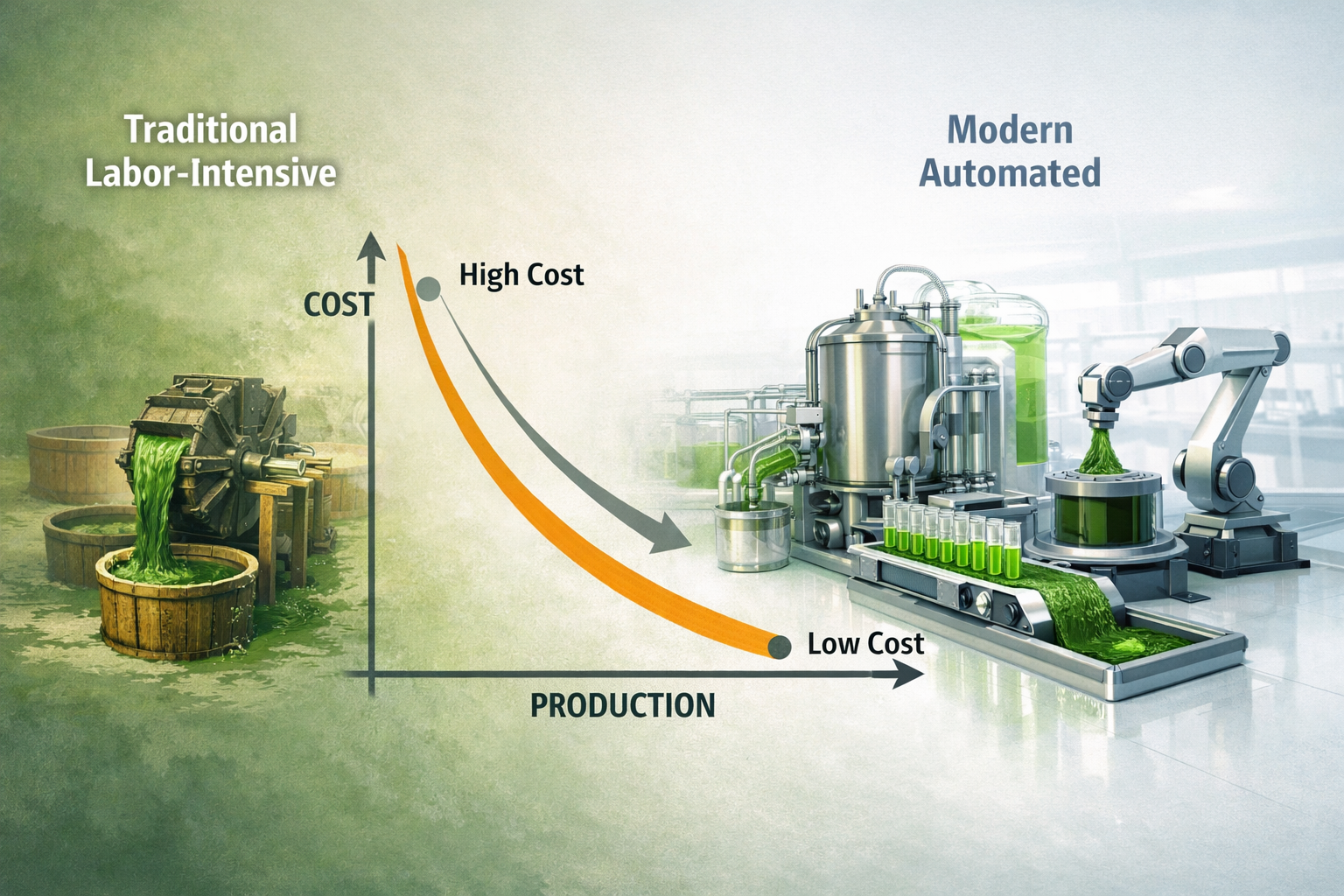
This creates a fundamentally different cost curve:
- Manual model: Flat initial cost, rising operational slope
- Automated model: Higher initial cost, declining long-term slope
Over a multi-year horizon, automation typically delivers lower cumulative cost.
8. Downtime and Maintenance Risk
Manual setups often adopt lower-cost equipment prone to:
- Frequent breakdowns
- Reactive maintenance
- Extended downtime
Automation combined with preventive maintenance planning reduces unexpected shutdowns and stabilizes output. Structured guidance through spirulina farming consultancy improves lifecycle planning and risk forecasting.
9. Cost Curve Summary Table
| Dimension | Manual Model | Automated Model |
| Initial Investment | Low | Moderate to High |
| Labour Cost | High recurring | Reduced recurring |
| Yield Stability | Variable | High consistency |
| Energy Efficiency | Often inefficient | Optimized control |
| Compliance Risk | Elevated | Structured compliance |
| Scalability | Limited | Efficient scaling |
| Long-Term Cost Curve | Rising | Stabilizing / declining |
The long-term economics strongly favor structured automation for farms targeting commercial scale and export markets.
10. Financial Simulation Example
Consider two farms producing identical annual volumes:
- Farm A (Manual): Lower capex, higher labour and energy cost
- Farm B (Automated): Higher capex, lower labour and energy cost
Over 3–5 years, cumulative labour savings, energy efficiency gains, reduced batch losses, and improved pricing power due to quality stability often offset initial automation investment.
Automation is therefore not merely a technology choice – it is a strategic financial decision.
Frequently Asked Questions
Q1. Is automation necessary for small spirulina farms?
Not always at micro-scale, but farms targeting commercial growth, certification, or export markets benefit significantly from structured automation.
Q2. Does automation eliminate labour entirely?
No. Automation reduces variability and manual burden but still requires skilled operators and supervision.
Q3. Is the capital investment in automation justified?
Over multi-year horizons, improved energy efficiency, yield stability, and reduced compliance risk typically justify the investment.
Q4. Which area benefits most from automation?
Agitation control, drying systems, and monitoring documentation provide the most significant operational and financial gains.
Q5. How does automation impact export readiness?
Automated systems improve traceability, process documentation, and quality consistency – critical for institutional and export buyers.
Conclusion
The real cost curve in spirulina farming cannot be evaluated solely on initial capital expenditure. Manual operations may appear economical at the beginning, but hidden labour costs, yield instability, energy inefficiencies, and compliance risks gradually erode margins.
Automation reshapes the cost structure by stabilizing production, reducing operational variability, improving energy efficiency, and strengthening audit readiness. Over time, engineered automation delivers a more predictable and sustainable financial trajectory.
For spirulina producers targeting scalable growth and global markets, automation is not a luxury – it is a structural competitive advantage.
Make us your source on Google
Table Of Contents