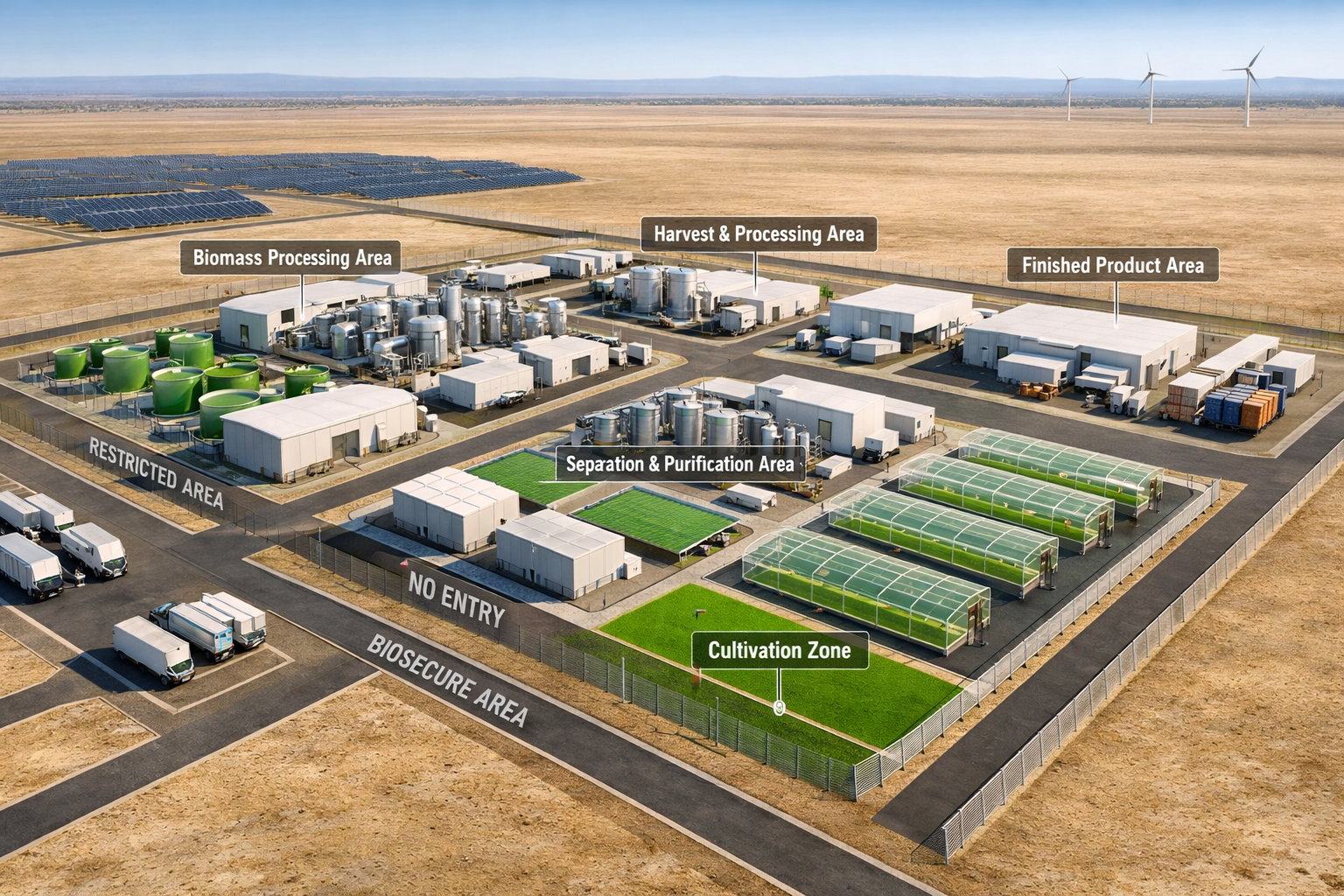
If you’re a farmer weighing spirulina as a venture, the first question is simple: what will it actually cost to set up, and at what size does it start paying off? The honest answer matters here, because most online figures dramatically understate the investment and overstate the returns for small operations. This guide breaks down real setup costs for small and medium farms and shows where the profitability line sits.
Small vs Medium: What the Terms Mean
For spirulina, scale isn’t just about land area. It’s about whether the farm can support the automation, lab, and certification that make output sellable at a premium.
A small farm (around 1 acre) is best understood as an entry, training, or niche-supply operation. A medium farm (2 to 3 acres) is the first size at which the numbers turn commercially sustainable and export-ready. Understanding this distinction upfront saves farmers from under-investing into a setup that can’t turn a profit.
Setup Cost Breakdown for a Small (1-Acre) Farm
Here’s where the money goes on a 1-acre setup:
| Component | Estimated Cost (INR) |
| Pond construction, building, agitation | ₹30 to 46 Lakhs |
| Harvesting and dewatering equipment | ₹10 to 12 Lakhs |
| Drying system (RWD/Vacuum) | ₹10 to 18 Lakhs |
| Packaging + cleanroom | ₹6 to 8 Lakhs |
| Automation (IoT/SCADA) | ₹3 to 5 Lakhs |
| Lab + QC setup | ₹10 to 12 Lakhs |
| Certification & documentation | ₹4 to 6 Lakhs |
| Total Investment | ₹73 to 107 Lakhs |
Notice how little of this is the pond itself. The bulk goes into harvesting, drying, and lab infrastructure, the systems that determine whether your product is certifiable and exportable.
A Lower-Cost Entry: Harvesting Automation Only
Farmers not ready for a full turnkey build sometimes start with just the harvesting and processing chain:
| Equipment Component | Estimated Cost (INR) |
| Pre-Filtration System (80-mesh) | ₹0.5 to 1 Lakhs |
| Harvesting system | ₹6 to 8 Lakhs |
| Vacuum Dewatering Unit | ₹4 to 5 Lakhs |
| Pumps & Automated Valves | ₹1 to 2 Lakhs |
| SCADA/Cloud Logging Setup | ₹3 to 5 Lakhs |
| Transfer Pipes & Connectors | ₹0.5 to 1 Lakhs |
| Total | ₹15 to 22 Lakhs |
This is a way to modernize an existing manual operation, but it doesn’t replace the lab, certification, and drying investment needed for premium markets.
Setup Cost for a Medium (2 to 3 Acre) Farm
A medium farm scales into ₹1.5 to ₹2.5 crore territory, with integrated RWD drying, advanced analytics, and often ERP systems. Three acres is enough to run up to 20 raceway ponds plus a harvesting unit, drying area, packaging room, storage, and an on-site testing lab. This is the configuration that balances cost against output and unlocks the organic price premium.
Recurring Costs Farmers Underestimate
Setup is only half the picture. Ongoing costs decide whether the farm survives:
- Nutrients are the largest recurring expense, running around ₹51 lakh a year for a 2 to 3 acre farm. There is no such thing as organic urea, so certified-organic nutrient sourcing costs more, not less.
- Organic certification costs ₹1.75 to ₹3 lakh annually, with ISO 22000 and audit fees on top.
- Lab testing (COA) runs ₹15,000 to ₹30,000 per batch.
- Skilled labor to maintain culture quality, calibrate systems, and keep HACCP documentation is non-negotiable.
Did You Know?
- A 1-acre farm often runs at a loss under realistic costs, while a 3-acre farm on the same cost base returns around 37% ROI. Under-scaling is the most common financial mistake in spirulina farming.
- Automation cuts harvesting labor by 80 to 90%. Manual farms save on setup but bleed money on labor and contamination. See how technology boosts mass production.
- Spirulina grows best at 30 to 35°C in semi-arid to tropical climates. Avoid frost-prone regions, they raise costs and reduce yield.
- Government subsidies exist but offset costs rather than eliminate them, and they require a solid business plan and certification to access.
The Profitability Line
| Farm Size | Investment | Break-even | Profitability |
| 1 Acre | ₹75 to 95L | Negligible ROI | Training or niche local sales |
| 2 to 3 Acres | ₹1.5 to 2.5 Cr | ~3 years | Commercially sustainable, export-ready |
| 5+ Acres | ₹2 Cr+ | Depends on contracts | Viable only with assured buyers |
The takeaway for small and medium farmers: don’t size your farm to your starting budget, size it to the point where it can actually be profitable. Stretching to a medium-scale, automated, certified setup is usually the difference between a hobby operation and a real business. For a fuller view of returns, see the profitability and ROI analysis and the guide to scaling for mass production.
Frequently Asked Questions
What is the minimum cost to start a spirulina farm in India? A modest 1-acre certified setup starts around ₹73 lakh. A harvesting-automation-only upgrade for an existing operation can be done for ₹15 to 22 lakh, but that doesn’t cover a full commercial build.
Can a small farmer make money from spirulina? At 1 acre, it’s difficult, the model tends to be loss-making or break-even, which is why small farms suit training or niche local sales. Profitability reliably begins at the 2 to 3 acre medium scale.
How much land do I need? Three acres supports a fully commercial operation with up to 20 raceway ponds plus processing and lab facilities. One acre works for entry-level or R&D use.
Why is automation worth the extra cost? It cuts labor 80 to 90%, reduces contamination, and makes certification and consistent quality achievable, which is where the actual margin comes from.
Do I need a lab on site? Yes. An in-house lab is mandatory for certification and for testing every batch against COA parameters before sale.
The Bottom Line
For small and medium farmers, spirulina is a genuine opportunity, but only when sized correctly. A 1-acre farm is a learning platform, not a profit center. The 2 to 3 acre medium farm is where automation, certification, and organic pricing combine into sustainable returns. Established providers like Greenbubble, awarded Best Microalgae Company by the European Algae Biomass Association in Paris and working with a customer base that accounts for over 90% of India’s spirulina production, offer turnkey farm solutions that help farmers build at a profitable scale from the start.
Make us your source on Google
Table Of Contents