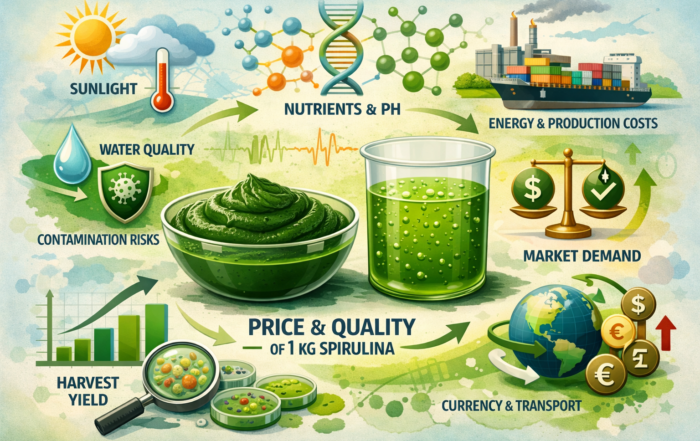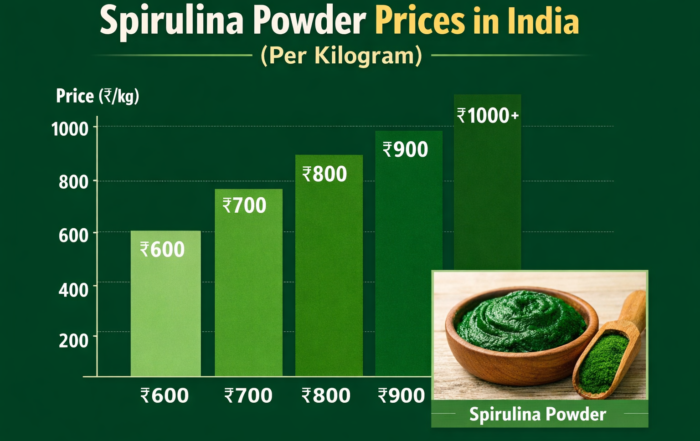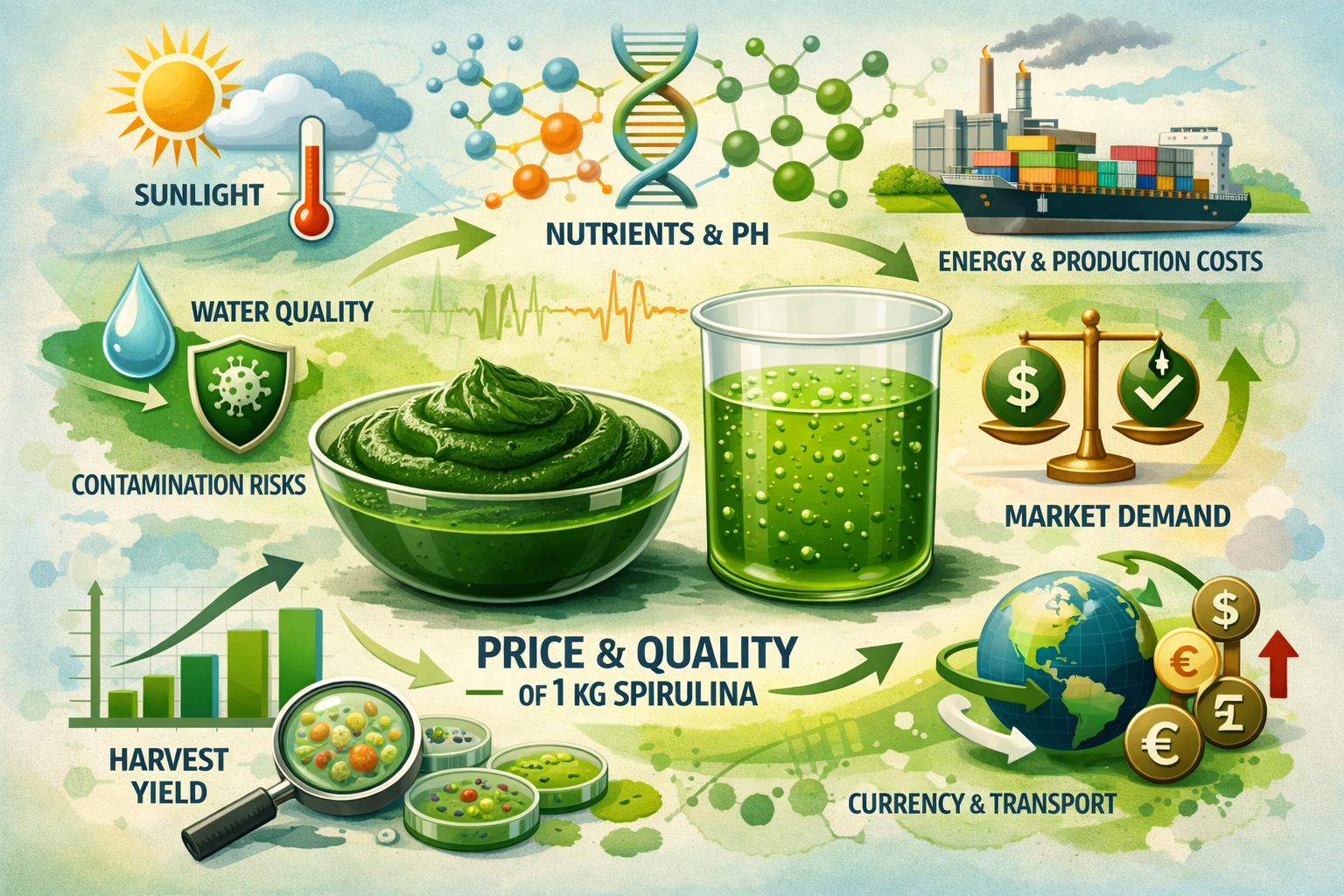
A one-kilogram quote for spirulina powder can range from roughly ₹600 at the uncertified bulk end to over ₹2,000 for certified organic, properly tested product – more than triple the spread for what appears, on paper, to be the same ingredient. Understanding why requires looking past the headline number to the production decisions that sit behind it.
This article breaks down exactly what determines a 1kg spirulina price, and what separates a quote that reflects genuine quality from one that does not.
1 Kg Price Ranges by Grade
| Grade | Price per Kg (INR) | What It Typically Means |
| Uncertified, sun-dried | ₹400-₹550 | No COA, high nutrient degradation, animal feed grade |
| Standard commercial | ₹600-₹700 | Basic testing, domestic supplement use |
| Certified organic | ₹800-₹1,800 | USDA/EU Organic, full COA, export-ready |
| Premium export-grade | ₹1,000-₹2,200 | High phycocyanin (15%+), full traceability |
These ranges shift with order volume, seasonal nutrient costs, and buyer-supplier relationship length – but the grade differential itself stays consistent. The gap is not inflation; it is the cost of the production steps that separate each tier.
The Five Factors That Actually Set the Price
1. Cultivation Conditions
Spirulina grown in well-managed raceway ponds with controlled temperature, pH, and nutrient dosing produces more consistent biomass with higher protein and pigment yield than poorly managed or seasonal open-air cultivation. Farms that invest in efficient agitator systems maintain better temperature stability and gas exchange, directly affecting the quality – and therefore price – of the harvested biomass.
2. Harvesting Method
Manual harvesting introduces contamination risk and inconsistent yield. Farms using automated harvesting equipment – rotary drum filters with fine mesh screens – produce cleaner, more consistent biomass at scale, which supports a higher and more justifiable per-kg price. This is covered in depth in automation in spirulina harvesting: why it’s non-negotiable.
3. Drying Technology
This is the single largest quality-driving cost in the entire production chain. Spray drying at 100-180°C is cheap but destroys a significant portion of phycocyanin and other heat-sensitive compounds. Refractive Window Drying systems, which keep product temperature below 45°C, cost considerably more in equipment and energy but preserve the nutritional integrity that justifies premium pricing. Vacuum dryers occupy a similar premium tier for smaller-batch production. The full comparison is laid out in spirulina drying methods comparison.
4. Certification and Lab Testing
Certified organic status adds ₹1.75-₹3 lakh in annual certification costs alone, spread across a farm’s total output. Combined with per-batch COA testing (₹15,000-₹30,000 per panel), certified producers carry meaningfully higher fixed costs than uncertified operations – costs that show up directly in the per-kg quote. The role of COA in premium spirulina pricing covers exactly how this works.
5. Packaging and Traceability
Spirulina packed in vacuum-sealed, multi-foil packaging with full batch traceability costs more to produce than loosely packed product with no documentation – but it also protects the nutrient quality the buyer is paying for in the first place, particularly phycocyanin and beta-carotene, which degrade with light and air exposure over time.
How to Read a 1 Kg Quote Properly
A quote with no accompanying documentation is not comparable to one with a full COA, regardless of which number is lower. Before accepting any 1kg price, ask for:
| Item to Request | What It Confirms |
| Batch-specific COA | Protein %, phycocyanin %, heavy metal results |
| Drying method | Whether nutrients were preserved or degraded |
| Certification documents | Organic status verifiable with certifying body |
| Microbial test results | Pathogen-free confirmation |
| Packaging specification | Whether product is protected from degradation in transit |
A supplier unwilling or unable to provide these for a quoted price is signalling something about that price – usually that it reflects a shortcut, not a saving.
Why the Cheapest 1 Kg Quote Is Rarely the Best Deal
A kilogram priced significantly below ₹900 without certification or COA documentation typically means one or more corners have been cut – uncontrolled water sourcing, sun-drying instead of temperature-controlled drying, or no batch testing at all. The danger of spirulina: myths vs real risks article covers why unverified sourcing – not the organism itself – is where genuine risk concentrates. For buyers purchasing at volume, a slightly higher verified price almost always works out cheaper than the cost of a rejected batch, a failed audit, or a contamination issue downstream.
What a Fair 1 Kg Price Reflects
Ultimately, the price of a kilogram of spirulina is a proxy for the infrastructure behind it – pond design, automation, drying technology, and lab verification. Greenbubble’s turnkey spirulina farm solutions, which underpin more than 90% of India’s spirulina production across more than 10 countries, represent the production standard against which certified, properly priced spirulina in the market should be benchmarked.
When evaluating a 1kg quote, the number alone tells you very little. The documentation behind it tells you almost everything.
Make us your source on Google
Table Of Contents