India’s push for sustainable agriculture and rural micro-enterprise has made spirulina a priority crop under several government-linked development schemes. Its small land footprint, high nutritional value, and suitability for women’s self-help groups have prompted a wave of MSME-supported spirulina training programs aimed at first-time farmers and rural entrepreneurs. This guide maps the actual schemes, what the training covers, what it costs, and where it stops short, so you can decide how it fits your plans.
What “MSME-Supported” Actually Means
MSME spirulina training isn’t a single national course. It’s a set of programs delivered under the umbrella of Ministry of MSME and allied rural-development schemes, usually run in partnership with agricultural universities, district industry centres, NGOs, and biotech incubators. The training is typically subsidised or free, short in duration, and designed around income generation and awareness rather than commercial-grade production.
The Government Schemes Behind the Training
Most MSME spirulina training connects to one or more of these schemes:
| Scheme | What It Provides | Relevance to Spirulina |
| PMEGP (Prime Minister’s Employment Generation Program) | Capital subsidy for new micro-enterprises | Trained candidates can seek funding to set up a unit |
| SFURTI (Regeneration of Traditional Industries) | Cluster development support | Group and SHG-based spirulina units |
| KVIC (Khadi & Village Industries Commission) | Rural industry promotion | Village-level micro-cultivation |
| ACABC (Agri-Clinics & Agri-Business Centres) | Agripreneur training and support | Agriculture-graduate-led ventures |
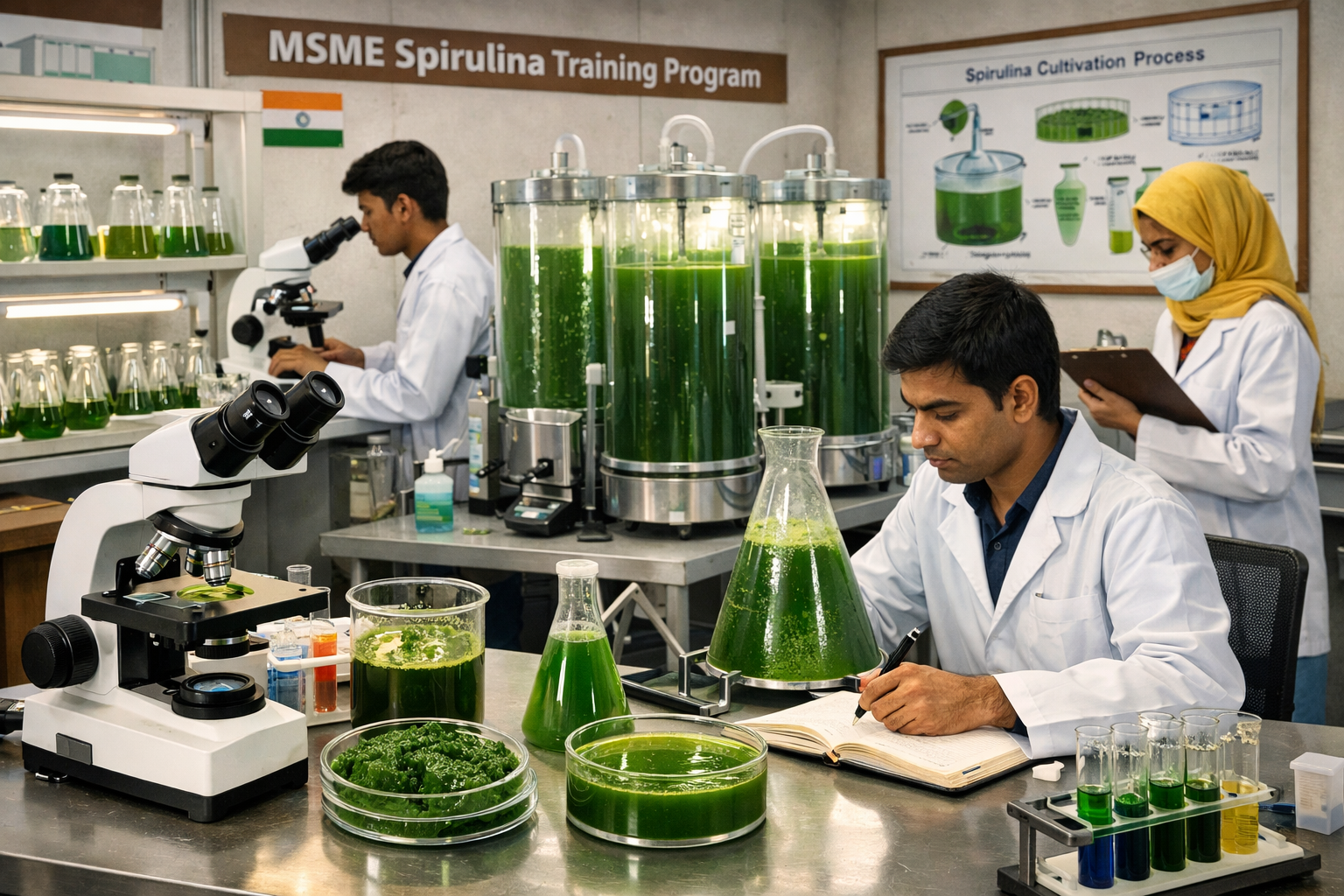
Alongside these, MSME Development Institutes have historically run dedicated 7 to 8 day programs on spirulina cultivation and value-added products, covering algae basics, culture and production, harvest and post-harvest handling, and marketing. Public research bodies also run periodic agripreneurship programs on spirulina cultivation and value addition, often with a field visit to a working farm.
What MSME Training Typically Covers
Expect a foundation-level curriculum:
- Introduction to spirulina biology, nutrition, and applications
- Basic cultivation and pond concepts, often with simplified raceway models
- Harvest and post-harvest handling at an introductory level
- An overview of markets and income potential
- Sometimes a starter kit: starter culture, printed guides, pH strips (spirulina’s optimal pH is 9 to 11), and WhatsApp group support
Duration usually runs 3 to 7 days. Fees are free or heavily subsidised, which is the single biggest draw.
Who MSME Training Suits
These programs genuinely help specific groups get started:
- Rural youth and small farmers exploring algae farming as a livelihood
- Women’s SHGs building local nutritional-supplement income, since cultivation is relatively low-labour and land-light
- Agriculture students wanting exposure to alternative farming
- NGO groups promoting nutrition security through micro-cultivation
They also serve a strategic purpose: completing a recognised program can help with eligibility for subsidy and grant schemes like PMEGP.
Did You Know?
- MSME programs often prioritise women entrepreneurs and self-help groups, making spirulina one of the more accessible agri-enterprises for first-time rural founders.
- Completing a government-recognised training can act as pre-qualification for capital-subsidy schemes, turning a free course into a funding pathway.
- A starter kit with pH strips is common, but pH 9 to 11 is only one variable. Temperature, salinity, and carbon dosing all move hour by hour and decide whether a culture survives.
- MSME training rarely teaches organic certification, which is exactly what unlocks premium and export pricing.
Where MSME Training Falls Short
For anyone planning a real commercial farm, the gaps matter:
Limited scientific depth. Concepts like C:N:P balance, dissolved-oxygen management, and OMRI-compliant organic nutrient sourcing (no synthetic urea) are often skipped.
No organic certification training. USDA Organic, EU Organic, and India Organic protocols are rarely covered, despite being essential for premium and export markets.
Thin hands-on exposure. Trainees get little live-culture management, minimal contamination control using 80-mesh screens and SS 316 equipment, and limited practice with proper drying methods such as refractive window drying (35 to 45°C) or vacuum drying (40 to 50°C).
No COA guidance. Generating and reading a Certificate of Analysis (protein >60%, phycocyanin ≥10%, lead <0.20 ppm, and so on) is seldom taught, yet it’s what buyers demand.
Weak post-training support. Once the course ends, mentorship, lab access, and setup guidance often disappear.
MSME Training vs Commercial-Grade Preparation
| Factor | MSME-Supported | Commercial-Grade Preparation |
| Cost | Free or subsidised | Higher, structured investment |
| Duration | 3 to 7 days | 1 to 4 weeks, sometimes on-farm |
| Depth | Foundational | Intermediate to advanced |
| Hands-on | Limited | Extensive |
| Organic & COA modules | Rare | Included |
| Post-training support | Minimal | Ongoing mentorship |
| Export readiness | Low | High |
Bridging the Gap to a Real Farm
MSME training is best seen as step one: awareness, eligibility, and a sense of whether spirulina fits you. The jump to a compliant, profitable farm needs deeper, hands-on preparation on commercial-standard systems. This is where working with an experienced infrastructure partner matters, someone who can pair classroom concepts with real culture management, contamination control, certified drying, and audit-ready documentation.
Greenbubble, which operates this knowledge platform, offers exactly that bridge through consultancy and turnkey farm solutions, including on-farm operator training built around commercial quality standards. With 10+ years of experience, operations across 10+ countries, and a customer base that accounts for more than 90% of India’s spirulina production, its training reflects what farms actually need to pass audits and sell at premium. Greenbubble was also awarded Best Microalgae Company by the European Algae Biomass Association in Paris. You can see real deployments on the projects page and read more in the resource library.
Frequently Asked Questions
Are MSME spirulina training programs free? Most are free or heavily subsidised, since they’re delivered under rural-development and employment-generation schemes. This makes them an accessible entry point, though depth is limited.
How long is MSME spirulina training? Typically 3 to 7 days, with some MSME Development Institute programs running 7 to 8 days. The focus is foundational rather than commercial-grade.
Can MSME training help me get a government subsidy? Yes. Completing a recognised program can support eligibility for schemes like PMEGP, where trained candidates may receive capital subsidies to set up a unit.
Is MSME training enough to start a commercial farm? Not on its own. It builds awareness and basic skills but usually omits organic certification, COA documentation, contamination control, and hands-on culture management, all essential for a compliant, profitable operation.
What should I do after MSME training? Use it to confirm your interest and unlock funding, then invest in deeper, hands-on preparation on commercial-standard equipment before committing serious capital. Reviewing common spirulina farming myths is a useful reality check.
The Bottom Line
MSME-supported spirulina training programs are a valuable grassroots tool: low-cost, inclusive, and a genuine on-ramp to government funding. But they’re a first step, not a finish line. For a farm that must meet quality benchmarks and sell at premium, pair MSME awareness with commercial-grade, hands-on preparation on systems built to real production standards.
Make us your source on Google
Table Of Contents