One of the most underestimated strategic decisions in spirulina farming is whether to standardize systems or customize them heavily for local conditions. Many projects assume that customization automatically leads to better performance, while standardization is seen as rigid or generic.
In reality, the choice between standardization and customization determines how reliably a spirulina farm scales, stabilizes, and remains compliant over time.
This article examines the trade-offs between standardized and customized spirulina farming systems from an investor and system-engineering perspective, focusing on control, scalability, and long-term risk.
What Standardization Means in Spirulina Farming
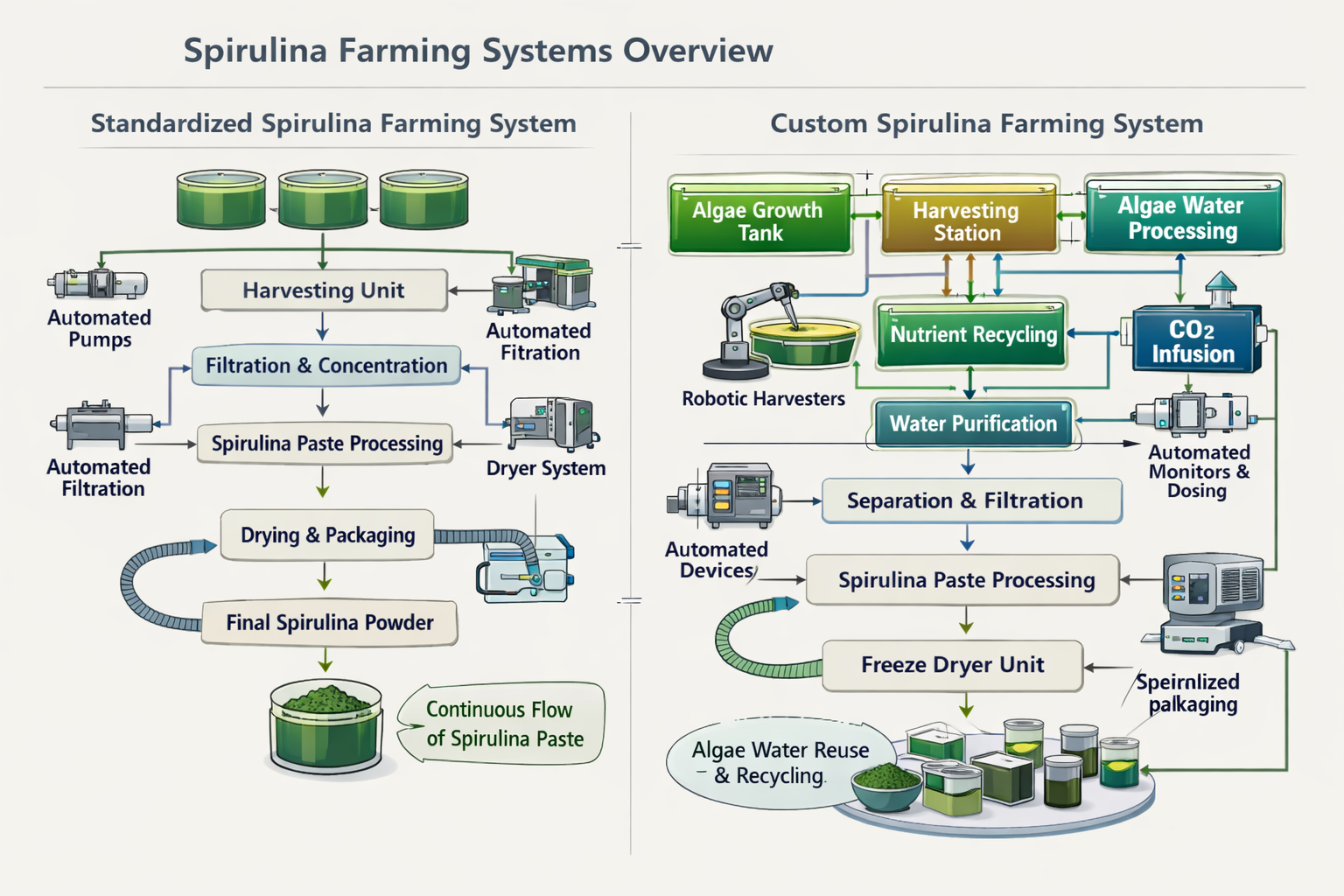
Standardization refers to using repeatable, validated designs across multiple projects or production blocks. This includes:
- Proven raceway pond geometries
- Defined agitation specifications using efficient agitator systems
- Standard harvesting and dewatering workflows built around harvesting equipment and assisted dewatering systems
- Validated drying and packing configurations using spirulina drying equipment and packing systems
Standardized systems are not inflexible. They are designed to perform predictably under a known operating envelope.
What Customization Actually Entails
Customization involves modifying system elements to suit site-specific conditions such as climate, water quality, land shape, or budget constraints.
In spirulina farming, customization often appears in:
- Non-standard pond dimensions
- Improvised agitation layouts
- Mixed harvesting methods
- Ad-hoc drying or storage solutions
While customization can address genuine constraints, excessive customization introduces variability that is difficult to control.
Where Customization Becomes a Liability
From an operational standpoint, each customized element adds a new failure mode.
Common consequences include:
- Inconsistent hydraulic behaviour across raceway ponds
- Uneven mixing despite efficient agitator intent
- Harvesting inefficiencies due to non-uniform pond outputs
- Drying and packing systems operating outside design assumptions
These issues compound as scale increases.
Why Standardization Supports Faster Stabilisation
Standardized systems shorten learning curves. Operators can apply known operating parameters rather than rediscovering them for each configuration.
Benefits include:
- Faster culture stabilisation
- Predictable harvesting and dewatering throughput
- Repeatable drying outcomes
- Easier troubleshooting and training
This directly reduces stabilisation timelines and working-capital stress.
The Myth That Customization Improves Yield
Higher yield is often cited as justification for customization. In practice, yield improvements from customization are rarely sustained.
Yield stability depends more on:
- Consistent mixing and nutrient distribution
- Controlled harvesting frequency
- Stable drying parameters
- Process discipline
Standardized systems outperform customized ones over time because variability is reduced.
Standardization vs Customization: Risk Comparison
| Dimension | Standardized Systems | Customized Systems |
| Predictability | High | Variable |
| Scale-up ease | Strong | Difficult |
| Operator training | Faster | Slower |
| Quality consistency | High | Uneven |
| Certification readiness | Easier | Complex |
| Long-term cost | Predictable | Often escalating |
Case Insight: Why Custom Pond Sizes Break Drying Economics
Custom pond sizing is one of the most common forms of over-customization in spirulina farms. While ponds are often resized to fit irregular land parcels or reduce perceived civil costs, these deviations create downstream economic distortion.
Drying systems are engineered around predictable biomass inflow rates. When pond sizes vary widely:
- Harvest volumes fluctuate beyond dryer design capacity
- Assisted dewatering residence times become inconsistent
- Drying cycles are either underloaded or forced into overload
- Energy efficiency drops while quality variability increases
Operators are then forced to either throttle harvesting or accept drying instability. Both outcomes increase operating cost and delay stabilisation.
Standardised pond dimensions aligned with drying capacity preserve throughput balance and protect drying economics at scale.
Where Limited Customization Is Justified
Customization is justified only when it addresses constraints that cannot be standardized.
Valid reasons include:
- Extreme climatic conditions
- Unavoidable land geometry constraints
- Regulatory or zoning limitations
Even then, customization should occur within a standardized system architecture.
Investor View: Repeatability Beats Novelty
Investors favour systems that can be replicated without redesign.
Repeatable systems allow:
- Faster expansion
- Easier benchmarking across sites
- Lower technical due-diligence risk
Highly customized farms may perform initially but struggle to attract follow-on capital.
How Greenbubble Balances Standardization and Customization
Greenbubble approaches spirulina farm design with a standardised core architecture that has been validated across multiple installations. Raceway ponds, efficient agitator design, harvesting equipment, assisted dewatering systems, spirulina drying equipment, and packing systems are selected as modular but standardised building blocks.
Customization is applied selectively to accommodate site-specific constraints, without compromising system coherence. This balance enables projects delivered through spirulina farming consultancy and spirulina farming turnkey solutions to scale without repeated redesign.
FAQs
Q1. Is full standardization always possible?
No. Some site-specific adaptation is unavoidable.
Q2. Why do heavily customized farms struggle at scale?
Because each variation introduces operational complexity.
Q3. Does standardization limit innovation?
No. Innovation occurs at the system level, not through ad-hoc changes.
Q4. Which approach suits export-oriented farms?
Standardized systems with controlled customization.
Q5. How does this choice affect certification?
Standardized processes simplify audits and compliance.
Conclusion: Stability Comes From Repeatability
In spirulina farming, stability and scalability come from repeatable systems, not bespoke designs. Standardization provides the control framework within which limited, intentional customization can succeed. Farms that understand this balance grow sustainably; those that over-customize often stall.
Make us your source on Google
Table Of Contents