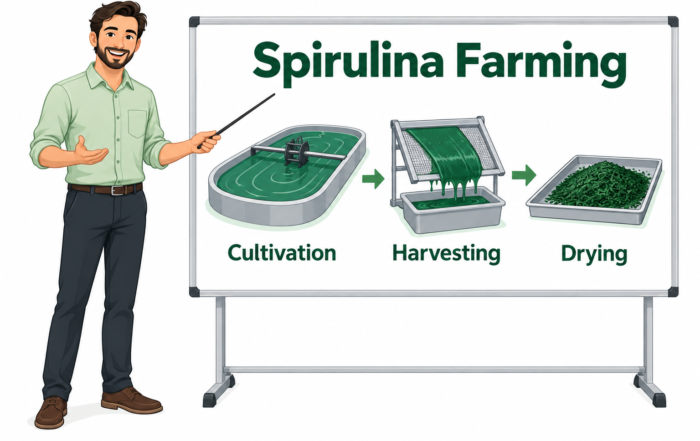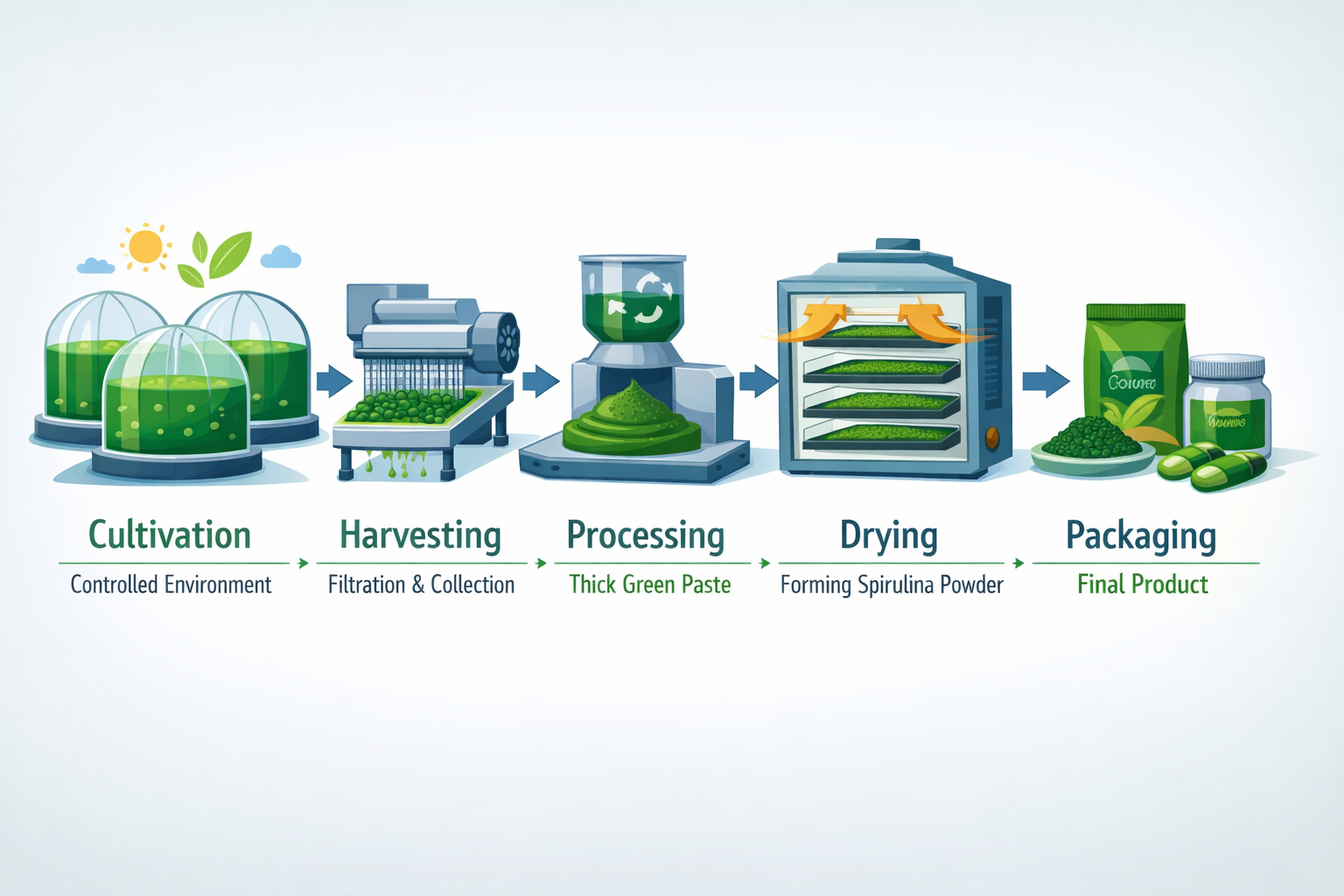
Spirulina production is often described in simplified terms – “grow it, dry it, pack it” – that obscure how technically demanding the actual process is. At commercial scale, spirulina production is a closely sequenced system involving precise pond engineering, continuous nutrient and environmental management, automated harvesting, temperature-controlled drying, and rigorous laboratory verification. Each stage depends on the one before it, and a shortfall at any single point limits what every subsequent stage can achieve.
This article walks through the complete production process in technical detail, stage by stage, with the specifications that govern each.
Stage 1: Pond Design and Site Selection
Commercial spirulina cultivation takes place in raceway ponds – long, shallow channels designed for continuous circulation rather than static growth.
| Pond Parameter | Specification |
| Length | 10-150 metres (100m typical for commercial scale) |
| Width | 5-20 metres (10m typical) |
| Depth | 0.25-0.35 metres (0.4m with water column typical) |
| Bottom design | Sloped, for easier biomass collection |
| Circulation mechanism | Paddlewheel-driven continuous flow |
| Land required (3-acre setup) | Supports approximately 20 raceway ponds |
Site selection prioritises climate zones with consistent warm temperatures and access to clean groundwater, since water quality is foundational to both yield and contamination control from the very first day of operation.
Stage 2: Culture Inoculation and Establishment
A verified, healthy spirulina culture – sourced from an established producer rather than wild-harvested material – is introduced into the prepared pond. The medium is brought to the correct alkalinity using sodium bicarbonate or, for organic-compliant operations, OMRI-approved organic carbon sources.
| Establishment Parameter | Target |
| Initial pH | 9-11 |
| Initial temperature | 30-37°C |
| Light exposure (early phase) | Shaded, increasing gradually |
| Culture source | Verified, contamination-free inoculum |
Newly inoculated cultures are vulnerable to photolysis under full light intensity, which is why shading during this early establishment phase – followed by gradual light increase – produces better long-term density than immediate full sun exposure.
Stage 3: Continuous Growth Management
This is the longest and most operationally demanding stage, requiring continuous monitoring and adjustment across several interdependent variables.
| Variable | Optimal Range | Monitoring Frequency |
| pH | 9-11 (rising trend indicates active growth) | Multiple times daily |
| Temperature | 30-37°C (32°C for maximum growth rate) | Hourly |
| Light intensity | 20,000-30,000 lux | Daily |
| C:N:P nutrient ratio | 160:50:2.5 | Continuous dosing against pH trend |
| Salinity | 5.8-11.7 ppt (optimal), tolerant to 20 ppt | Periodic |
Efficient agitator systems run continuously throughout this stage, ensuring even light penetration, consistent gas exchange, and stable temperature distribution. Inconsistent agitation creates microclimates within a single pond that show up as uneven biomass density at harvest – a detail covered further in the role of agitators in maintaining spirulina health.
Temperature management becomes particularly active above 40°C, where bleaching risk begins. Operations respond with increased agitation, partial shading, or cold culture addition from storage to keep water temperature from exceeding 38°C even when ambient temperature reaches 45-50°C.
Stage 4: Contamination Monitoring
Throughout cultivation, the pond is monitored for several contamination categories simultaneously.
| Contamination Type | Control Method |
| Insect larvae (flies, midges) | 80-mesh screen frames in front of agitators, cleaned daily |
| Competing algae species | Culture isolation, water source verification |
| Bacterial/viral contamination | Water quality testing, facility hygiene protocols |
| Heavy metals | Pre-use testing of all water and nutrient inputs |
Farms located near agricultural land face an additional risk: herbicide residues such as 2,4-Dichlorophenoxyacetic acid can inhibit spirulina cultivation even at trace concentrations, making water source testing especially important in these locations.
Stage 5: Harvesting
Once the culture reaches optimal density, harvesting begins using automated equipment rather than manual methods.
| Harvesting Step | Process | Mesh Size |
| Pre-filtration | Removes debris and feed material | 80-mesh |
| Primary harvesting | Separates spirulina from culture medium | 500-mesh |
| Washing | Removes excess salts from concentrated biomass | Integrated wash cycle |
Rotary drum filters constructed from SS 316 stainless steel gently separate spirulina from the surrounding water while allowing the culture medium to return to the pond for reuse. Manual harvesting at commercial scale introduces contamination risk and inconsistent yield, and makes certification audits considerably harder to pass – a distinction explored fully in automation in spirulina harvesting: why it’s non-negotiable.
Stage 6: Dewatering
The washed, concentrated biomass is converted into a thick cake using assisted dewatering systems or automated dewatering units.
| Dewatering Parameter | Specification |
| Method | Pressure or vacuum filtration |
| Target solids content | ~20% |
| Shear stress | Minimised to preserve cell integrity |
Stage 7: Drying – The Stage That Determines Final Quality
Drying is the single most consequential step in the entire production chain, because it determines whether the nutrients built up over weeks of cultivation actually survive into the finished powder.
| Drying Method | Temperature Range | Nutrient Retention | Best Suited For |
| Refractive Window Drying (RWD) | Below 45°C | Excellent | Small to large commercial scale |
| Vacuum drying | Below 45°C | Very good | Lab to small scale |
| Spray drying | 100-180°C | Low | High-throughput industrial, lower-grade use |
| Sun drying | Ambient, prolonged exposure | Poor | Not recommended for premium product |
RWD operates as an inline, continuous system that keeps product temperature below 45°C throughout processing – the threshold above which phycocyanin, beta-carotene, and GLA all begin degrading significantly. A full comparison of methods and their trade-offs is covered in spirulina drying methods comparison and why Refractive Window Dryers are ideal for spirulina.
Stage 8: Powdering and Sieving
| Step | Process |
| Grinding | Ball mill or air classifier mill, under GMP conditions, often with nitrogen flushing |
| Particle size | Sieved to uniform 80-100 mesh |
| Metal detection | Powder passed through metal detectors to remove foreign particles |
Stage 9: Laboratory Testing and COA Generation
Every batch is tested in an in-house laboratory before release, generating a batch-specific Certificate of Analysis.
| COA Parameter | Minimum Specification |
| Protein | ≥60% by dry weight |
| Phycocyanin | ≥10% |
| Beta-carotene | ≥5,500 mg/kg |
| Lead | ≤0.20 µg/g |
| Arsenic | ≤0.50 µg/g |
| Total aerobic microbial count | ≤50,000 cfu/g |
| Pathogens (E. coli, Salmonella) | Absent |
A product without this batch-specific verification has not actually been confirmed safe or nutritionally complete, regardless of label claims – covered further in what your Certificate of Analysis should show.
Stage 10: Packing and Storage
| Packing Element | Specification |
| Sealing method | Vacuum-sealed |
| Packaging material | Multi-foil with aluminium coating |
| Why it matters | Protects against light, moisture, and oxygen – the main drivers of phycocyanin and beta-carotene degradation post-drying |
Why Every Stage Has to Hold Together
Spirulina production functions as a chain, not a series of independent decisions. Excellent cultivation can be undone by high-temperature drying. Careful drying can be undone by poor packaging that allows oxidative degradation during storage and transit. This is why commercial-grade production treats pond design, growth management, harvesting, drying, testing, and packing as one integrated system, engineered together – an approach reflected in turnkey farming solutions rather than equipment sourced and assembled piecemeal.
Frequently Asked Questions
How long does the full production cycle take, from inoculation to packaged powder?
Culture establishment typically takes one to two weeks before the first harvest is possible. Once established, a healthy culture can be harvested on a rolling basis – often daily or every few days – with the harvest-to-dry-powder cycle (washing, dewatering, drying, testing, packing) typically completed within 24-48 hours per batch.
Why is automation considered non-negotiable rather than optional?
Manual harvesting and processing introduce contamination risk, inconsistent yield, and make certification audits significantly harder to pass. At commercial scale, the cost of automation is consistently lower than the cost of failed audits, inconsistent quality, and lost buyer contracts that manual operations tend to produce over time.
What is the single most common production mistake that reduces final quality?
Drying at high temperatures – whether through spray drying or uncontrolled sun drying – is the most common and most damaging mistake. It can destroy a significant portion of the phycocyanin and GLA that careful cultivation just spent weeks producing, regardless of how well the earlier stages were managed.
Can spirulina production be organic-certified at every stage described above?
Yes, but it requires specific substitutions: OMRI-approved organic carbon and nitrogen sources instead of conventional nutrients, dedicated facilities preventing cross-contamination with non-organic operations, and detailed record-keeping at every stage for certifying body audits. What makes spirulina farming organic covers these requirements in detail.
Does the production process differ for spirulina destined for animal feed versus human consumption?
The cultivation and harvesting stages are largely similar, but human-grade product requires stricter drying temperature control, more rigorous COA testing across a fuller panel, and GMP-compliant packaging. Biomass that does not meet human-grade specifications – due to minor moisture or pigment variation – can often be redirected to animal feed applications rather than discarded, as explained in difference between spirulina for human use vs animal feed.
How is quality consistency maintained across different harvest batches?
Consistency comes from tight control of growth parameters (pH, temperature, nutrient dosing) across every pond, standardised harvesting and drying protocols, and batch-by-batch COA testing that catches any deviation before blending or packing. Farms blending output from multiple ponds into larger packed batches rely on this per-batch testing to ensure the blended product meets specification uniformly.
The Standard This Process Reflects
The ten stages detailed above describe spirulina production as practiced on properly run commercial operations – not a simplified or aspirational version, but the actual technical standard required to produce export-grade, COA-verifiable spirulina. Greenbubble’s systems, deployed across more than 10 countries and underpinning over 90% of India’s spirulina production, are built around this exact level of stage-by-stage engineering. Reviewing real project case studies offers a concrete look at this process operating at commercial scale across different farm sizes and climates.
Make us your source on Google
Table Of Contents