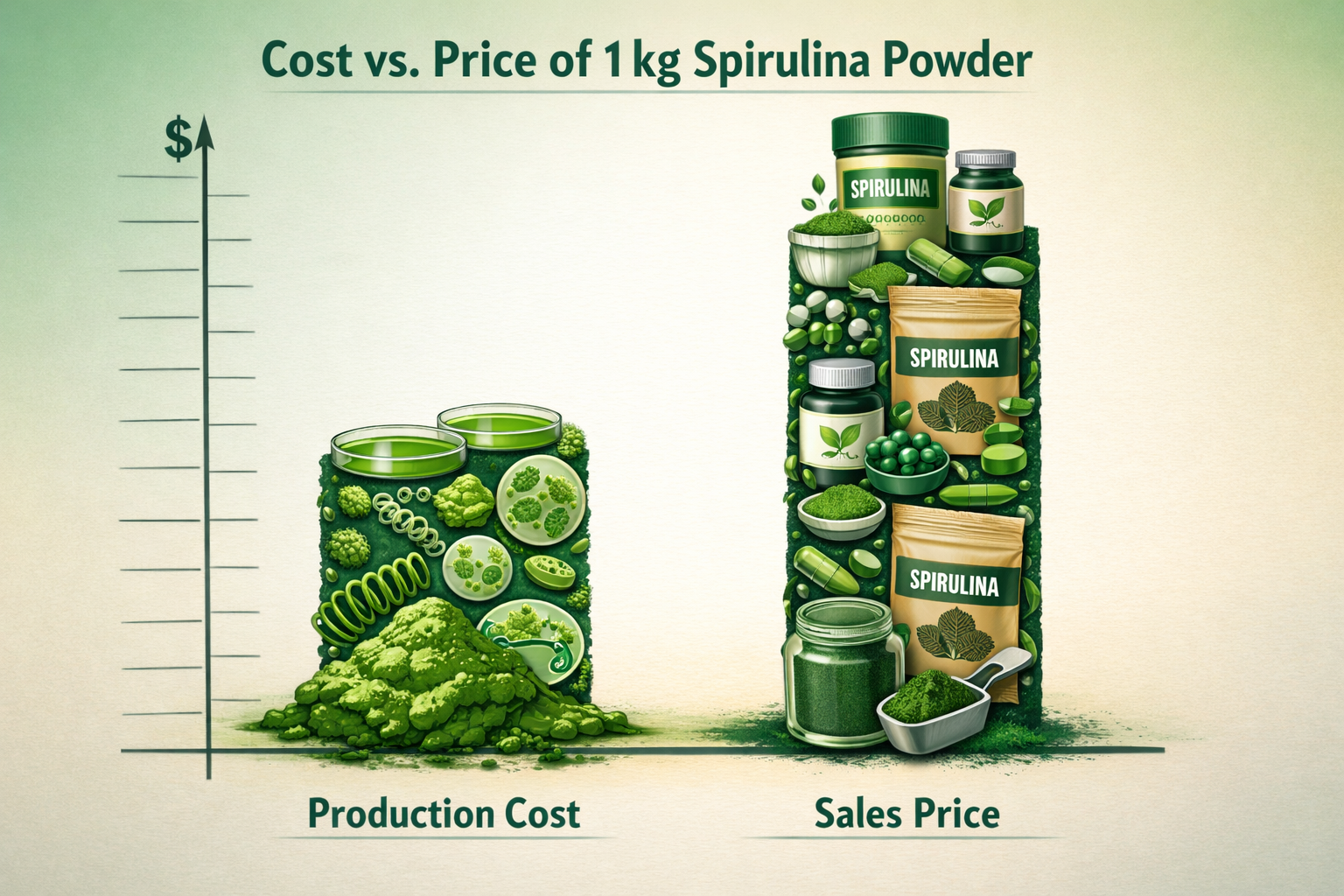
Most pricing conversations around spirulina focus on what a kilogram sells for. Far fewer look at what it actually costs to make one – and the gap between those two numbers is where the real story sits. Margins vary enormously depending on grade, certification, and scale, and understanding the cost side changes how a price quote should be read, whether you are buying or producing.
This article works backward from the farm floor: what goes into producing 1kg of spirulina powder, and how that stacks up against what the market pays for it.
Building the Cost of 1 Kg from the Ground Up
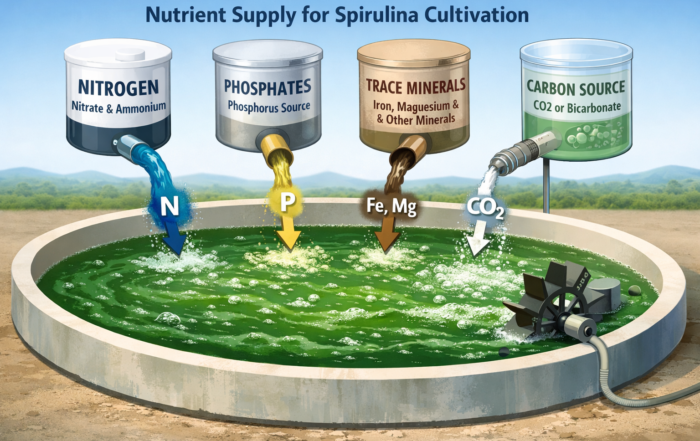
Nutrient inputs. Spirulina requires a continuous supply of carbon, nitrogen, phosphorus, and trace minerals dosed against pH trends. On a 3-acre certified farm, nutrient cost alone runs approximately ₹51 lakh per year. Divided across a typical annual yield of 20-30 tonnes for that farm size, nutrients alone contribute roughly ₹170-₹255 per kg.
Power and automation. Agitation, pumping, automated harvesting, and drying systems all draw continuous power. At approximately ₹12 lakh annually for a 3-acre operation, this adds roughly ₹40-₹60 per kg.
Labour. Skilled operators – not casual labour – are required to manage culture health, run agitators correctly, monitor pH and temperature, and operate drying and packing lines. At roughly ₹15-24 lakh annually, this contributes ₹50-₹120 per kg depending on farm efficiency.
Lab testing and certification. Per-batch COA testing runs ₹15,000-₹30,000 per panel, and annual organic certification adds ₹1.75-₹3 lakh. Spread across annual output, this typically adds ₹15-₹30 per kg.
Packaging. Vacuum-sealed, multi-foil packing systems with aluminium coating cost more than basic packaging but protect phycocyanin and beta-carotene from degradation – contributing roughly ₹15-₹25 per kg.
Cost vs Price: The Side-by-Side Comparison
| Component | Cost Contribution per Kg (₹) |
| Nutrient inputs | 170-255 |
| Power & automation | 40-60 |
| Labour | 50-120 |
| Lab testing & certification | 15-30 |
| Packaging | 15-25 |
| Maintenance & misc. | 30-50 |
| Total production cost (certified, 3-acre scale) | ₹320-₹540/kg |
| Market Price Point | Typical Range (₹/kg) | Implied Margin Over Production Cost |
| Farm-gate bulk sale (certified) | ₹1,200-₹1,800 | 2.5x-4.5x |
| B2B sale to formulators | ₹1,500-₹2,200 | 3x-5.5x |
| Export to certified buyers | ₹1,800-₹2,500 | 3.5x-6x |
| Retail equivalent (after full chain) | ₹12,000-₹25,000 | 25x-60x |
The farm-gate margin looks healthy on paper – but it has to absorb business overheads (marketing, freight, insurance, office costs) that sit outside direct production cost, which is why a 3-acre farm’s actual net profit margin, as detailed in the real ROI of spirulina farming, is considerably thinner than the gross cost-to-price gap suggests.
Why the Gap Looks Bigger Than It Is
Three things inflate the apparent margin that a simple cost-vs-price comparison shows:
Business overheads aren’t in the production cost. Office management, marketing and sales, insurance, and freight typically add 15-25 lakh annually on top of direct plant costs for a 3-acre operation – costs that don’t appear in a per-kg production cost table but absolutely eat into the farm-gate margin.
CapEx amortisation is invisible in per-kg cost. Setting up a 3-acre farm with raceway ponds, RWD drying systems, and lab infrastructure requires ₹1.5-₹2.5 crore in upfront capital. That investment has to be recovered over years, and the cost-per-kg figures above reflect only operating expenditure, not capital recovery.
Yield variability changes everything. A farm achieving 30 tonnes annually spreads fixed costs much further than one yielding 15 tonnes due to contamination, seasonal disruption, or poor culture management. Lower yield can push per-kg production cost up by 40-60%, collapsing margins that looked comfortable on a spreadsheet.
Where the Real Margin Actually Sits
| Stage | Approximate Margin Reality |
| Farm-gate bulk sale | Thin after overheads and CapEx amortisation |
| Distributor/aggregator layer | Moderate – 15-25% markup for logistics |
| Brand/formulation layer | Largest – encapsulation, marketing, and retail positioning capture most value |
| Retail shelf | Significant – 25-40% on top of brand price |
The uncomfortable truth for producers is that the largest margins in the spirulina value chain sit downstream of the farm, not at it – a dynamic covered in more depth in contract manufacturing vs own brand: margin realities in spirulina.
What This Means for Buyers and Producers
For buyers, understanding true production cost is a negotiating tool. A quoted price far above ₹540/kg production cost with no certification or COA to justify the premium deserves questions. A price too close to ₹320/kg almost certainly means a corner has been cut somewhere in nutrient quality, automation, or testing.
For producers, this comparison is a reminder that farm-gate pricing alone rarely builds a sustainable business without either scale (to spread fixed costs further) or a move toward direct B2B or export channels that capture more of the downstream margin currently going to distributors and brands.
The Production Standard Behind Every Number Here
These cost figures assume a properly run operation – controlled cultivation, automated processing, and consistent lab verification. Greenbubble’s turnkey farm infrastructure, deployed across more than 10 countries and underpinning over 90% of India’s spirulina production, reflects the cost structure and production discipline that these numbers are built on. A farm cutting corners on any of these line items will see different numbers – usually lower cost, but also lower yield, lower quality, and a much harder path to certification.
Make us your source on Google
Table Of Contents