Spirulina cultivation rests on three interdependent systems: the pond that contains the culture, the nutrients that feed it, and the harvesting process that converts grown biomass into usable product. Each has specific, documented parameters – not rules of thumb – and getting any one wrong limits what the other two can achieve. This reference lays out the working numbers behind each.
Pond Setup: Specifications That Matter
| Parameter | Specification | Why It Matters |
| Pond type | Raceway pond | Continuous circulation via paddlewheel ensures even light and gas exchange |
| Length | 10-150 metres | Larger ponds buffer temperature swings more effectively |
| Width | 5-20 metres | Affects agitation reach and light penetration uniformity |
| Depth | 0.25-0.35 metres | Shallow depth maximises light exposure and gas exchange |
| Commercial scale dimensions | 100m x 10m x 0.4m (typical) | Standard for mid-to-large commercial operations |
| Bottom design | Sloped | Eases biomass collection during harvest |
| Land requirement (3-acre setup) | Supports ~20 raceway ponds | Sufficient for harvesting, drying, packaging, and lab infrastructure |
Pond size has a direct relationship with thermal stability. Larger ponds have a greater buffering capacity against ambient temperature swings, which is why climate and geography play into pond sizing decisions, not just total farm area. Efficient agitator systems are non-negotiable regardless of pond size – uneven agitation creates localised temperature and light gradients that compromise consistent biomass quality.
Growth Parameters: The Conditions Spirulina Needs
| Factor | Optimal Range | Risk Outside Range |
| pH | 9-11 | Below 9: contamination risk rises; above 11.5: growth inhibited |
| Temperature | 30-37°C | Above 40°C: bleaching; below 15°C: growth stops |
| Light intensity | 20,000-30,000 lux | Excess light without shading causes photolysis in young cultures |
| Salinity tolerance | 4-20 ppt | Growth favours lower end (5.8-11.7 ppt) |
| C:N:P ratio | 160:50:2.5 | Imbalance limits growth rate and protein yield |
These figures are not flexible suggestions – they are the operating envelope within which spirulina performs reliably. The detailed mechanics of each variable are covered in understanding pH, temperature, and light in spirulina cultivation and pH and temperature: the twin pillars of spirulina growth.
Nutrient Inputs: What the Culture Actually Needs
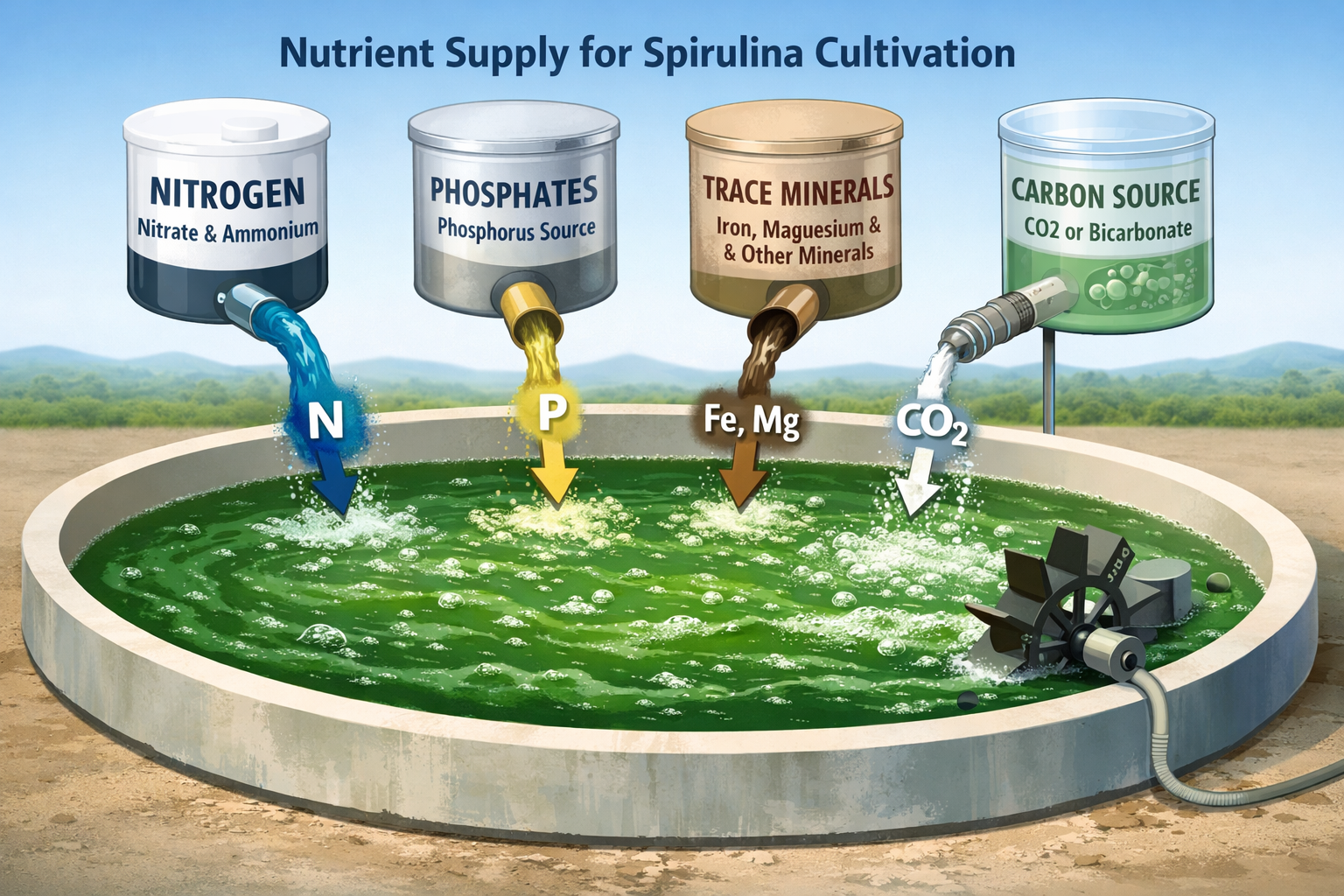
| Nutrient | Source (Organic-Compliant) | Source (Conventional) |
| Carbon | Sugars, dissolvable organic plant material | Sodium bicarbonate |
| Nitrogen | OMRI-approved nitrate-based or organic fertilisers | Urea, ammonium nitrate (not organic-compliant) |
| Phosphorus | Phosphate rock, organic minerals | Potassium phosphate |
| Trace minerals | Verified organic mineral sources | Magnesium sulfate, iron sulfate, zinc, selenium |
A critical distinction for organic-certified operations: there is no such thing as organic urea, and ammonium nitrate is not an organic-compliant nitrogen source regardless of supplier claims. All nutrient sources – organic or conventional – must be tested for pesticide residue, microbial content, and heavy metals before entering the pond, a requirement detailed in spirulina and carbon source: organic options explained and what makes spirulina farming organic.
Temperature Management: Keeping the Culture in Range
| Outside Temperature | Management Action |
| Up to 45°C | Maintain via agitation and water top-up |
| 45-48°C | Increase agitation; consider partial shading |
| Above 45°C | Deploy green shading net to prevent culture exceeding 38°C |
| Water temp exceeds 38°C | Add new cold culture from storage |
Larger ponds provide a greater thermal buffer, but active management remains essential even at scale. This is one of the operational disciplines covered in how to maintain spirulina culture in high temperatures and reinforced by maintain spirulina culture quality practices more broadly.
Harvesting: From Pond to Biomass Cake
| Stage | Process | Equipment |
| Pre-filtration | Removes debris and feed material, 80-mesh | Mesh screen frame |
| Harvesting | Separates spirulina from culture, concentrates via 500-mesh | Rotary drum filters |
| Washing | Removes excess salts from concentrated biomass | Integrated wash cycle |
| Dewatering | Converts slurry to ~20% solids cake | Assisted dewatering systems |
Automated harvesting through fine-mesh rotary drum filters is the standard for commercial operations – manual harvesting introduces contamination risk, inconsistent yield, and makes certification audits considerably harder to pass, as detailed in automation in spirulina harvesting: why it’s non-negotiable. Equipment is built from SS 316 stainless steel and designed for clean-in-place washing, minimising contamination risk between harvest cycles.
After Harvest: What Happens to the Biomass Cake
| Stage | Specification |
| Drying method | Refractive Window Drying or vacuum drying |
| Maximum process temperature | 45°C |
| Powdering | Ball mill or air classifier mill, GMP-compliant |
| Final particle size | 80-100 mesh |
| Testing | Full COA per batch before packing |
The dewatered cake is dried in an inline continuous system that holds temperature below 45°C – the threshold above which phycocyanin and other heat-sensitive compounds begin to degrade significantly. This single processing decision determines whether everything achieved during cultivation actually survives into the finished product.
Common Failure Points Across the Process
| Stage | Common Mistake | Consequence |
| Pond design | Undersized ponds in hot climates | Poor thermal stability, frequent bleaching |
| Nutrient dosing | Using non-organic nitrogen sources on certified farms | Certification audit failure |
| Agitation | Inconsistent or manual stirring | Uneven biomass quality, contamination risk |
| Harvesting | Manual harvesting at scale | Inconsistent yield, certification difficulty |
| Drying | High-temperature spray or sun drying | Significant phycocyanin and nutrient loss |
These failure points are explored individually across most common mistakes in new spirulina farms and spirulina culture crash: what went wrong – both useful diagnostic references for producers troubleshooting an underperforming operation.
The System Behind the Numbers
Every specification in this reference reflects how cultivation, nutrient management, and harvesting actually function as one integrated system, not three separate decisions. Greenbubble’s turnkey farming solutions, which underpin more than 90% of India’s spirulina production across more than 10 countries, are designed around exactly this kind of system-level integration – pond, nutrients, and harvesting engineered to work together rather than independently. Examining real project case studies shows these parameters applied at actual operating scale across different climates and farm sizes.
Make us your source on Google
Table Of Contents