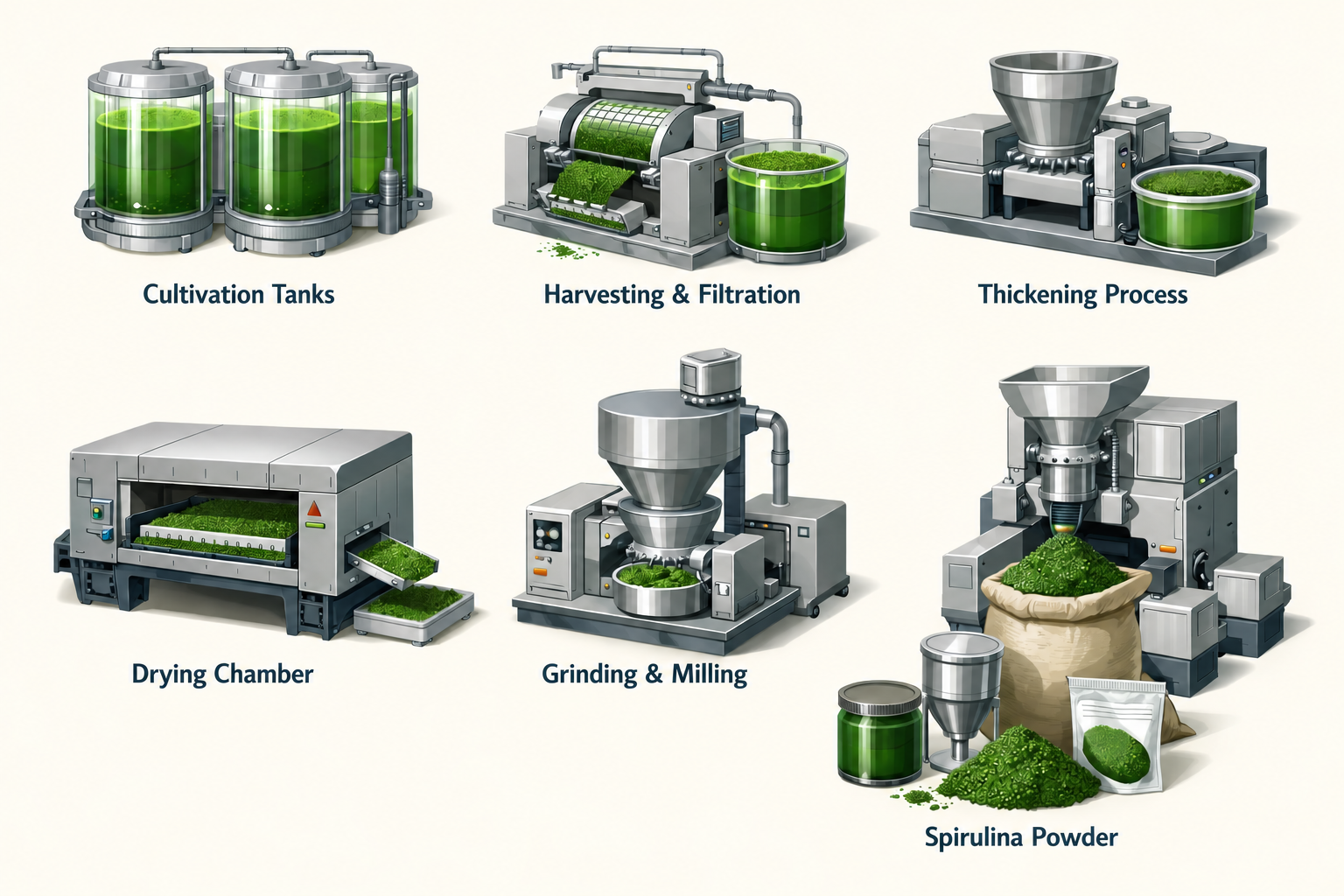
The spirulina powder sitting in a capsule or smoothie jar has passed through a long, technically demanding sequence before it ever reached that form. Understanding the full pond-to-powder journey clarifies why quality varies so dramatically across products carrying the same name – and why each production decision along the way either preserves or destroys the nutritional value the organism started with.
Stage 1: The Pond
Production begins in a raceway pond – a long, shallow channel typically 100 metres long, 10 metres wide, and 0.4 metres deep, with a sloped bottom for easier biomass collection. A paddlewheel keeps the culture in continuous circulation, which is essential rather than cosmetic: it ensures even light exposure, consistent gas exchange, and stable temperature distribution across the entire pond.
The culture is maintained at pH 9-11 and temperature 30-37°C – the conditions under which spirulina grows fastest and produces the highest concentrations of protein, phycocyanin, and GLA. Efficient agitator systems are what keep these conditions uniform rather than left to chance.
Stage 2: Nutrient Management
Throughout the growth cycle, the culture is dosed with carbon, nitrogen, phosphorus, and trace minerals in a C:N:P ratio of roughly 160:50:2.5. Carbon dosing is typically timed against pH trend – as spirulina consumes bicarbonate ions, pH rises, and that rise is used as a live signal for when and how much to dose next, keeping the culture in its optimal alkalinity window continuously.
Stage 3: Contamination Control
Spirulina ponds are vulnerable to insect larvae, competing algae species, and microbial contamination. Fine mesh screens positioned in front of agitators trap debris and require daily cleaning, while water sources are tested for heavy metals and pesticide residue before use – a discipline that matters even more for farms situated near agricultural land.
Stage 4: Harvesting
Once the culture reaches optimal density, automated harvesting equipment – typically rotary drum filters fitted with 500-mesh screens – separates spirulina biomass from the surrounding culture medium, which returns to the pond for reuse. Manual harvesting at this stage introduces both contamination risk and inconsistent yield, which is why automation is treated as standard rather than optional in serious commercial operations.
Stage 5: Washing and Dewatering
The harvested biomass is washed to remove excess salts, then converted into a thick cake – typically around 20% solids – using assisted dewatering systems that apply pressure or vacuum filtration with minimal shear stress, protecting cell integrity ahead of drying.
Stage 6: Drying – The Stage That Determines Final Quality
This is the single most consequential step in the entire production chain. The dewatered cake is dried in an inline, continuous system using Refractive Window Drying, which keeps product temperature below 45°C throughout. This threshold matters because phycocyanin, beta-carotene, and GLA all degrade significantly above it – a spray-dried product processed at 100-180°C can lose much of the nutritional value that careful cultivation just spent weeks building.
Stage 7: Powdering and Sieving
The dried material is powdered using a ball mill or air classifier mill under GMP-compliant conditions, then sieved to a uniform 80-100 mesh particle size and passed through metal detection to catch any foreign particles before blending.
Stage 8: Lab Testing
Every batch is tested in an in-house laboratory against a full panel – protein, phycocyanin, beta-carotene, heavy metals, and microbial safety – to generate a batch-specific Certificate of Analysis. Spirulina without this verification has not been confirmed to contain what its label claims, regardless of how it was produced.
Stage 9: Packing
Once the COA confirms quality, the powder is packed using vacuum-sealed, multi-foil, aluminium-coated packaging designed to protect against light, moisture, and oxygen – the three things that continue degrading phycocyanin and beta-carotene even after drying is complete.
Why Every Stage Has to Hold
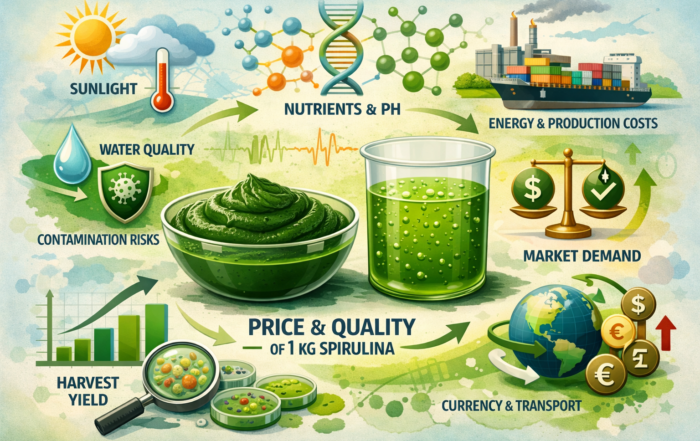
The pond-to-powder journey is a chain, and the final product can only be as good as its weakest link. Excellent cultivation undone by high-temperature drying produces a powder with depleted phycocyanin despite a healthy culture history. Careful drying undone by poor packaging loses nutrient value in storage before it ever reaches a consumer. This is why commercial-scale production treats pond, harvesting, drying, testing, and packing as one integrated system rather than nine separate decisions made independently.
Greenbubble’s turnkey farming systems, which underpin more than 90% of India’s spirulina production across more than 10 countries, are built around exactly this kind of end-to-end integration – engineering each stage to protect what the previous stage achieved, rather than treating cultivation and processing as unrelated problems solved separately.
Make us your source on Google
Table Of Contents