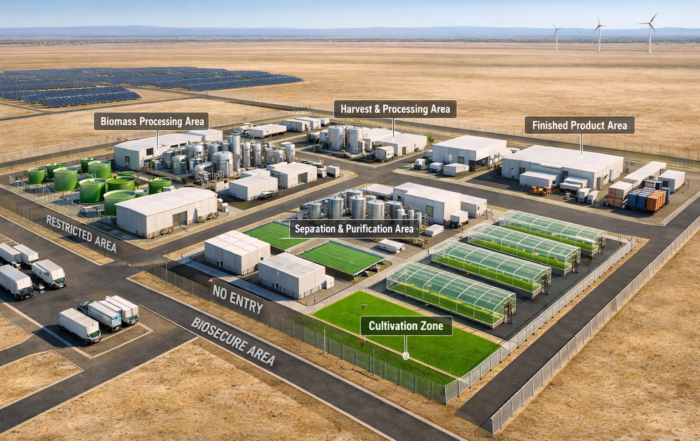
Telangana’s warm, sunny Deccan climate and Hyderabad’s large pharmaceutical and food industries make it a promising state for spirulina cultivation. For farmers and entrepreneurs looking beyond traditional crops, spirulina offers a high-value product with growing demand from supplement makers, feed companies and exporters.
Getting started the right way matters, though. Summer heat, groundwater quality and scale all decide whether a farm becomes profitable or struggles from its first season. We have built spirulina farms across India and in more than 10 countries, and our customers account for more than 90% of India’s spirulina production. Here is what you need to know to start spirulina cultivation in Telangana.
Why Telangana Suits Spirulina
| Telangana’s advantage | What it means for spirulina |
|---|---|
|
Strong sunlight for most of the year |
Sunlight is the most economical energy source, and commercial farms don’t need artificial lighting |
|
Warm Deccan climate |
Spirulina grows best at 30 to 37°C, which matches much of the year |
|
Moderate rainfall inland |
Less culture dilution than in high-rainfall states |
|
Hyderabad’s pharma and nutraceutical industry |
Nearby buyers for supplement-grade and pharma-grade spirulina |
|
Large poultry sector |
Steady demand for feed-grade spirulina |
|
Hyderabad air cargo and road links to eastern ports |
Export routes despite being a landlocked state |
The poultry link is especially relevant. Research shows that including about 1% spirulina in poultry diets gives optimal egg yolk pigmentation, making spirulina a useful ingredient for feed companies. See spirulina for poultry and animal feed.
The Challenges to Plan For
Summer Heat
Temperatures in many Telangana districts cross 42 to 45°C in April and May. Spirulina culture starts bleaching above 40°C, so heat control is essential. We manage it through:
- Hourly temperature monitoring
- Shade nets deployed when outside temperatures cross 45°C, keeping culture below 38°C
- Agitator speed and run time adjusted to control temperature
- Deeper water in summer for thermal buffering
- Cold culture reserves added when ponds approach 38°C
- Larger raceway ponds, which hold temperature more steadily than small tanks
Learn more in how to maintain spirulina culture in high temperatures.
Groundwater Quality
Much of Telangana sits on hard-rock aquifers, and some districts are known for groundwater quality problems, including high fluoride levels. Spirulina absorbs what is in its water, and contaminants can end up in the final product. Every site needs full water testing, followed by sand and UV filtration and regular retesting. Read how to avoid heavy metals and contamination in spirulina farming.
Cooler Winter Nights in the North
Northern districts such as Adilabad can have cold winter nights. Spirulina needs daytime temperatures of about 15°C or more to grow. Polyhouse structures help keep ponds warm during December and January.
Monsoon Management
The southwest monsoon from June to September brings cloud cover and rain that can dilute ponds. Covered ponds, good drainage and regular salinity and nutrient checks keep production stable.
Best Regions in Telangana for Spirulina
| Region | Example districts | Strengths | Watch-outs |
|---|---|---|---|
|
Around Hyderabad |
Rangareddy, Medchal, Sangareddy, Vikarabad |
Close to buyers and air cargo |
Higher land costs, industrial pollution in some areas |
|
South Telangana |
Mahabubnagar, Nagarkurnool, Wanaparthy |
Strong sunlight, low rainfall, available land |
Summer heat and water availability |
|
Central Telangana |
Siddipet, Medak, Karimnagar, Warangal |
Balanced climate and good road access |
Groundwater quality varies |
|
Nalgonda region |
Nalgonda, Suryapet, Yadadri |
Sunny and warm |
Known groundwater quality concerns, so testing is critical |
|
North Telangana |
Adilabad, Nirmal, Mancherial |
Good water availability in parts |
Hot summers and cooler winter nights |
The final decision always depends on water testing, local weather data and neighbouring land use. Sites near farmland should also be tested for herbicides such as 2,4-D. For a wider comparison, see the best climate zones for spirulina cultivation in India.
Getting Started: Six Steps
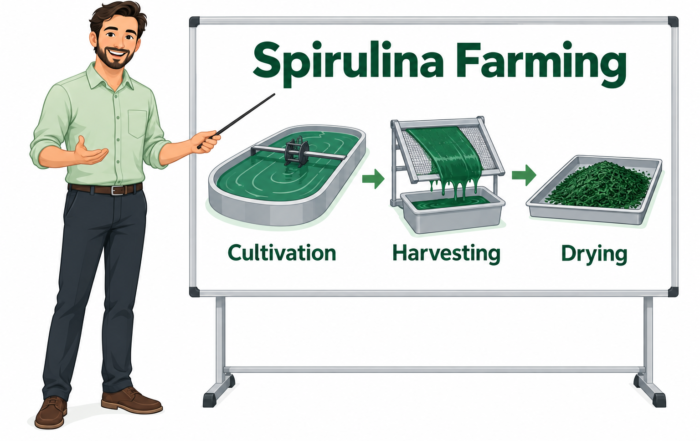
1. Choose your market first. Pharma, supplement, export and feed buyers need different grades and certifications. Your target buyer shapes your farm design.
2. Test and select your site. Test groundwater fully, keep away from industrial effluents, and check for agricultural chemicals nearby.
3. Plan the right scale. Start with 2 to 3 acres for a commercial farm. That is enough for up to 20 raceway ponds plus harvesting, drying, packing, storage and an on-site lab.
4. Build proper ponds. Commercial raceway ponds typically cover 1,000 to 4,000 square metres each, with sloped bottoms, agitation, and shading for summer.
5. Automate harvesting and processing. Use 500-mesh rotary drum harvesting equipment in SS 316, dewatering, and low-temperature drying that keeps spirulina below 45°C. Follow it with hygienic powdering and vacuum-sealed packing. Manual processing leads to contamination and failed certification audits.
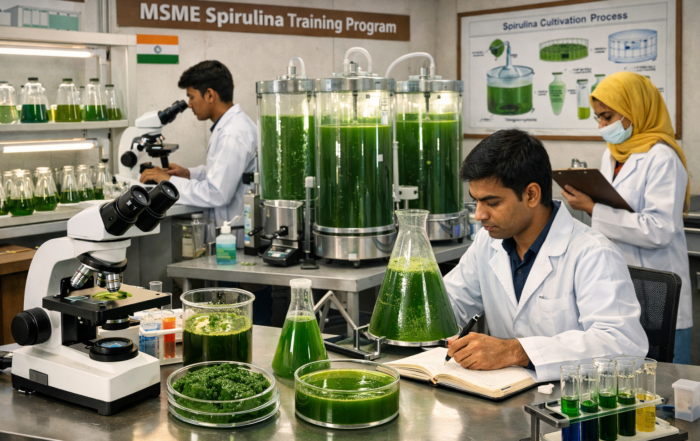
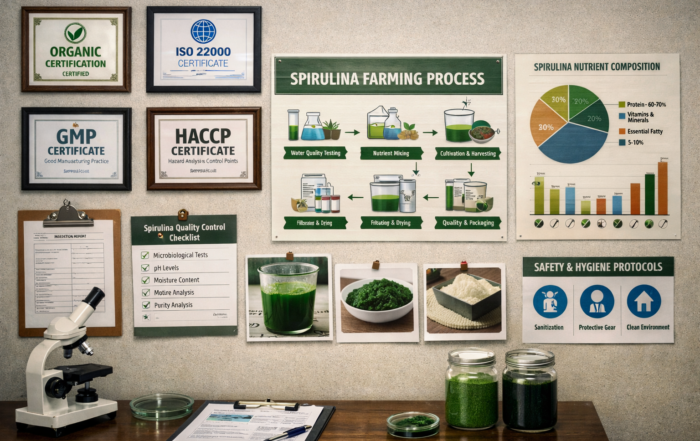
6. Set up a lab and train your team. Test every batch in-house for protein, moisture, pigments, microbial safety and heavy metals, and issue a COA before sale. Trained operators are as important as good equipment.
What It Costs
Setup Cost for a 1-Acre Farm
| Component | Estimated cost (₹) |
|---|---|
|
Pond construction |
15 to 18 lakh |
|
Buildings |
10 to 20 lakh |
|
Agitation systems |
5 to 8 lakh |
|
Harvesting and dewatering |
10 to 12 lakh |
|
Drying system (RWD or vacuum) |
10 to 18 lakh |
|
Packaging and cleanroom |
6 to 8 lakh |
|
Automation (IoT and SCADA) |
3 to 5 lakh |
|
Lab and quality control |
10 to 12 lakh |
|
Certification and documentation |
4 to 6 lakh |
|
Total |
73 lakh to 1.07 crore |
Annual operating costs run at about ₹53 lakh for 1 acre and about ₹1.06 crore for 2 to 3 acres. The largest costs are nutrients, salaries and power. For the full breakdown, see spirulina farming cost in India.
Realistic Returns
| Farm size | Setup cost | Annual revenue | Annual costs | Result |
|---|---|---|---|---|
|
1 acre |
₹1.07 crore |
₹75 lakh |
₹83.22 lakh |
Loss of about ₹8.2 lakh |
|
3 acres |
₹2.1 crore |
₹2 crore |
₹1.22 crore |
Profit of about ₹78 lakh (about 37% ROI) |
Farms of 2 to 3 acres typically break even in about three years. Farms of 1 acre or less generally struggle to cover their fixed costs.
Who Buys Spirulina in Telangana?
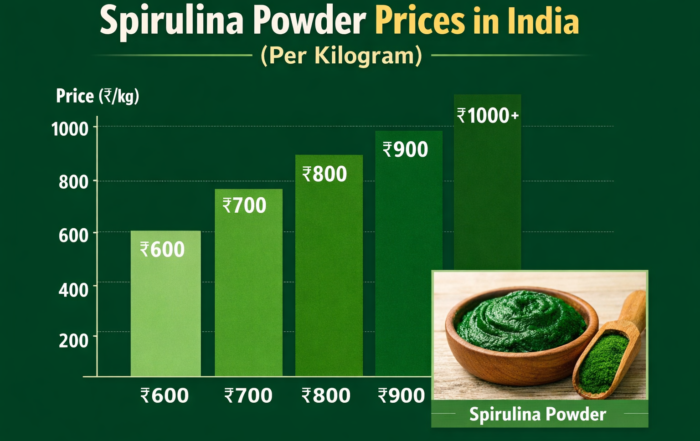
| Buyer type | Typical price (₹/kg) | Grade required |
|---|---|---|
|
Nutraceutical and supplement brands |
800 to 1,500 |
Certified organic, high phycocyanin |
|
Domestic supplement manufacturers |
600 to 800 |
Standard commercial grade |
|
Export traders |
800 to 1,000 |
USDA or EU Organic, full traceability |
|
Government and institutional programmes |
900 to 1,300 |
Certified, food-safety compliant |
|
Poultry and aquaculture feed |
400 to 600 |
Consistent carotenoids |
Hyderabad’s pharmaceutical industry adds another opportunity: pharma buyers evaluate spirulina against stricter specifications and documentation. Read how pharma-grade spirulina is evaluated differently. If you are also considering the neighbouring state, compare spirulina farming in Andhra Pradesh.
How We Help You Get Started in Telangana
We take you from site selection to certified production:
- Site assessment, including water testing and land-use checks
- Farm design for Telangana’s heat, with correctly sized raceways, shading and agitation
- Integrated automated harvesting, dewatering, drying and packing
- In-house lab setup, so every batch has a COA
- Team training and support through stabilisation and certification
We have been recognised as Best Microalgae Company by the European Algae Biomass Association in Paris. Our turnkey spirulina farming solutions start from ₹1 crore / US $200,000, and our spirulina farming consultancy can help you assess your land before you invest.
Starting Strong in Telangana
Telangana has the sunshine, the warmth and the buyers that spirulina needs. What separates a profitable farm from a struggling one is how it is started:
- Choose a site with clean, tested water.
- Build at a commercially viable scale.
- Protect the culture from summer heat.
- Automate processing and test every batch.
Get those basics right from day one, and your Telangana spirulina farm is set up to grow steadily for years.
Make us your source on Google
Table Of Contents