The terms get used interchangeably in supplier conversations, trade enquiries, and even formal contracts. They are not the same thing. The difference between private label and white label spirulina is not just semantic – it determines who owns the margin, who carries the risk, and who is building something of lasting value in the transaction.
Most spirulina producers do not sit down and choose one model deliberately. They drift into whichever arrangement the first buyer proposes. That drift is expensive.
The Definitions, Precisely
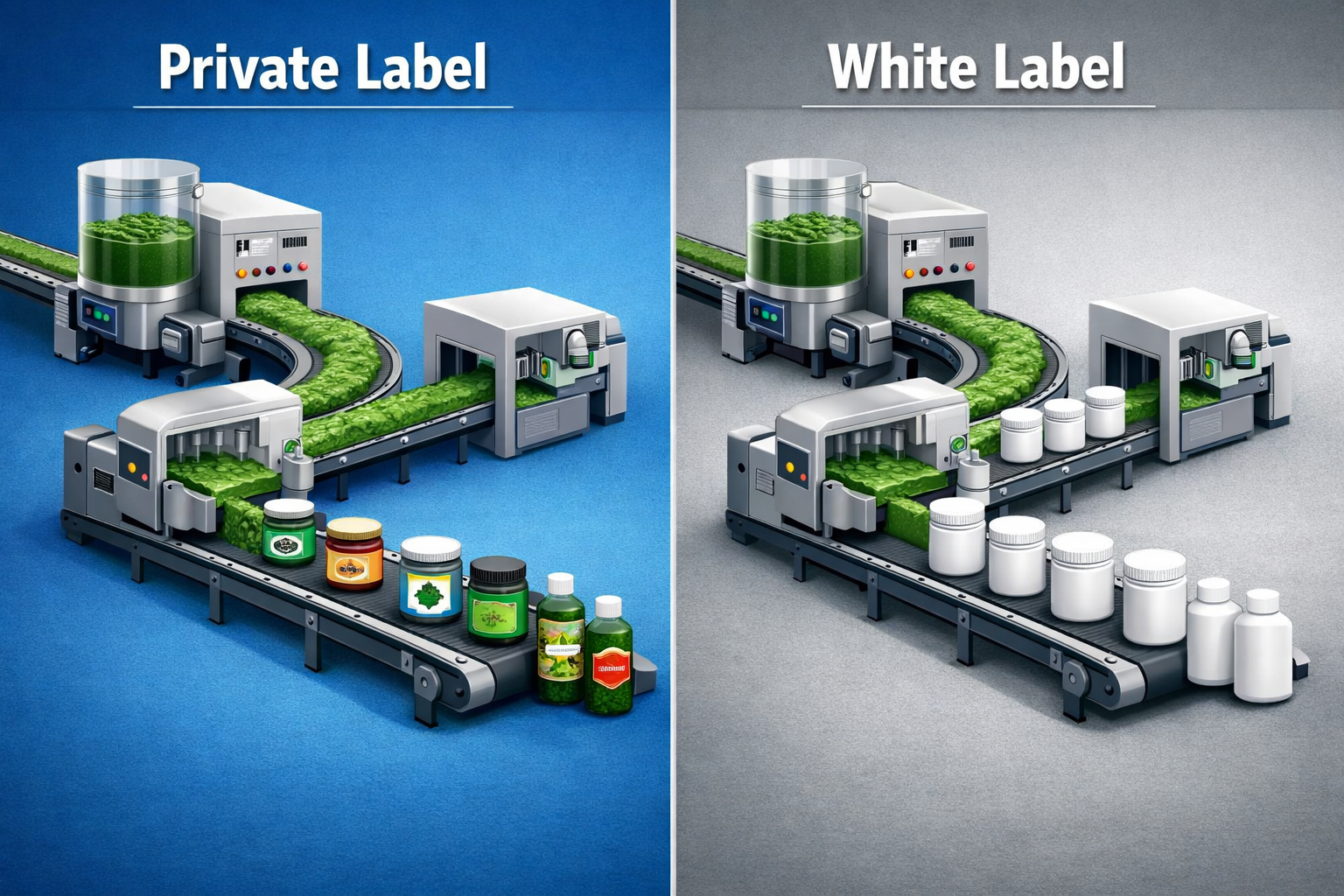
White label spirulina means the producer manufactures a standardised product – same formulation, same specifications, same packaging format – that multiple buyers purchase and resell under their own brand names. The producer controls the product. The buyer controls the label.
Private label means the producer manufactures a product to the buyer’s specific requirements – particular certifications, custom formulations, specific capsule counts, proprietary packaging – exclusively for that buyer. The buyer owns the brand. The producer owns the manufacturing relationship.
The distinction matters because it determines leverage. In white label, the producer has it. In private label, the buyer typically does.
The Margin Structure: Where Money Moves
| White Label | Private Label | |
| Who sets product specs | Producer | Buyer |
| Exclusivity | None – same product sold to many | Typically exclusive to one buyer |
| Price negotiation leverage | Producer (standardised product) | Buyer (custom requirements) |
| Switching cost for buyer | Low – can source elsewhere easily | High – reformulation costs and time |
| Switching cost for producer | Low – other buyers exist | High – losing one buyer = losing a line |
| Typical realisation per kg (certified organic) | ₹1,200-₹2,000 | ₹900-₹1,500 |
| Upfront investment by producer | Standard production infrastructure | Often custom equipment or process changes |
| Documentation burden | Standard COA + certification | COA + certification + buyer-specific audit requirements |
The counterintuitive finding here is that private label – which sounds more premium and relationship-driven – often realises lower per-kilogram pricing than white label. The reason is simple: a buyer who has invested in designing a custom product, specifying a particular encapsulation format, and building their brand around your supply has enormous negotiating leverage at contract renewal. They know switching suppliers requires time and risk. They use that knowledge.
Volume Economics: What Scale Does to Each Model
| Farm Size | Viable Model | Why |
| 1 acre (10-15 tons/year) | Neither model is reliably profitable | OpEx of ₹53L/year against revenue of ₹75L leaves no margin for brand-building or custom manufacturing overhead |
| 2-3 acres (20-30 tons/year) | White label with 2-3 buyers | Diversified buyer base protects against single-buyer loss; standardised product reduces complexity |
| 3-5 acres (30-60 tons/year) | White label core + selective private label | Volume justifies one or two private label relationships with minimum order guarantees |
| 5+ acres (60+ tons/year) | Private label at scale with contract security | Large volumes reduce per-unit overhead; private label premiums become meaningful at tonnage |
The 1-acre farm reality is worth dwelling on. At this scale, annual operating expenditure runs approximately ₹53 lakhs. Revenue at standard certified organic white label pricing sits around ₹75 lakhs. That leaves roughly ₹22 lakhs before business overheads – marketing, freight, insurance, office costs – which typically consume ₹15 lakhs or more. The actual EBITDA is negligible or negative. Neither white label nor private label solves a cost structure problem at this scale. Only scale solves a cost structure problem.
Certification: How Each Model Changes the Compliance Burden
This is where many producers underestimate private label costs. A white label producer maintains one set of certifications – USDA Organic, HACCP, GMP – and applies them uniformly across all buyers. One annual audit cycle. One documentation trail. One recertification cost of ₹1.75-₹3 lakhs per year.
A private label producer serving three different buyers may face three different audit requirements, three different traceability formats, three different COA panels, and three different buyer-imposed quality protocols – all running simultaneously on the same facility. The incremental certification and testing overhead is real.
| Compliance Cost | White Label | Private Label (per additional buyer) |
| Organic certification (USDA/EU) | ₹1.75-₹3L/year | Same base + buyer audit fees |
| Lab testing per batch (COA) | ₹15,000-₹30,000 | ₹15,000-₹30,000 + buyer-specific panels |
| ISO 22000 setup | ₹80,000-₹1.5L initial | Shared across buyers |
| Buyer-specific audit facilitation | Not required | ₹25,000-₹75,000 per audit |
Who Actually Captures the Most Value
The honest answer is neither model automatically creates wealth for the producer. Both models create wealth for the entity that controls the end consumer relationship – and that entity is almost always the buyer.
A supplement brand purchasing white label certified organic spirulina at ₹1,400/kg, encapsulating it, branding it, and selling it at ₹6,000-₹8,000 per kilogram equivalent in retail captures four to five times the producer’s realisation. The producer carries the capital risk (₹1.5-₹2.5 crore in farm infrastructure for a 3-acre setup), the certification burden, the quality liability, and the production complexity. The buyer carries a logo and a marketing budget.
This is not an argument against supplying to buyers. It is an argument for understanding exactly what the transaction is – and pricing accordingly.
The Model That Changes the Equation
The producers who break out of the white label / private label margin trap consistently do one thing differently: they build at least one direct channel alongside their supply relationships. Not instead of them – alongside them.
A 3-acre farm generating ₹1.5-₹2 crore in annual bulk and white label revenue has the production infrastructure, the certifications, and the COA track record to launch a direct institutional sales channel – hospitals, wellness chains, sports nutrition formulators – without a distribution intermediary. That channel, even if it accounts for 20-25% of annual volume, can contribute 40-50% of net profit because no margin layer is extracted between the farm gate and the buyer.
The arithmetic of spirulina is ultimately simple: every intermediary between your facility and the end consumer is a tax on the quality investment you made in certification, automation, and testing. The fewer those intermediaries, the more of that investment you actually recover.
White label or private label – choose based on your scale and risk tolerance. But build toward the model where you eventually sell to someone who values what your COA actually proves.
Make us your source on Google
Table Of Contents