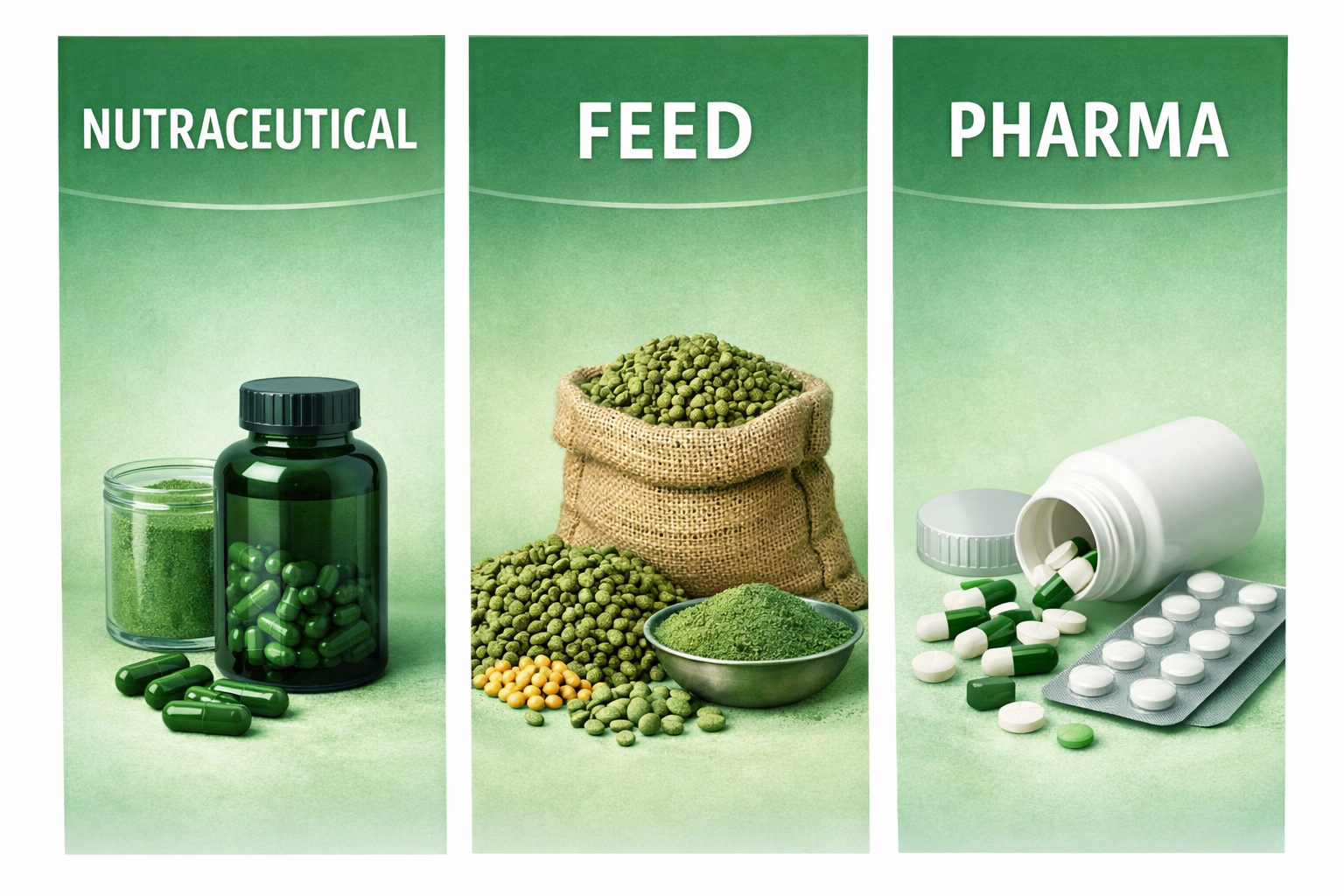
Global spirulina demand is often quoted as a single expanding market. In practice, spirulina demand behaves very differently across nutraceutical, feed, and pharmaceutical segments. Each segment operates under distinct price ceilings, quality thresholds, regulatory expectations, and volume dynamics.
Understanding these differences is critical for investors and producers, because demand growth in one segment does not translate automatically into opportunity in another. Many spirulina projects fail by targeting “global demand” without defining which demand they are actually capable of serving.
This article breaks down global spirulina demand by end-use segment and explains what the forecast really means for commercial producers.
Why Aggregated Spirulina Demand Numbers Are Misleading
Market reports frequently present spirulina demand as a unified CAGR-driven story. This masks structural differences between:
- Retail nutraceutical consumption
- Industrial feed inclusion
- Pharmaceutical-grade applications
Each segment values spirulina for different reasons and imposes different production constraints. Treating demand as interchangeable leads to overestimated revenue projections.
Nutraceutical Spirulina: High Visibility, Tight Quality Filters
The nutraceutical segment represents the most visible portion of global spirulina demand. It includes tablets, capsules, powders, and functional blends sold directly to consumers.
Demand drivers include:
- Wellness and immunity positioning
- Clean-label and plant-based trends
- E-commerce and private-label expansion
However, nutraceutical demand is constrained by strict quality expectations:
- Consistent pigment and protein content
- Validated shelf life
- Low microbial and heavy metal limits
- Reliable reliable packing systems performance
This segment rewards producers who invest in controlled systems such as standardized raceway ponds, efficient agitator systems, harvesting equipment, assisted dewatering systems, spirulina drying equipment, and packing systems.
Feed Spirulina: Volume Potential, Severe Price Pressure
Feed-grade spirulina is used in aquaculture, poultry, and specialty animal nutrition. While this segment offers higher volume potential, it operates under very different economics.
Characteristics include:
- Lower acceptable price per kilogram
- Reduced tolerance for CAPEX-heavy processing
- Limited justification for premium drying or packaging
Feed demand grows steadily but absorbs supply primarily from low-cost producers. Export-grade systems often struggle to compete here unless capacity is large and operating costs are optimised aggressively.
Pharmaceutical Spirulina: Small Volumes, Extreme Barriers
Pharmaceutical applications represent the smallest but most technically demanding segment.
Demand here is driven by:
- Isolated compounds (e.g., phycocyanin fractions)
- Clinical-grade traceability
- Regulatory compliance and documentation
Barriers include:
- GMP-level facility requirements
- Batch-level documentation
- Reproducible biochemical profiles
Only a small fraction of global spirulina producers can realistically access this segment. Demand exists, but it is not accessible without specialised infrastructure and compliance expertise.
Comparative Demand Reality Across Segments
| Segment | Demand Visibility | Volume Potential | Price Realisation | Quality Threshold | Producer Accessibility |
| Nutraceutical | High | Moderate | Medium–High | High | Selective |
| Feed | Low | High | Low | Moderate | Broad |
| Pharmaceutical | Very Low | Very Low | Very High | Extreme | Very Limited |
This table illustrates why “global demand growth” must always be interpreted through a segment lens.
Forecast Implications for Producers
From a commercial planning perspective:
- Nutraceutical demand favours standardized, export-grade systems with reliable stabilisation timelines
- Feed demand favours scale and cost efficiency over refinement
- Pharmaceutical demand favours documentation, repeatability, and regulatory depth
Producers attempting to straddle multiple segments often dilute system design and fail to meet any segment fully.
Investor Perspective: Demand Quality Matters More Than Demand Size
Investors do not chase aggregate demand curves – they assess whether a producer can meet the quality and consistency demanded by a specific segment.
Key investor questions include:
- Which segment is the system designed for?
- Are quality thresholds structurally achievable?
- Does stabilisation time align with segment expectations?
- Is pricing resilient or commoditised?
Projects aligned with nutraceutical demand tend to show the most balanced risk-return profile when systems are engineered correctly.
How Greenbubble Aligns System Design With Demand Reality
Greenbubble approaches spirulina projects by first clarifying target demand segments. System architecture – raceway ponds, efficient agitator systems, harvesting equipment, assisted dewatering systems, spirulina drying equipment, and packing systems – is then designed to meet the quality thresholds of that segment.
This demand-first approach ensures that projects delivered through spirulina farming consultancy and spirulina farming turnkey solutions are aligned with real, accessible demand rather than headline market numbers.
FAQs
Q1. Is nutraceutical spirulina demand saturated?
No, but entry barriers are rising due to quality expectations.
Q2. Can one farm serve all three segments?
Rarely. System design requirements differ significantly.
Q3. Is feed spirulina a safer entry market?
Only for producers optimised for cost and volume.
Q4. Why is pharmaceutical demand so limited?
Because compliance and consistency requirements are extremely high.
Q5. How should producers choose a target segment?
Based on system capability, not market hype.
Conclusion: Demand Must Match Capability
Global spirulina demand is real, but it is not uniform. Nutraceutical, feed, and pharmaceutical markets reward fundamentally different production strategies. Projects succeed when system design matches demand reality – not when demand forecasts are treated as generic opportunity.
Make us your source on Google
Table Of Contents