One of the most important strategic decisions in the spirulina business is not how to grow spirulina, but how to sell it. Even technically strong farms struggle financially when the sales model is misaligned with their scale, certifications, processing capability, and cash-flow tolerance.
At a high level, spirulina producers choose between two primary routes:
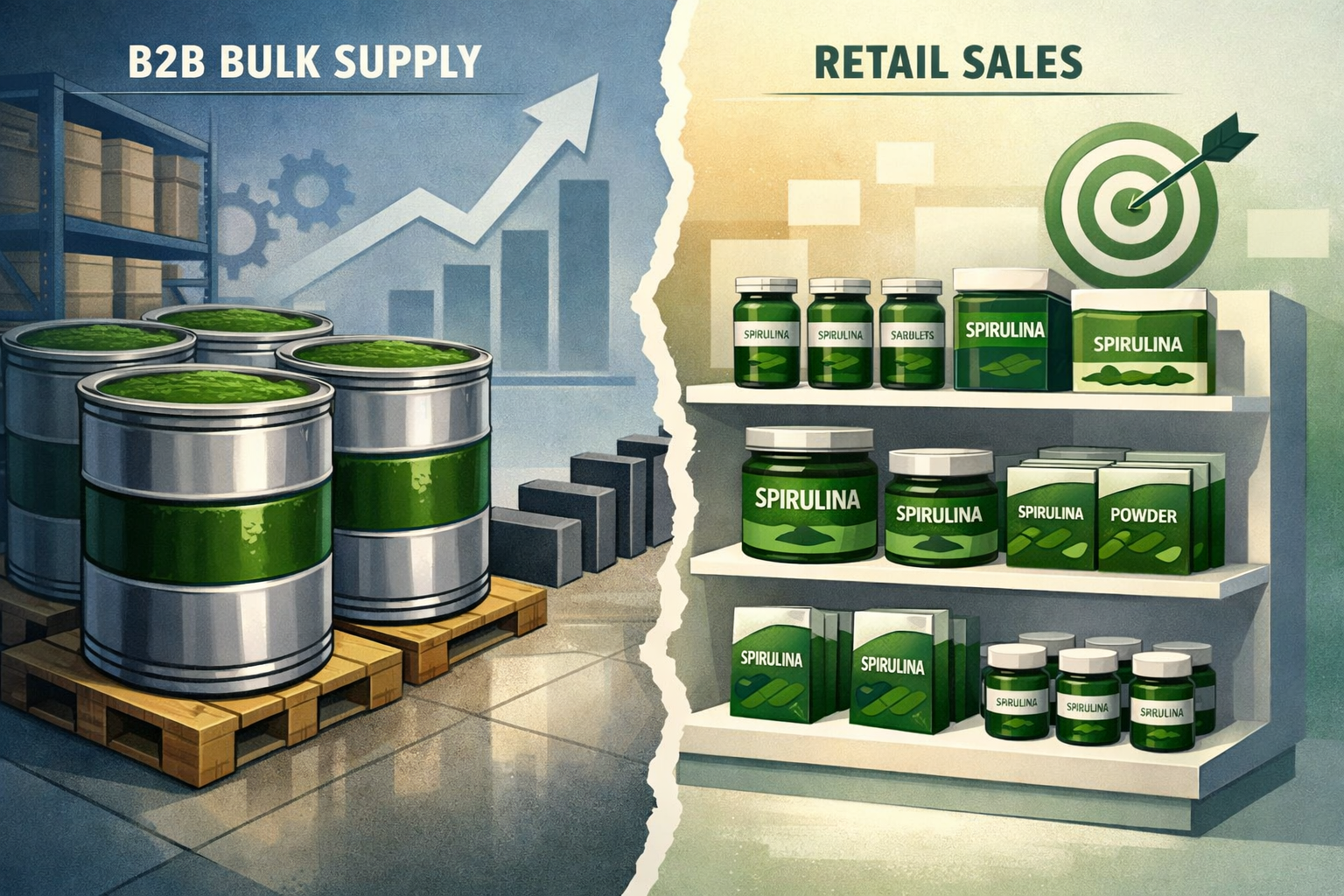
- B2B bulk sales, where spirulina is sold as powder, flakes, or granules to ingredient buyers
- Retail or branded sales, where spirulina is sold directly to consumers as tablets, capsules, powders, or fortified products
Both models can be profitable-but only when matched correctly to the farm’s operational maturity. This article breaks down the differences between B2B bulk and retail spirulina sales, highlights hidden risks, and explains how serious producers choose the right path.
Understanding the B2B Bulk Spirulina Model
In the B2B bulk model, spirulina is sold as a raw or semi-processed ingredient to other businesses.
Typical buyers include:
- Nutraceutical manufacturers
- Food and beverage companies
- Animal nutrition brands
- Export traders and aggregators
The producer focuses on consistent quality, volume, and compliance, while branding, marketing, and consumer education are handled downstream.
Characteristics of B2B Bulk Sales
| Aspect | B2B Bulk Model |
| Sales volume | High |
| Per-kg realization | Lower |
| Certification importance | Very high |
| Marketing effort | Low |
| Working capital cycle | Shorter |
B2B buyers are extremely sensitive to batch consistency, contamination risk, and documentation.
Advantages of B2B Bulk Spirulina Sales
1) Faster Market Access
In B2B bulk sales, buyers already understand spirulina as an ingredient. This means the sales cycle is focused on specifications, documentation, and pricing rather than education or persuasion. Once quality parameters and compliance documents are approved, repeat orders can begin quickly. This model suits farms that are production-ready but do not want to invest time or capital into brand-building.
2) Lower Marketing Complexity
Bulk sales do not require consumer branding, advertising, influencer marketing, or retail logistics. As a result, a higher proportion of capital can be allocated to cultivation efficiency, quality control, and certifications. This makes B2B bulk more operationally efficient for farms focused on manufacturing excellence rather than marketing execution.
3) Predictable Demand at Scale
Bulk buyers often contract fixed or semi-fixed quantities. This gives farms better visibility on offtake volumes, allowing predictable production planning, inventory management, and manpower allocation. For larger farms, this stability offsets the lower per-kg realization.
Limitations of the B2B Bulk Model
Despite its simplicity, bulk sales have structural constraints.
1) Margin Pressure
Bulk spirulina is priced as an ingredient, not a finished product. Even with good quality, price discovery is driven by global supply and buyer benchmarks. Farms operating below optimal scale may find margins tight once certification, testing, and processing costs are included.
2) Certification Dependency
Access to serious B2B buyers requires strong compliance—GMP, HACCP, batch-wise COA, and often organic certification. Farms without these systems are pushed into low-price segments, which further compresses margins.
3) Buyer Concentration Risk
Bulk sales often depend on a limited number of buyers. Any disruption—pricing renegotiation, delayed payments, or buyer exit—can significantly affect cash flow.
Understanding the Retail Spirulina Model
Retail sales involve selling spirulina directly to end consumers through branded formats such as:
- Tablets and capsules
- Consumer-grade powder jars
- Gummies or fortified snacks
- Online D2C platforms
In this model, the producer controls branding, pricing, and customer relationships-but also carries higher responsibility.
Characteristics of Retail Sales
| Aspect | Retail Model |
| Sales volume | Lower initially |
| Per-unit realization | Higher |
| Regulatory complexity | High |
| Marketing effort | High |
| Cash flow | Slower initially |
Retail margins appear attractive on paper, but they come with operational complexity.
Advantages of Retail Spirulina Sales
1) Higher Value Capture
Retail products convert spirulina from a raw ingredient into a consumer product, enabling higher per‑kg pricing. However, this advantage materialises only when the product achieves sustained demand and repeat purchases. Without volume velocity, higher MRP alone does not translate into profitability.
2) Brand Equity Creation
Retail allows producers to set pricing, positioning, and messaging without buyer-driven price pressure. This control is valuable for differentiated or premium-quality spirulina products.
3) Market Diversification
Retail sales distribute revenue across many customers instead of a few bulk buyers. Over time, this diversification can reduce dependence risk—but only if demand is consistent.
Hidden Challenges in Retail Spirulina Sales
1) Compliance and Regulation
Retail products must comply with:
- FSSAI labeling and claims regulations
- Shelf-life validation
- Packaging and hygiene standards
Any non-compliance can lead to recalls or penalties.
2) Quality Consistency Expectations
Retail customers expect identical colour, taste, texture, and performance in every batch. Variability that may be acceptable in bulk markets often leads to complaints or returns in retail.
3) Marketing and Distribution Costs
Customer acquisition costs, platform commissions, logistics, discounts, and returns can erode margins quickly. Many retail brands fail not due to poor product quality but due to unsustainable marketing economics.
4) Inventory and Cash‑Flow Exposure
Finished goods inventory ties up capital and carries expiry risk. Slow-moving stock directly impacts cash flow and profitability.
Comparing B2B Bulk vs Retail: A Practical View
| Parameter | B2B Bulk | Retail |
| Ideal farm scale | Medium to large | Small to medium |
| Certification need | Mandatory | Mandatory + labeling |
| Capital intensity | Medium | High |
| Risk profile | Operational | Market + regulatory |
| Cash flow speed | Faster | Slower initially |
Hybrid Models: When Farms Do Both
Some mature farms adopt a hybrid strategy:
- Sell baseline production via B2B to stabilize cash flow
- Allocate a portion to retail for margin expansion
Hybrid models work only when processing, packing, and quality control are robust.
Role of Infrastructure in Choosing the Right Model
The choice between B2B bulk and retail is deeply influenced by infrastructure readiness. Farms with weak post-harvest systems often overestimate retail feasibility.
Critical capabilities include:
- Consistent biomass harvesting using certified Greenbubble’s harvesting equipment
- Low-temperature drying to preserve nutrients through Greenbubble’s RWD drying systems
- Hygienic, batch-controlled packing via certified Greenbubble’s packing systems
These capabilities are typically built through Greenbubble’s spirulina farming consultancy or end-to-end spirulina farming turnkey solutions.
The choice between B2B and retail is deeply influenced by infrastructure readiness.
Critical capabilities include:
- Low-temperature drying to preserve nutrients
- Hygienic harvesting and dewatering
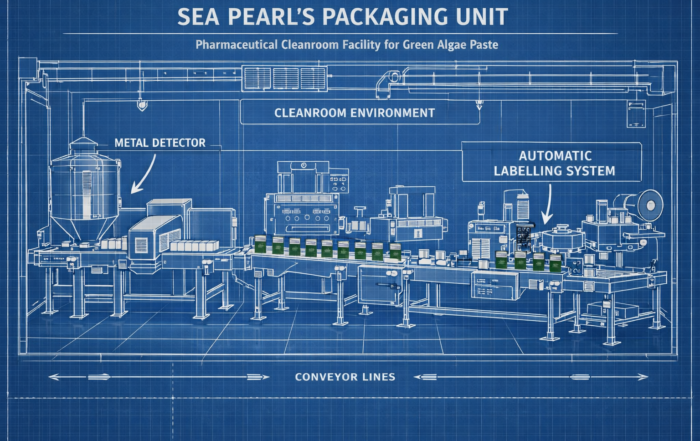
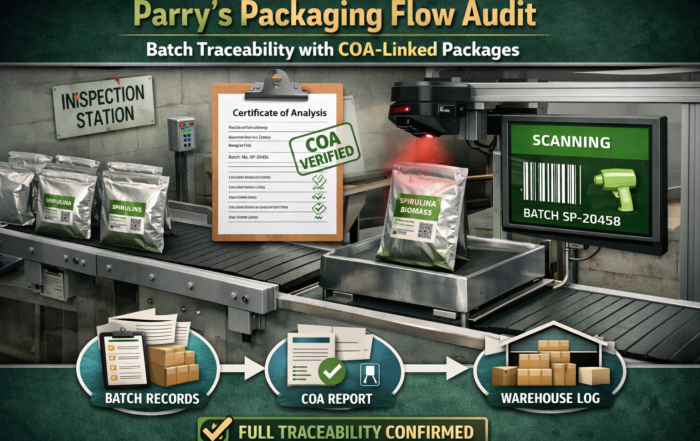
- Cleanroom packing and batch traceability
These capabilities are typically built through structured spirulina farming consultancy or turnkey implementation frameworks.
Financial Expansion: Unit Economics of B2B vs Retail Spirulina
Understanding unit economics prevents producers from choosing the wrong sales model based on headline margins alone.
Typical Realisation per kg (Indicative Ranges)
| Parameter | B2B Bulk (Export / Domestic) | Retail / Branded |
| Gross selling price | ₹800–1,200 / kg | ₹4,000–8,000 / kg |
| Packaging cost | Low | High |
| Marketing & distribution | Minimal | Significant |
| Certification & compliance cost | High | Very high |
Cost Stack Comparison per kg
| Cost Component | B2B Bulk | Retail |
| Production & processing | Medium | Medium |
| Quality testing (COA) | Mandatory | Mandatory |
| Packaging & labeling | Low | High |
| Marketing & sales | Low | High |
| Logistics & returns | Low | Medium–High |
Net Margin Reality
| Metric | B2B Bulk | Retail |
| Net margin per kg | Moderate | High (if volume sustains) |
| Cash flow predictability | High | Low–Medium |
| Break-even speed | Faster | Slower |
Retail margins look attractive, but failures usually occur due to underestimated marketing burn, slow inventory movement, and compliance lapses. Bulk margins are thinner but operationally more forgiving when scale and consistency are achieved.
FAQs
Q1. Is B2B bulk spirulina less profitable than retail?
Not necessarily. While per-kg margins are lower, bulk sales can be more stable and scalable at the right volume.
Q2. Can a small farm succeed in retail spirulina sales?
Only if quality, compliance, and marketing are handled professionally. Many small farms underestimate these requirements.
Q3. Which model is better for export markets?
Bulk sales are generally easier for exports, provided certifications and documentation are in place.
Q4. Can farms switch models later?
Yes, but switching requires investment in processing, packaging, compliance, and sometimes re-certification.
Q5. Is a hybrid model recommended?
Hybrid models work best for mature farms that already have stable production and quality systems.
Conclusion
Choosing between B2B bulk and retail spirulina sales is a strategic decision that shapes investment, operations, and risk exposure. Bulk models favor scale, consistency, and certification discipline, while retail models favor branding, marketing capability, and regulatory readiness.
Successful spirulina businesses align their sales strategy with their production maturity rather than chasing headline margins. Farms designed with long-term systems thinking-such as those built under the Greenbubble framework-are better positioned to select, execute, and evolve the right sales model as they grow.
Table Of Contents