Most spirulina producers obsess over what happens inside the farm. pH levels, harvest cycles, drying temperatures, phycocyanin percentages. They should focus on those things that matter enormously. But there is a different number that quietly determines whether a branded spirulina business survives: the margin that is still left by the time the product reaches the person who actually consumes it.
For most producers who launch their own brand without a clear distribution strategy, that number is far smaller than they expected. Often, it is negative.
The Premium Illusion
Here is the version of events that draws producers into branded spirulina. Bulk certified organic spirulina sells for ₹800-₹1,500 per kilogram. The same kilogram, encapsulated, labelled, and sold under a consumer brand at a health store or online, can retail for ₹4,000-₹8,000 or more. The margin looks transformative.
What that comparison omits is the entire chain of hands the product passes through between your packaging room and that consumer – and what each of those hands extracts.
A typical consumer health product moving through conventional distribution loses margin in layers. A national distributor takes 15-25%. A regional sub-distributor takes another 10-15%. A retail chain or pharmacy demands 30-40% margin on the shelf price. By the time you account for freight, returns, damaged stock, and payment cycles that can stretch 60-90 days, the producer’s effective realisation on a ₹500 bottle of spirulina capsules can be under ₹150. Against a production cost – including certified organic inputs, RWD drying, in-house lab testing, GMP-compliant packaging, and certification overheads – that is rarely under ₹120 per bottle at small volumes.
The premium exists. The producer rarely captures it.
Why Distribution Eats Spirulina Margins Specifically
Spirulina is not a forgiving product for traditional distribution channels. Several of its characteristics make margin erosion worse than for most health supplements.
Shelf life sensitivity. Properly dried and vacuum-sealed spirulina powder retains nutritional quality for 24 months under correct storage conditions. But that clock starts at packaging, not at retail. A product sitting in a distributor’s warehouse for three months, then a regional depot for two more, then on a pharmacy shelf for four months arrives at the consumer with less than a year of shelf life remaining. Returns of near-expiry stock come back to the producer. The distributor’s contract typically ensures that.
Cold chain and storage requirements. Premium spirulina – particularly products with high phycocyanin content – degrades faster when exposed to heat and humidity. Standard ambient warehousing used by most FMCG distributors in tropical climates is not adequate. Producers who do not specify and enforce storage conditions in their distribution agreements will see product quality complaints arrive six months after dispatch, traceable to a warehouse that stored stock at 38°C for two weeks.
Low consumer awareness in conventional retail. Unlike protein powder or multivitamins, spirulina still requires education at the point of sale in most Indian markets. A product sitting silently on a pharmacy shelf next to better-known supplements does not sell itself. Distributors do not invest in education. Retailers do not invest in it either. The producer must – which means marketing spend that was never factored into the margin calculation.
The Platforms That Promise Volume and Deliver Price Wars
Online marketplaces feel like the obvious alternative. No distributor. No retailer. Direct to consumer. Algorithms doing the work.
The reality is more complicated. Marketplace platforms – Amazon, Flipkart, health-focused D2C aggregators – extract margin through listing fees, fulfilment costs, advertising spend, and aggressive discounting pressure. A spirulina brand that is not investing in sponsored placements is invisible. One that is investing in sponsored placements is burning margin to acquire customers it does not own, on a platform that can change its algorithm or fee structure at any time.
The deeper problem is price anchoring. Once a spirulina product is listed on a marketplace alongside dozens of competitors – many of whom are selling uncertified or low-grade product at a third of the price – the consumer’s reference point for what spirulina costs is set by the cheapest option on the screen. Communicating why your USDA Organic certified, RWD-dried, in-house tested product is worth five times the price of a solar-dried competitor requires content, trust, and repeated exposure. Marketplaces optimise for transaction speed, not brand education.
What Distribution Control Actually Means
Distribution control does not mean selling exclusively from a website and hoping customers find it. It means deliberately designing the path from your packaging room to the end consumer such that margin is preserved and the brand story is not diluted at every handoff.
For spirulina producers, there are a few models that structurally protect margins better than conventional distribution.
Direct institutional sales. Hospitals, wellness clinics, corporate wellness programmes, nutraceutical formulators, and sports nutrition brands that want a white-label certified organic ingredient are buyers who will pay closer to production value, order in meaningful volumes, and require far less marketing overhead than retail. The sales cycle is longer, but the margin conversation is grounded in documented quality – your COA, your certifications, your traceability – rather than shelf positioning.
Subscription D2C. A producer who builds even a small base of direct subscribers – customers who receive monthly supply at a fixed price – owns that customer relationship entirely. No distributor fee, no marketplace commission, no returns policy dictated by a retail chain. Subscription economics also allow better production planning, which reduces waste and improves the economics of organic-compliant batch testing.
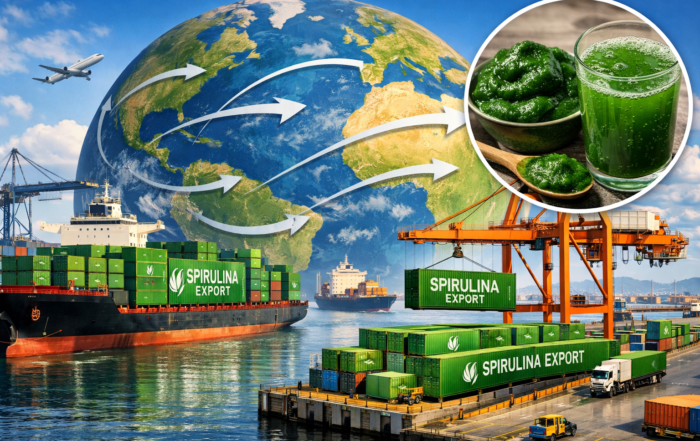
Export with margin agreements. International buyers in the US, EU, and Middle East purchasing certified organic spirulina for supplement manufacturing or food fortification are typically paying prices that reflect the true cost of certification-compliant production. These relationships require more upfront documentation – USDA Organic or EU Organic certification, full batch traceability, third-party lab verification – but they bypass the domestic distribution stack entirely.
The Margin Math That Producers Need to Run First
Before choosing a distribution channel, a spirulina producer building their own brand needs to calculate their minimum viable realisation per unit – the floor below which the brand cannot function without eroding the farm’s economics.
On a 3-acre certified farm with annual operating expenditure of approximately ₹1.05 crore and annual revenue target of ₹2 crore, the blended cost per kilogram of finished powder sits between ₹600 and ₹900 depending on yield consistency, rejection rates, and batch testing costs. Encapsulation, labelling, and GMP-compliant packaging add ₹80-₹150 per unit at small volumes. Certification amortised across branded SKUs adds further overhead.
Any distribution arrangement that delivers less than ₹180-₹220 per 60-capsule unit back to the producer – after all channel costs – is a business that requires the farm to subsidise the brand indefinitely. That is not a sustainable structure. It is a slow drain on the operation that was supposed to generate the cash flow in the first place.
The Real Competitive Advantage
Certified organic spirulina produced with automation, RWD drying, and rigorous in-house testing is genuinely differentiated. The COA proves it. The certification documents prove it. The farm infrastructure proves it. That differentiation has real value – but only if the producer controls enough of the path to market to actually charge for it.
Distribution control is not a sales strategy. It is the mechanism by which everything invested in production quality becomes margin rather than someone else’s profit. Without it, the premium is real. The producer just never sees it.
Make us your source on Google
Table Of Contents