Spirulina is frequently marketed as a high-margin, high-yield superfood business. As a result, business plans often present attractive numbers: rapid payback periods, strong EBITDA margins, low land requirement, and growing global demand.
However, when subjected to investor, lender, or institutional buyer due diligence, many spirulina business plans fail.
The failure is rarely due to lack of opportunity. It is due to weak assumptions, incomplete cost modeling, underestimated operational risks, and unrealistic scalability projections.
Due diligence evaluates structural viability – not optimism.
At Greenbubble, feasibility evaluation begins with engineering logic, cost realism, and operational risk mapping rather than theoretical yield projections.
1. Overestimated Yield Assumptions
One of the most common weaknesses in spirulina business plans is aggressive yield projection.
Typical flawed assumptions include:
- Ideal growth rates assumed year-round
- No allowance for seasonal variation
- Zero contamination losses
- No culture crash modeling
- Perfect nutrient balance scenarios
In reality, yield fluctuates due to:
- Temperature variation
- Sunlight intensity changes
- Nutrient imbalance
- Operational errors
- Equipment downtime
Investors discount plans that fail to incorporate realistic variance buffers.
2. Underestimated Energy Costs
Many business plans assume flat electricity pricing and ideal efficiency.
Common omissions:
- Agitation load variability
- Drying energy intensity
- Pumping and filtration energy
- Auxiliary systems consumption
Without optimized raceway ponds and calibrated efficient agitators, energy cost per kilogram can materially exceed projections.
Energy sensitivity modeling is often absent from small-scale feasibility reports.
3. Ignoring Compliance and Certification Costs
Export-grade spirulina requires certifications such as HACCP, GMP, ISO 22000, Organic, and sometimes Kosher or Halal.
Business plans frequently underestimate:
- Infrastructure modification costs
- Documentation system setup
- Audit and re-audit fees
- Laboratory testing expenses
- Consultant engagement
Facilities structured through spirulina farming turnkey solutions embed compliance early, reducing retrofit risk. However, plans that defer certification planning often face unexpected capital expenditure later.
Investors scrutinize regulatory preparedness carefully.
4. Unrealistic Pricing Assumptions
Many business plans rely on:
- Premium retail pricing
- Assumed export pricing without contracts
- No discount modeling for bulk buyers
In reality, spirulina pricing varies significantly based on:
- Quality grade
- Certification status
- Volume commitment
- Market saturation
Without signed offtake agreements, revenue assumptions remain speculative.
Due diligence requires realistic revenue modeling under conservative price scenarios.
5. Incomplete Cost Breakdown
Weak business plans often omit:
- Preventive maintenance allocation
- Equipment depreciation
- Packaging material escalation
- Freight and logistics
- Working capital cycle requirements
Hidden operating costs compound over time and alter break-even timelines.
Structured cost planning supported by spirulina farming consultancy improves financial modeling accuracy.
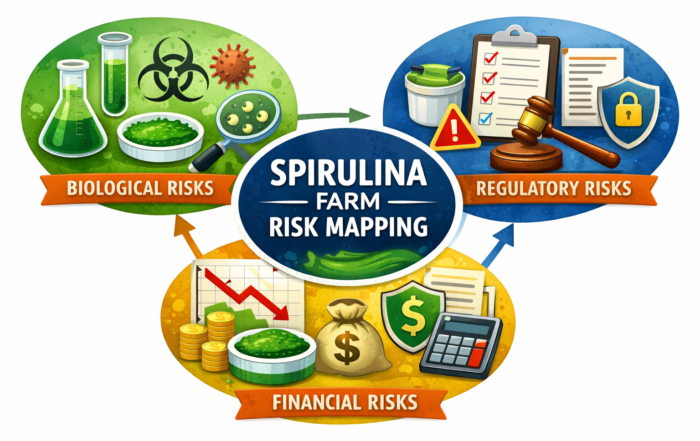
6. No Risk Buffer or Sensitivity Analysis
Sophisticated due diligence requires:
- Worst-case yield modeling
- Energy cost escalation scenarios
- Currency fluctuation exposure
- Raw material price volatility
- Contamination loss scenarios
Business plans that present only base-case projections signal weak financial rigor.
Investors expect sensitivity analysis across key variables.
7. Weak Scalability Strategy
Many plans assume that scaling is linear.
In practice, scaling introduces:
- Infrastructure redesign needs
- Additional compliance requirements
- Increased supervision complexity
- Marginal cost shifts
Without modular or engineered scaling pathways, expansion can disrupt production efficiency.
8. Absence of Market Validation
Common due diligence questions include:
- Who are your confirmed buyers?
- What grade specifications do they require?
- What volume commitments exist?
- What are the payment terms?
Plans based solely on projected demand without buyer validation lack credibility.
9. Weak Management and Technical Depth
Investors assess not only numbers but team capability.
Business plans often lack:
- Technical cultivation expertise
- Quality assurance leadership
- Regulatory experience
- Export logistics familiarity
Execution capability is as important as projected margins.
10. Due Diligence Red Flag Summary
| Area | Common Weakness | Investor Reaction |
| Yield | Over-optimistic projection | Discounted valuation |
| Energy | Underestimated cost | Margin skepticism |
| Compliance | No structured certification plan | High risk perception |
| Pricing | Retail-based assumption | Revenue doubt |
| Cost Modeling | Missing indirect costs | Financial credibility concern |
| Risk Analysis | No sensitivity modeling | Rejection or heavy discount |
| Market Validation | No buyer contracts | Funding hesitation |
Most spirulina plans fail not because the business is unviable – but because the modeling is incomplete.
11. What Strong Spirulina Business Plans Include
Investor-grade spirulina business plans typically demonstrate:
- Conservative yield projections
- Energy benchmarking data
- Certification roadmap and budget
- Signed or advanced-stage buyer discussions
- Sensitivity analysis tables
- Detailed capex and opex breakdown
- Working capital planning
- Scalable infrastructure design
Financial realism builds investor confidence.
Frequently Asked Questions
Q1. Why do investors reject spirulina business plans?
Because many plans rely on optimistic assumptions without risk modeling, realistic cost projections, or confirmed market demand.
Q2. What is the biggest due diligence weakness?
Overestimated yields and underestimated energy costs are among the most common red flags.
Q3. Do certifications impact investor confidence?
Yes. A structured certification roadmap significantly improves credibility and valuation strength.
Q4. Is spirulina still considered attractive by investors?
Yes, when supported by realistic projections, engineered infrastructure planning, and validated market access.
Q5. How can a spirulina plan become due-diligence ready?
By incorporating conservative modeling, compliance planning, sensitivity analysis, and professional operational design.
Conclusion
Most spirulina business plans fail due diligence not because the market opportunity is weak, but because assumptions are aggressive, risk modeling is shallow, and operational planning lacks engineering discipline.
Due diligence rewards realism, structured compliance, and defensible cost modeling.
Spirulina entrepreneurs who build their financial models on conservative yield estimates, realistic energy benchmarks, documented certification pathways, and validated buyer engagement significantly increase their probability of securing capital and long-term commercial success.
Make us your source on Google
Table Of Contents