Certification audits are a critical gateway for spirulina producers seeking access to export markets, institutional buyers, nutraceutical brands, and pharmaceutical supply chains. Certifications such as HACCP, GMP, ISO 22000, FSSAI, Organic, and Kosher or Halal are often mandatory for commercial-scale business.
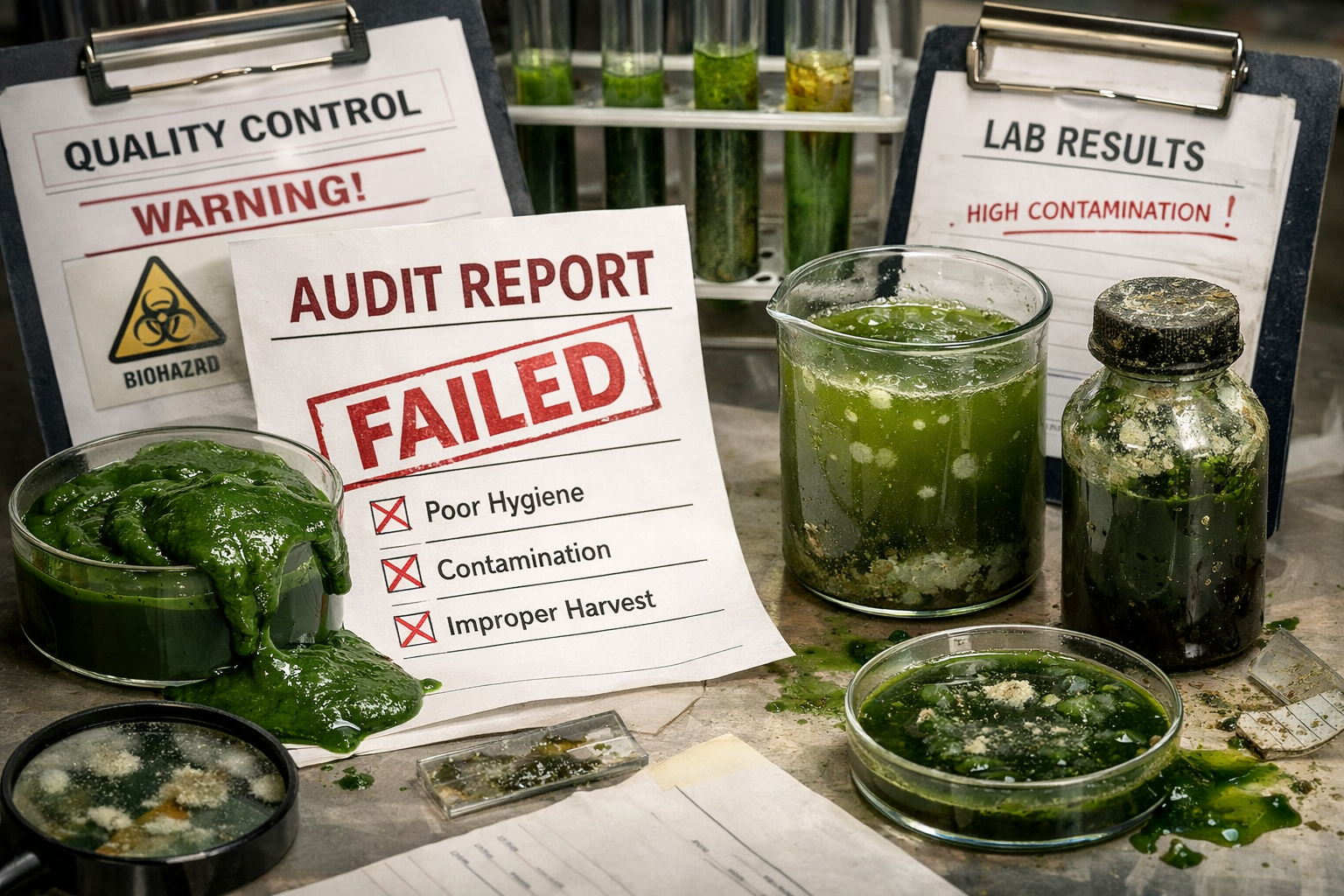
However, many manual or semi-structured spirulina farms consistently fail these audits. The root cause is not product quality alone, but the absence of standardized processes, documentation, traceability, and controlled infrastructure.
Manual operations rely heavily on human intervention, informal practices, and undocumented procedures – conditions that are fundamentally incompatible with modern certification requirements.
At Greenbubble, engineered spirulina production systems are designed for audit readiness from day one, ensuring that hygiene, traceability, process control, and documentation align with global certification standards.
1. Lack of Standard Operating Procedures (SOPs)
Certification bodies require clearly documented and consistently followed Standard Operating Procedures for every critical activity, including:
- Pond preparation and inoculation
- Nutrient dosing and monitoring
- Harvesting and dewatering
- Drying and packaging
- Cleaning and sanitation
- Equipment maintenance
Manual farms often rely on operator experience rather than written SOPs. Even when SOPs exist, they are inconsistently followed or poorly documented, leading to major non-conformities during audits.
2. Poor Traceability and Batch Control
Traceability is a cornerstone of food and nutraceutical certifications. Auditors expect complete backward and forward traceability for every batch, including:
- Raw material sources
- Production dates and pond identification
- Processing and drying records
- Packaging and dispatch details
Manual farms typically lack structured batch coding systems and digital or well-maintained manual records. When auditors request traceability verification, these farms are often unable to reconstruct complete production histories, resulting in critical audit failures.
3. Inadequate Hygiene and Zoning Controls
Certifications such as GMP, ISO 22000, and HACCP require strict zoning and hygiene segregation, including:
- Clear separation of raw, processing, and finished goods areas
- Controlled personnel movement
- Dedicated changing rooms and sanitation stations
- Pest control systems
Manual spirulina farms frequently operate in open or loosely controlled environments where cultivation, harvesting, drying, and packaging areas overlap. Properly designed raceway ponds support controlled cultivation environments that integrate seamlessly with hygienic zoning and compliant material flow. This lack of hygienic zoning leads to high contamination risk and immediate audit non-compliance.
4. Uncontrolled Drying and Processing Conditions
Drying is a critical control point in spirulina production. Certification bodies require:
- Controlled temperature and humidity
- Documented drying parameters
- Food-grade equipment and surfaces
- Protection from environmental contaminants
Manual drying methods – such as open sun drying or poorly enclosed systems – expose spirulina to dust, insects, microbes, and foreign matter. Certification-compliant facilities rely on enclosed, food-grade spirulina drying equipment that ensures controlled temperature, hygiene, and full process documentation. Additionally, the absence of recorded process parameters makes validation impossible during audits.
5. Inconsistent Documentation and Record-Keeping
Audits are evidence-driven. If an activity is not documented, it is treated as not having occurred.
Manual farms often struggle with:
- Incomplete or missing records
- Backdated or inconsistent entries
- Lack of calibration logs for instruments
- Missing cleaning and sanitation records
- Absence of training documentation
These documentation gaps frequently result in major or critical non-conformities, even when actual practices are reasonably sound.
6. Weak Hazard Analysis and Critical Control Point (HACCP) Implementation
HACCP certification requires a structured approach to identifying and controlling biological, chemical, and physical hazards. Manual farms typically face challenges such as:
- Incomplete hazard identification
- Undefined Critical Control Points (CCPs)
- Absence of monitoring limits and corrective actions
- Poor validation and verification practices
Without a robust HACCP plan supported by real-time monitoring and records, certification bodies cannot validate food safety control, leading to audit failure. Structured SOP and HACCP implementation is often accelerated through expert support from spirulina farming consultancy aligned with global certification standards.
7. Inadequate Infrastructure and Material Flow Design
Audit-compliant spirulina facilities require well-planned infrastructure, including:
- Food-grade contact surfaces
- Smooth, cleanable walls and floors
- Controlled drainage systems
- Logical material and personnel flow
Manual farms often operate in retrofitted or makeshift facilities that do not support hygienic design principles. Structural limitations – such as poor drainage, cross-movement of materials, and non-food-grade surfaces – are difficult to correct without significant redesign.
8. Lack of Equipment Calibration and Validation
Certifications require periodic calibration and validation of critical equipment such as:
- Thermometers and temperature sensors
- Weighing scales
- pH meters and laboratory instruments
Manual farms frequently lack calibration schedules, certificates, and records. This undermines the reliability of process data and results in audit non-conformities.
9. Insufficient Training and Competency Records
Auditors evaluate not only systems but also the competence of personnel. Manual farms often fall short in:
- Structured training programs
- Food safety and hygiene training
- Documentation of training attendance and effectiveness
- Defined roles and responsibilities
Without verifiable training records, auditors cannot confirm that staff are qualified to perform critical operations safely and consistently.
10. Weak Supplier Control and Raw Material Documentation
Certification standards require documented approval and monitoring of suppliers for nutrients, packaging materials, and other inputs. Manual farms often lack:
- Approved supplier lists
- Supplier evaluation records
- Certificates of analysis (COAs) and compliance documents
This creates traceability and quality assurance gaps that auditors classify as significant risks.
11. Common Audit Non-Conformities in Manual Spirulina Farms
| Area | Typical Issue | Audit Impact |
| Documentation | Missing or inconsistent records | Major non-conformity |
| Traceability | Incomplete batch tracking | Critical non-conformity |
| Hygiene | Poor zoning and sanitation | Major to critical |
| Drying | Uncontrolled open drying | Critical non-conformity |
| HACCP | Weak or poorly implemented plan | Major non-conformity |
| Calibration | No calibration records | Major non-conformity |
| Training | No documented training | Major non-conformity |
| Infrastructure | Non-food-grade or poorly designed areas | Major non-conformity |
A combination of these issues typically results in certification denial or suspension.
12. How Engineered Systems Enable Audit Success
Audit success is not achieved through documentation alone – it requires infrastructure and processes designed for compliance. Structured spirulina facilities incorporate:
- Hygienic zoning and controlled workflows
- Closed or protected drying environments
- Standardized SOPs and digital or structured records
- Robust traceability and batch coding systems
- Integrated HACCP and quality management systems
Greenbubble’s engineered approach aligns facility design, equipment selection, and operational protocols with global certification requirements, significantly improving first-time audit success rates. Consistent cultivation conditions supported by efficient agitators further enhance process control, traceability, and GMP compliance.
13. Transitioning from Manual to Audit-Ready Operations
Manual spirulina farms can successfully transition to certification-ready status through a structured approach:
Step 1: Gap Assessment
Evaluate current practices against HACCP, GMP, ISO 22000, or Organic standards.
Step 2: Infrastructure Upgrades
Implement hygienic zoning, enclosed drying systems, and food-grade processing areas, often streamlined through turnkey spirulina farming solutions that integrate compliant infrastructure and workflows from the design stage.
Step 3: SOP and HACCP Development
Create and validate SOPs, hazard analyses, CCPs, and corrective action procedures.
Step 4: Documentation and Traceability Systems
Introduce batch coding, record-keeping formats, and calibration and maintenance logs.
Step 5: Training and Internal Audits
Train staff regularly and conduct internal audits to ensure sustained compliance.
Frequently Asked Questions
Q1. Why do manual spirulina farms fail certification audits even with good product quality?
Because certifications evaluate systems, documentation, hygiene, and traceability – not just product quality. Manual operations typically lack the structured controls required.
Q2. Is sun-drying spirulina acceptable for certification?
Generally no for export-oriented food and nutraceutical certifications, as it lacks environmental control and contamination protection required by GMP and HACCP standards.
Q3. Can small spirulina farms achieve certifications like HACCP and GMP?
Yes, but they must adopt standardized processes, hygienic infrastructure, proper documentation, and traceability systems.
Q4. What is the most common reason for audit failure?
Incomplete documentation and lack of traceability are among the most frequent and critical causes of audit failure.
Q5. How long does it take to become certification-ready?
With proper guidance and infrastructure alignment, farms can typically achieve audit readiness within 3 to 9 months, depending on their starting point.
Conclusion
Manual spirulina farms fail certification audits not because spirulina is difficult to certify, but because informal processes, inadequate infrastructure, weak documentation, and poor traceability do not meet modern food and nutraceutical compliance standards.
Certification success requires an engineered approach that integrates hygienic design, standardized procedures, robust documentation, and disciplined quality systems. For spirulina producers targeting export and institutional markets, transitioning from manual practices to structured, audit-ready operations is not optional – it is a fundamental requirement for sustainable commercial growth.
Make us your source on Google
Table Of Contents