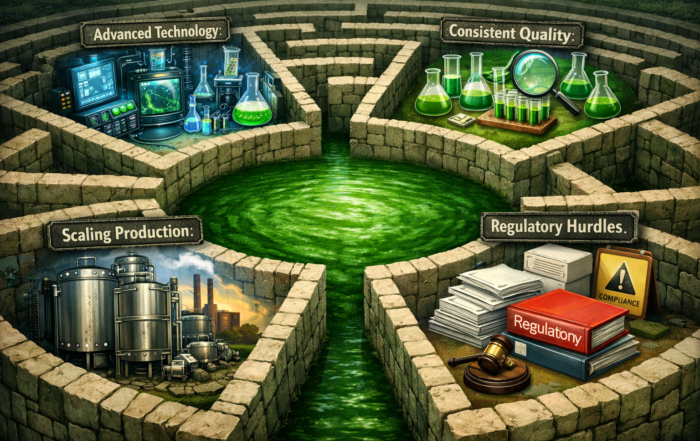
Many spirulina farms focus heavily on cultivation capacity – expanding pond area, improving growth rates, and optimizing biomass density. While upstream productivity is important, scalability failures often occur downstream.
In commercial spirulina production, downstream infrastructure – not pond size – ultimately determines how far a farm can grow.
Harvesting, dewatering, drying, quality control, packaging, and documentation systems form the throughput ceiling of the business. When these systems are under-designed, even high biomass output cannot translate into increased revenue.
At Greenbubble, scalable spirulina production is designed with downstream capacity aligned to projected expansion from the beginning.
1. Harvesting Capacity Constraints
As cultivation area increases, harvesting frequency and volume increase proportionally.
Common bottlenecks include:
- Slow filtration systems
- Manual harvesting inefficiencies
- Inconsistent slurry concentration
- Limited harvesting windows
When harvesting cannot keep pace with biomass growth, operators are forced to delay collection. Delayed harvesting leads to:
- Reduced biomass quality
- Pigment degradation
- Overgrowth stress
- Yield loss
Scalable farms align harvesting capacity with peak biomass output rather than average output.
2. Dewatering Limitations
After harvesting, spirulina slurry must be dewatered efficiently before drying.
Under-capacity dewatering systems create:
- Backlog accumulation
- Extended holding time
- Increased microbial exposure risk
- Quality variability
If slurry sits too long before drying, nutrient degradation accelerates.
Dewatering throughput must match daily harvest volume at full-scale production – not pilot-scale levels.
3. Drying as the Primary Scalability Constraint
Drying is the most common downstream bottleneck.
Small farms often install drying systems sized only for initial production. When cultivation expands, drying infrastructure becomes insufficient.
Symptoms include:
- Biomass queue buildup
- Inconsistent moisture levels
- Nighttime overload operation
- Emergency drying improvisation
Commercial-grade spirulina drying equipment must be sized for future capacity targets, not just current output.
Drying capacity determines how much finished product can be produced per day. If drying cannot scale, revenue cannot scale.
4. Quality Control and Laboratory Throughput
As output volume increases, quality testing requirements increase proportionally.
Bottlenecks appear in:
- Microbial testing capacity
- Moisture validation
- Heavy metal screening
- Batch documentation review
Institutional and export buyers demand batch-level traceability and testing consistency. Without scalable QA infrastructure, farms risk shipment delays and audit non-conformities.
5. Packaging and Finishing Constraints
Packaging systems designed for small volumes often struggle when production increases.
Constraints include:
- Limited sealing capacity
- Manual filling variability
- Labeling compliance delays
- Bulk packing inefficiency
When packaging lags behind drying, finished inventory accumulates without shipment readiness. Cash flow slows despite high production.
6. Documentation and Compliance Lag
Higher production volume increases documentation workload:
- Batch records
- Cleaning logs
- Calibration records
- Shipment documentation
- Export paperwork
Manual systems that worked at small scale become unmanageable at larger scale. Documentation lag can delay shipments and trigger compliance risk.
Facilities structured through spirulina farming turnkey solutions integrate scalable documentation workflows aligned with production growth.
7. Energy Infrastructure Saturation
Downstream expansion increases energy demand significantly, especially during drying.
If electrical infrastructure is undersized, farms encounter:
- Voltage instability
- Generator dependency
- Forced staggered operations
- Equipment stress
Energy planning must anticipate downstream load growth over multi-year expansion phases.
8. Cold Storage and Inventory Management Gaps
If finished product accumulates faster than shipment cycles, storage limitations emerge.
Risks include:
- Moisture reabsorption
- Quality degradation
- Packaging damage
- FIFO tracking failures
Inventory planning must scale with throughput.
9. The Throughput Ceiling Effect
Scalability is determined by the slowest downstream process.
Even if cultivation doubles, revenue will not increase unless:
- Harvesting capacity doubles
- Dewatering capacity doubles
- Drying throughput doubles
- Packaging throughput doubles
If any one stage remains fixed, it becomes the throughput ceiling.
10. Downstream Bottleneck Impact Summary
| Downstream Stage | Bottleneck Risk | Scalability Impact |
| Harvesting | Slow filtration | Reduced quality & yield |
| Dewatering | Backlog accumulation | Microbial risk |
| Drying | Insufficient capacity | Revenue ceiling |
| QA Testing | Lab overload | Shipment delay |
| Packaging | Manual filling | Cash flow slowdown |
| Documentation | Record backlog | Audit risk |
| Energy Supply | Infrastructure saturation | Forced output cap |
Downstream limitations silently constrain growth long before pond area becomes limiting.
11. Designing for Scalable Throughput
To prevent downstream bottlenecks, farms should:
- Size drying systems for projected 3–5 year output
- Align harvesting and dewatering rates with peak production
- Implement preventive maintenance schedules
- Integrate modular packaging systems
- Build documentation workflows that scale with volume
- Conduct annual throughput audits
Strategic planning supported by spirulina farming consultancy ensures downstream readiness before expansion capital is deployed.
Frequently Asked Questions
Q1. Why do spirulina farms struggle after expanding pond area?
Because downstream systems like drying and packaging were not expanded proportionally.
Q2. What is the most common scalability bottleneck?
Drying capacity is typically the primary throughput constraint.
Q3. Can downstream systems be upgraded later?
Yes, but retrofitting during active production disrupts operations and increases capital cost.
Q4. How can farms identify bottlenecks early?
Through throughput mapping, peak-load modeling, and expansion planning before capacity constraints appear.
Q5. Does downstream design affect export readiness?
Yes. Inconsistent drying, weak QA capacity, and documentation lag directly affect buyer confidence and compliance outcomes.
Conclusion
Spirulina scalability is not determined by how much biomass can be grown – it is determined by how efficiently that biomass can be processed, tested, packed, and delivered.
Downstream bottlenecks create invisible ceilings that prevent farms from converting biological productivity into commercial growth.
Engineered downstream capacity, modular expansion planning, and structured throughput modeling transform spirulina operations from cultivation-focused farms into scalable commercial manufacturing systems.
Make us your source on Google
Table Of Contents