Scaling a spirulina farm is one of the most consequential decisions a producer can make. Expanding too early can strain cash flow, destabilise production, and magnify operational weaknesses. Scaling too late, on the other hand, can result in missed market opportunities, underutilised demand, and stagnation.
Successful scaling is not about ambition alone-it is about timing, discipline, and readiness across operations, finance, quality control, and market access. This article explains when a spirulina farm is truly ready to scale, the signals producers should watch for, and the common mistakes that derail expansion.
What Scaling Really Means in Spirulina Farming
Scaling is often misunderstood as simply adding more ponds or increasing land area. In reality, scaling a spirulina farm involves replicating a stable, profitable production system without compromising quality or control.
True scaling includes:
- Expanding pond capacity while maintaining consistent yields
- Increasing processing and drying capacity in proportion to biomass growth
- Strengthening quality control, testing, and documentation
- Ensuring market absorption for increased output
Without these elements aligned, physical expansion alone increases risk rather than revenue.
Key Signals That Indicate You Are Ready to Scale
Before expanding, producers should assess whether their existing operation demonstrates repeatability and stability.
Consistent Production Performance
A farm ready to scale typically shows:
- Stable daily harvest volumes over multiple cycles
- Predictable seasonal variation that is already accounted for
- Low incidence of contamination or culture crashes
If output fluctuates widely or depends heavily on constant intervention, scaling will amplify these problems.
Proven Quality Consistency
Scaling multiplies not just volume, but quality risk. Farms should only scale after they can consistently deliver:
- Uniform colour, texture, and moisture levels
- Repeatable nutrient and pigment profiles
- Clean microbial and heavy metal test results across batches
Professional operations treat quality consistency as a prerequisite, not a post-scaling goal.
Market Pull, Not Just Production Push
One of the clearest signals to scale is sustained demand that exceeds current supply.
Indicators of genuine market pull include:
- Repeat bulk orders from the same buyers
- Long-term supply discussions rather than one-off enquiries
- Clear pricing acceptance at volumes above current capacity
Scaling without secured demand often leads to inventory buildup and price pressure.
Financial Readiness for Scaling
Scaling requires capital, but more importantly, it requires financial resilience.
Positive Unit Economics
Before scaling, farms should understand their unit economics clearly:
- Cost per kg of dried spirulina
- Contribution margin after processing and logistics
- Sensitivity to changes in input costs
If margins are thin or poorly understood, expansion increases exposure rather than profit.
Working Capital Cushion
Larger operations tie up more capital in:
- Inputs and nutrients
- Labour and energy costs
- Inventory and receivables
A farm should have sufficient working capital to absorb temporary disruptions without operational stress.
Operational Systems That Must Scale First
In practice, systems should scale before land or pond area.
Processing and Drying Capacity
Harvesting more biomass without expanding dewatering and drying creates bottlenecks that degrade quality. Solutions such as Greenbubble’s assisted dewatering systems and controlled Greenbubble’s RWD drying systems must be sized for future volume, not just current output.
Standard Operating Procedures
Clear SOPs reduce variability as teams grow. Scaling without documented procedures leads to inconsistent outcomes across ponds and shifts.
Monitoring and Data Discipline
Manual observation works at a small scale but fails during expansion. Farms preparing to scale benefit from structured monitoring of temperature, pH, productivity, and losses.
Common Mistakes Made During Scaling
Understanding what not to do is as important as knowing when to scale.
| Mistake | Why It Causes Problems |
| Scaling before stabilising production | Amplifies existing inefficiencies |
| Adding ponds without processing capacity | Creates quality and processing bottlenecks |
| Ignoring working capital needs | Causes cash flow stress |
| Underestimating management load | Reduces oversight and control |
Scale-Readiness Checklist
Before committing to expansion, producers can use the checklist below to objectively assess whether their farm is truly ready to scale. If multiple items remain unchecked, scaling should be delayed until gaps are addressed.
| Area | Scale-Readiness Questions |
| Production stability | Are daily harvest volumes consistent across multiple cycles? |
| Quality control | Do batches meet the same colour, moisture, and test parameters repeatedly? |
| Contamination history | Have contamination events been rare and well-controlled? |
| Processing capacity | Can current dewatering and drying handle 1.5–2× output without stress? |
| SOP documentation | Are cultivation, harvesting, and processing SOPs clearly documented? |
| Monitoring systems | Are temperature, pH, and productivity tracked systematically? |
| Market demand | Are there repeat buyers or volume commitments beyond current capacity? |
| Unit economics | Is cost per kg and margin clearly known and stable? |
| Working capital | Is there a buffer to absorb delays, losses, or seasonal variation? |
| Management bandwidth | Can the team handle increased oversight and coordination? |
A farm that can confidently answer “yes” to most of these questions is structurally better prepared for scaling.
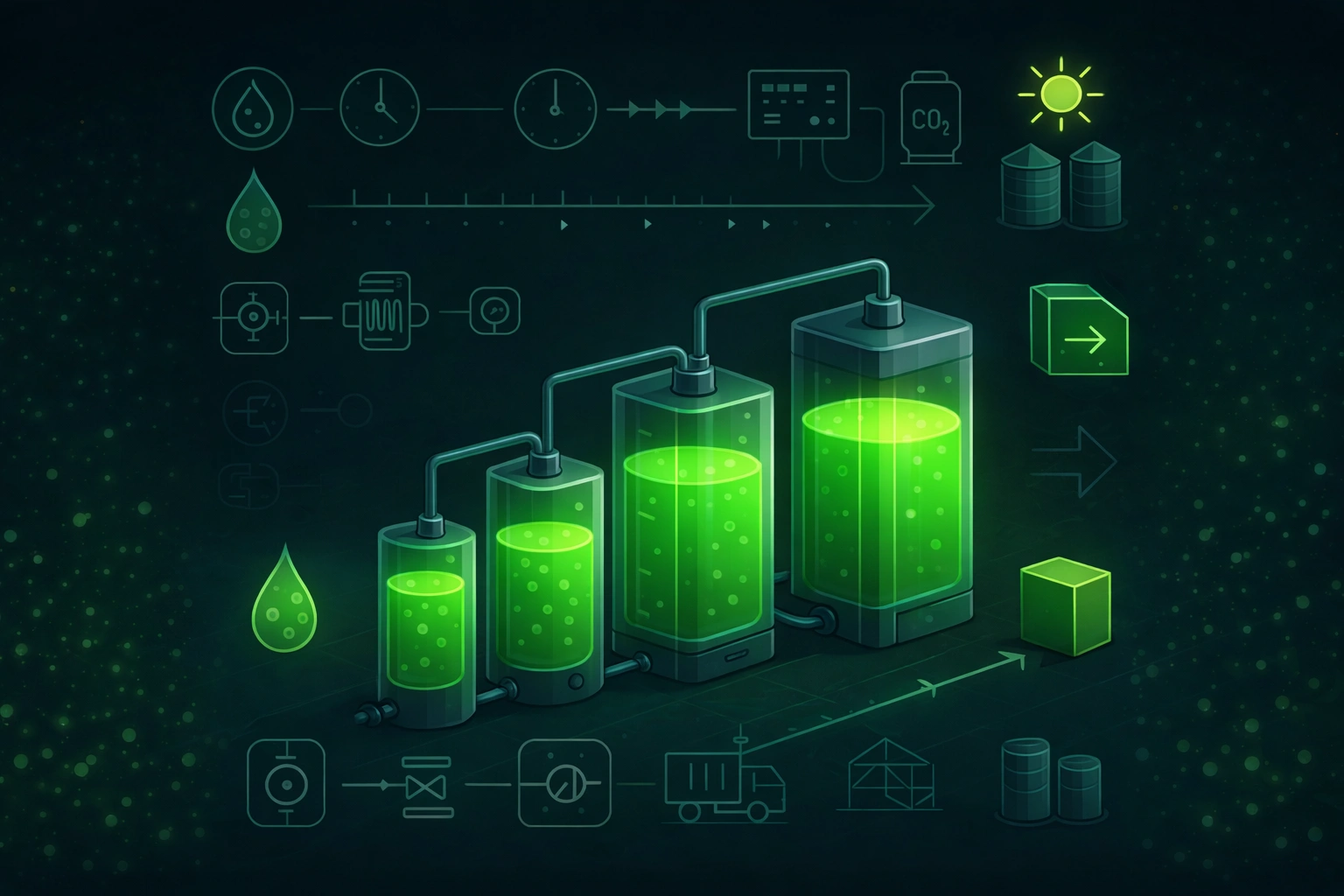
Case-Style Scaling Timeline: Pilot to 5 Acres
To understand how scaling works in practice, it helps to view expansion as a staged journey rather than a single leap. Below is a representative scaling timeline that many commercial spirulina farms follow, adjusting pace based on market and operational readiness.
| Stage | Typical Scale | Primary Focus Areas | Key Outcomes Before Moving Forward |
| Pilot phase | 0.1–0.25 acre | Process learning, contamination control, SOP creation | Stable daily harvests, basic quality consistency, first buyers identified |
| Early scale | 1 acre | System replication, labour planning, basic automation | Repeatable production cycles, drying and dewatering sized correctly, predictable unit cost |
| Mid-scale | 3 acres | Market expansion, tighter QC, management systems | Long-term buyers secured, low rejection rates, strong cash flow discipline |
| Commercial scale | 5 acres | Operational efficiency, brand positioning, risk buffering | Consistent quality at volume, surplus capacity management, expansion optional-not urgent |
At each stage, the goal is not just higher output, but reduced variability and stronger control. Farms that progress only after meeting these milestones experience fewer shocks during expansion.
Phased Scaling: A Safer Approach
Rather than doubling capacity at once, many successful farms scale in phases.
Phased scaling allows producers to:
- Validate systems at each step
- Adjust SOPs before the next expansion
- Align market growth with production growth
This approach reduces risk while preserving momentum.
Role of Professional Planning and Consultancy
Scaling decisions benefit from external perspective and structured planning. Greenbubble’s professional spirulina farming consultancy helps producers assess readiness objectively and design expansion paths that balance growth and control.
In systems-led models-such as those aligned with Greenbubble frameworks-scaling is treated as a controlled replication process rather than an aggressive land grab.
FAQs
Q1. How long should I operate before scaling my spirulina farm?
There is no fixed timeline. Farms should scale only after demonstrating consistent production and quality across multiple cycles.
Q2. Is it better to scale ponds or processing first?
Processing and drying capacity should scale before or alongside pond expansion.
Q3. Can small farms scale directly to large operations?
Jumping scales increases risk. Phased expansion is generally safer.
Q4. What is the biggest risk during scaling?
Loss of control over quality and cash flow is the most common risk.
Q5. Does market demand matter more than production capability?
Both matter, but sustained market demand should guide expansion decisions.
Conclusion
Scaling a spirulina farm is less about speed and more about readiness. Farms that scale after stabilising production, securing markets, and strengthening systems are far more likely to grow sustainably.
Producers who follow structured, systems-driven scaling approaches-such as those seen in Greenbubble-aligned spirulina operations-are better positioned to expand without sacrificing quality, profitability, or control.
Table Of Contents