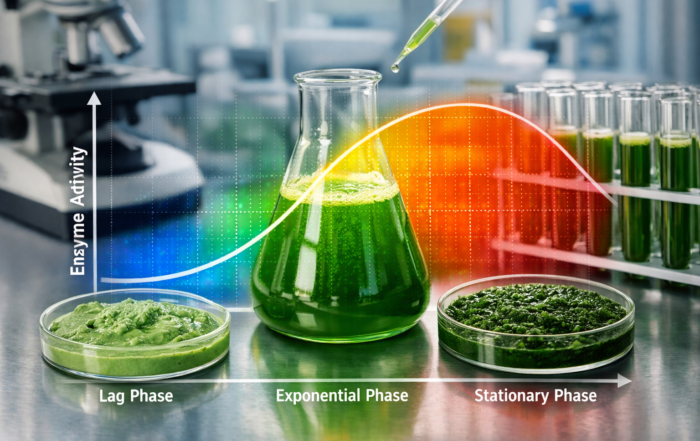
In long-term spirulina farming, not all performance decline is caused by contamination, nutrient imbalance, or poor climate control. Even under stable operating conditions, spirulina cultures undergo biological aging-a process known as senescence. Culture aging is gradual, predictable, and often misunderstood, yet it plays a decisive role in long-term yield stability and nutritional consistency.
This article looks at spirulina senescence through a lifecycle lens, examining how cultures change over time, how aging manifests operationally, and how commercial farms manage aging without relying on crisis-driven resets.
Senescence Is Not Failure: Reframing Culture Aging
Senescence does not imply that a spirulina culture is unhealthy or contaminated. It reflects a natural shift in cellular behaviour as populations undergo repeated division cycles under sustained selective pressure.
In large-scale systems designed by Greenbubble, senescence is treated as a known biological trajectory, not an unexpected failure mode. The goal is not to eliminate aging, but to recognise and manage it before value erosion begins.
Early-Life Phase: High Plasticity and Rapid Adaptation
During early culture life, spirulina exhibits high metabolic flexibility. Cells respond quickly to nutrient inputs, light changes, and harvesting interventions. Growth rates are strong, recovery after harvest is rapid, and nutritional density is typically high.
This phase is often mistaken for a permanent performance baseline. In practice, it represents a temporary window of maximal responsiveness.
Mid-Life Phase: Stabilisation and Predictability
As cultures mature, growth becomes more predictable but less elastic. Enzyme activity stabilises, stress tolerance improves, and response to intervention slows slightly. Yield remains strong, but adaptive traits begin to dominate over expressive traits such as pigment and protein synthesis.
Greenbubble-operated farms treat this phase as the optimal commercial window, where consistency, predictability, and controlled output matter more than peak growth rates.
Late-Life Phase: Onset of Functional Senescence
In aging cultures, cellular division continues, but efficiency declines. Senescent populations prioritise maintenance over synthesis, leading to gradual reduction in protein percentage, pigment intensity, and recovery efficiency.
Importantly, biomass output may remain stable for extended periods, masking underlying quality erosion. Without trend-based monitoring, farms often discover senescence only after downstream value declines.
Operational Signals of Culture Aging
Culture aging is best identified through patterns, not single metrics. Common indicators include:
- Longer recovery time after harvest
- Declining protein percentage with stable yield
- Reduced responsiveness to nutrient adjustments
- Increasing COA variability across batches
- Narrowing performance margin under stress
These signals often overlap with genetic drift or adaptive strain behaviour, making misdiagnosis common.
Role of System Design in Aging Dynamics
System design influences how quickly senescence manifests. High-density operation, aggressive harvesting, and repeated stress events accelerate aging. Farms using automated and well-calibrated harvesting equipment are better able to control harvest intensity and avoid premature senescence caused by over-extraction.
Engineered raceway pond systems combined with uniform circulation via efficient agitator systems reduce micro-stress accumulation that hastens senescence.
In Greenbubble-designed farms, aging rate is considered during layout, depth selection, and circulation planning rather than treated as an afterthought.
Aging Versus Genetic Drift: Where Farms Get Confused
While genetic drift alters population characteristics, senescence affects cellular efficiency across the population. Drift changes what the culture is; senescence changes how well it performs.
Both can coexist, but senescence progresses even in genetically stable cultures. Treating all decline as drift often leads to unnecessary reinoculation when process-level adjustments would suffice.
Numerical Benchmarks for Detecting Senescence
Rather than relying on lab-intensive analysis, experienced farms track aging through comparative metrics:
| Benchmark Indicator | What Changes With Aging | Practical Interpretation |
| Recovery time | Gradual increase | Reduced cellular efficiency |
| Protein % trend | Slow downward drift | Senescent metabolism |
| Harvest-to-dry ratio | Lower dry recovery | Maintenance-dominated growth |
| Input sensitivity | Weaker response | Diminishing metabolic plasticity |
| COA spread | Wider batch variation | Loss of population synchrony |
When multiple indicators drift together, senescence is usually the underlying cause.
Managing Aging Without Premature Reset
Not all aging requires immediate culture replacement. Effective management focuses on slowing senescence and extracting value during stable phases. In integrated farm setups delivered through spirulina farming turnkey solutions, aging control is addressed across design, operations, and refresh planning rather than isolated interventions.
Common strategies include:
- Moderating harvest intensity
- Reducing repeated stress events
- Allowing longer recovery windows
- Avoiding chronic maximum-density operation
- Periodic performance benchmarking with support from spirulina farming consultancy support
Greenbubble integrates these principles into SOPs to extend productive culture lifespan without sacrificing quality.
Downstream Consequence: Loss of Predictability, Not Collapse
Senescence rarely causes sudden culture failure. Its commercial impact is subtler-reduced predictability. Output becomes harder to standardise, specifications tighten, and margins erode as variability increases.
Recognising aging early allows farms to plan refresh cycles strategically rather than reacting to quality complaints or rejected batches.
FAQs
Q1. How long does it take for spirulina cultures to age?
The timeline varies with density, harvesting pressure, and stress exposure, but aging effects typically emerge over months in continuous systems.
Q2. Can senescent cultures recover fully?
Partial recovery is possible through stress reduction, but full restoration usually requires reinoculation.
Q3. Is culture aging the same as contamination?
No. Senescence is an internal biological process, whereas contamination involves external organisms.
Q4. Do automated systems slow culture aging?
Yes. Automation reduces unnecessary stress and improves consistency, slowing senescence.
Q5. Should aging cultures always be replaced?
No. Replacement should be planned based on trend analysis, not single performance dips.
Conclusion: Aging Is a Variable, Not a Surprise
Spirulina senescence is inevitable in long-term cultivation, but its impact is controllable. Farms that understand culture aging as a lifecycle process-rather than a failure-can manage timing, extract consistent value, and plan refresh cycles deliberately. In mature operations, aging is not avoided; it is anticipated and designed around.
Table Of Contents