Introduction
Spirulina cultivation is a precision-driven process where contamination control is key to maintaining productivity, purity, and export compliance. Even minor contamination can compromise COA certification and render the batch unfit for human consumption. Understanding the various types of contaminants and their control strategies helps farmers maintain organic and HACCP standards while ensuring consistent yields.
For a detailed look at testing standards and certification processes, refer to Spirulina Quality Control in Mass Production: Ensuring Consistency and Safety.
Types of Contaminants in Spirulina Farming
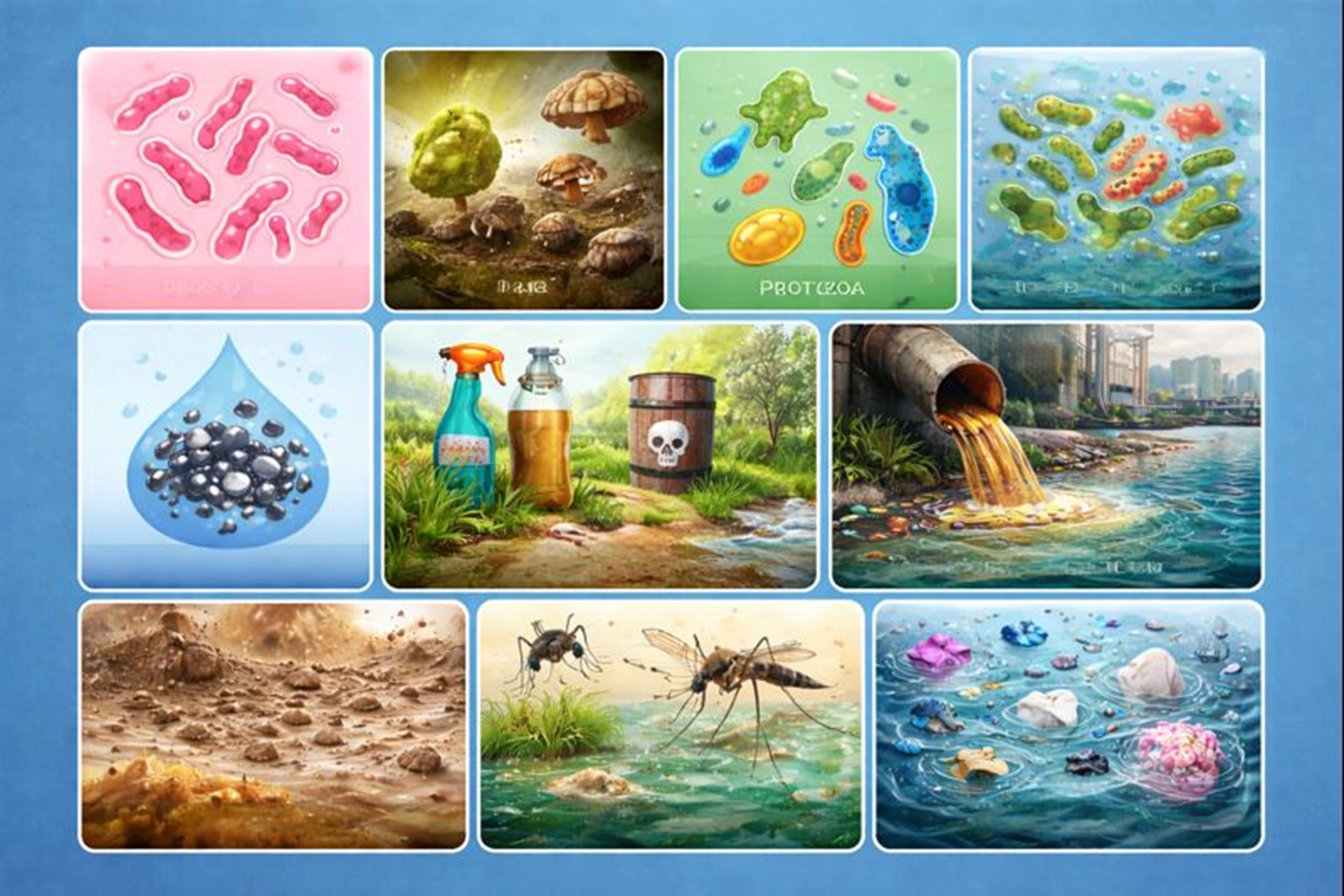
Contaminants in spirulina farms fall into three main categories: biological, chemical, and physical. Each requires a specific detection and control method to safeguard culture integrity.
Biological Contaminants
Biological contamination arises from living organisms like bacteria, fungi, protozoa, and competing algae. These invaders can deplete nutrients, alter pH, and destroy spirulina cultures.
Common biological contaminants include:
- Competing microalgae (green algae, diatoms)
- Bacteria such as E. coli, Salmonella, and Staphylococcus
- Fungi and molds
- Protozoan grazers
- Viral agents and bacteriophages
Control Methods
- Use UV-treated or RO-filtered water for cultivation.
- Start with pure, axenic spirulina cultures.
- Maintain optimal pH (9–11) and temperature (35–37°C) to suppress competitors.
- Employ automated monitoring systems for pH and temperature. (Automation in Spirulina Farming: How Technology Can Boost Mass Production)
- Follow strict sanitization of tools and ponds using FDA-approved disinfectants.
Example: Microbial COA Compliance Table
| Parameter | Specification | Result |
| Total Aerobic Count (cfu/g) | NMT 50,000 | 8,000 |
| Yeast & Mold (cfu/g) | NMT 100 | 70 |
| E. coli per g | Absent | Absent |
| Salmonella sp. per g | Absent | Absent |
| Staphylococcus sp. per g | Absent | Absent |
Maintaining such parameters ensures the culture meets HACCP and export-grade safety standards. Learn more about setting up compliant production in How to Build a HACCP-Compliant Spirulina Facility.
Chemical Contaminants
Chemical contamination includes heavy metals, pesticides, and industrial residues that affect the nutritional and safety profile of spirulina. These often originate from contaminated water, fertilizers, or equipment corrosion.
Major chemical contaminants:
- Heavy metals: lead, cadmium, mercury, arsenic
- Agricultural pesticides or herbicides
- Residual cleaning agents or sterilants
- Hydrocarbons and lubricants from machinery
Control Methods
- Test borewell and input water for heavy metals before every production cycle.
- Use stainless steel (SS 316) equipment to avoid metal leaching.
- Employ activated carbon or ion-exchange filtration for purification.
- Use only OMRI-approved organic nutrient sources.
- Periodically validate COA heavy metal parameters.
Example: Heavy Metal & Elemental Contaminant Standards
| Parameter | Specification (Max) | Typical Result |
| Lead (µg/g) | 0.20 | 0.11 |
| Arsenic (µg/g) | 0.50 | 0.10 |
| Cadmium (µg/g) | 0.20 | <0.09 |
| Mercury (µg/g) | 0.025 | <0.025 |
| Pesticides | Absent | Absent |
Chemical control and testing uphold global compliance benchmarks for nutraceutical and food-grade spirulina.
Physical Contaminants
Physical contaminants are non-living impurities that affect product purity. These include dust, sand, insects, or fibers introduced during pond operation or harvesting.
Sources of physical contamination:
- Wind-blown debris or dust entering open raceway ponds
- Fibers from harvesting nets or plastic liners
- Insects and leaf litter
- Microplastic residues from degraded materials
Control Methods
- Install insect-proof mesh covers and windbreaks around ponds.
- Conduct daily skimming and debris removal.
- Use 80-mesh pre-filtration before harvesting.
- Operate in a semi-closed polyhouse to minimize exposure.
- Follow proper drying protocols to prevent secondary contamination. (Spirulina Drying Methods: Comparison)
Comprehensive Contamination Control Framework
| Control Layer | Description | Methods |
| Preventive | Prevent entry of contaminants | Water treatment, sterilization, screening |
| Monitoring | Detect contamination early | pH, microbial count, visual inspection |
| Corrective | Manage contamination events | Partial dilution, replacement, selective cleaning |
| Quality Assurance | Ensure consistent purity | Routine COA, HACCP compliance |
For an in-depth microbial safety guide, visit Identifying & Preventing Microbial Contaminants in Spirulina.
FAQs
1. What are the most common contaminants in spirulina farms?
The most common include bacteria (E. coli, Salmonella), competing microalgae, dust, heavy metals, and pesticide residues.
2. How can farmers prevent contamination during harvesting?
By using closed or covered raceway ponds, 80-mesh pre-filtration, and rotary drum filters to remove debris and prevent microbial contact.
3. What role does automation play in contamination control?
Automated SCADA or IoT systems monitor pH, temperature, and agitation, reducing human interference and contamination risks.
4. Are organic-certified farms less prone to contamination?
Yes, because organic protocols mandate clean inputs, OMRI-approved nutrients, and strict testing, reducing chemical and microbial exposure.
Q5: How frequently should testing be done?
Microbial and heavy metal testing should be performed weekly, with COA validation before each batch release.
Conclusion
Contamination control in spirulina farming defines the line between small-scale production and export-grade quality. With precise biological, chemical, and physical monitoring systems, farms can maintain optimal culture health, achieve consistent yields, and ensure compliance with USDA Organic and HACCP standards.
By integrating automation, water filtration, and strict COA-based testing, farmers can build reliable, scalable, and contamination-free spirulina systems suitable for both domestic and international markets.
Table Of Contents