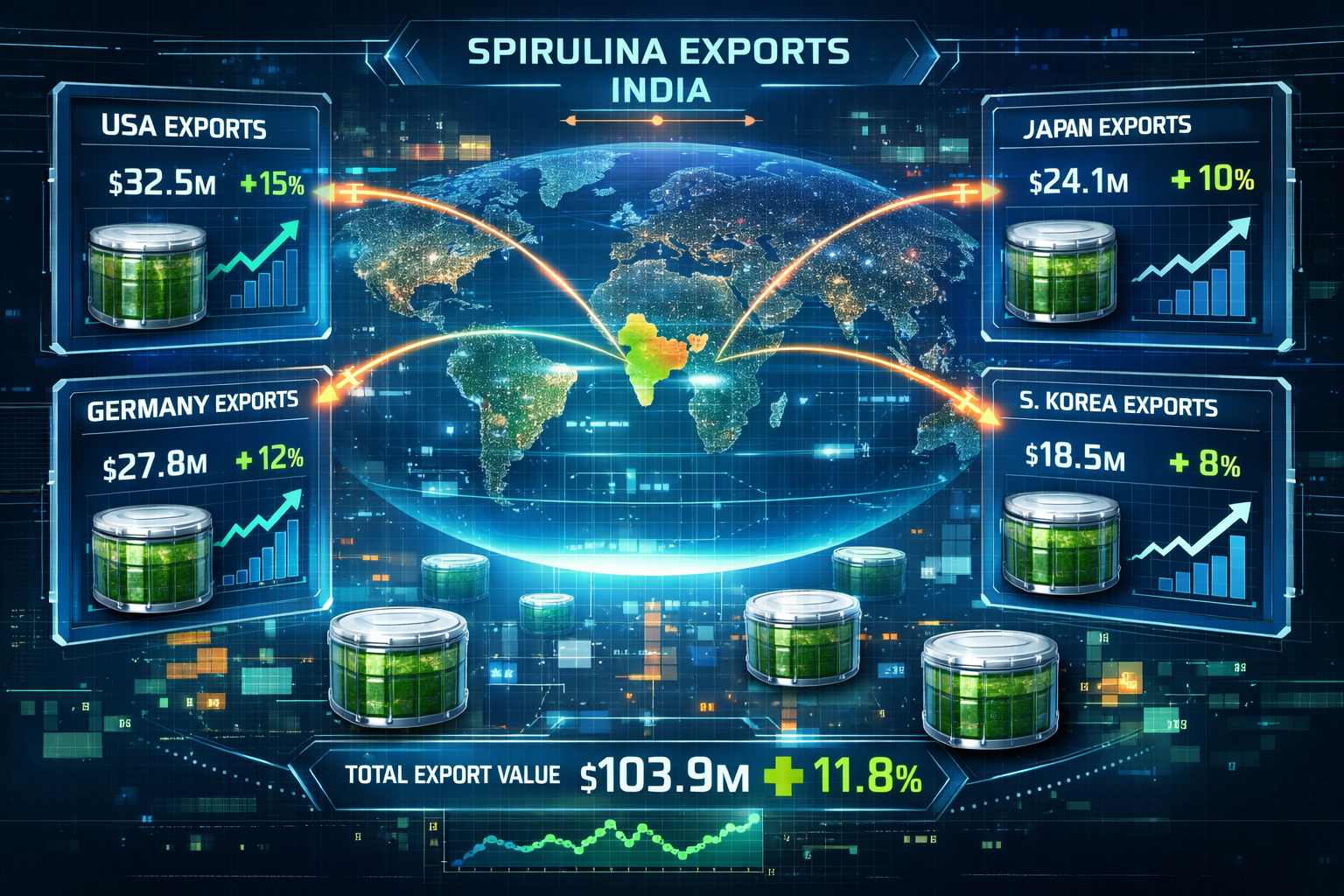
India has steadily emerged as a competitive producer of spirulina, driven by favourable climate, cost advantages, and growing technical capability. However, for many producers, real scale and margin improvement come not from domestic sales alone, but from accessing international markets where demand for high-quality spirulina continues to rise.
Exporting spirulina is not just about finding overseas buyers. It requires alignment with specific market expectations around quality, form factor, certifications, traceability, and consistency. This article outlines the most important spirulina export markets for Indian producers and explains what it takes to succeed in each.
Why Export Markets Matter for Indian Spirulina Producers
Export markets typically offer:
- Higher and more stable pricing compared to fragmented domestic markets
- Larger volume commitments once trust is established
- Demand for value-added forms such as powder, tablets, and extracts
For system-driven producers, exports provide the scale visibility needed to justify larger investments in processing, drying, and quality systems.
Key Factors That Influence Export Success
Before entering any export market, producers must evaluate readiness across several dimensions:
- Consistent quality and batch uniformity
- Compliance with international food and supplement standards
- Ability to meet documentation and traceability requirements
- Logistics reliability and shelf-life management
Markets differ significantly in how strictly these factors are enforced.
United States: Largest and Most Competitive Market
The United States is one of the world’s largest consumers of spirulina, driven by strong demand from the nutraceutical, functional food, and wellness industries.
Market characteristics:
- High volume demand
- Strict regulatory scrutiny
- Preference for certified, traceable supply
Indian producers targeting the US must align with FDA regulations and buyer-specific quality benchmarks. Consistency and documentation matter as much as price.
European Union: Quality-First, Regulation-Heavy
The EU market is attractive due to premium pricing, but entry barriers are high.
Key features:
- Strong demand for organic and clean-label spirulina
- Stringent food safety and contaminant limits
- Emphasis on sustainability and traceability
EU buyers often favour long-term supplier relationships, making this a stable but demanding market.
Japan and South Korea: Precision and Purity Focus
East Asian markets value spirulina for its functional and health benefits.
Notable expectations:
- Extremely low contamination thresholds
- Preference for fine powders and extracts
- Strong emphasis on supplier reliability
These markets reward precision but require advanced quality control and testing discipline.
Middle East: Growing Demand, Form-Factor Driven
The Middle East is an emerging market for spirulina, particularly in supplements and wellness blends.
Characteristics:
- Rapidly growing consumer awareness
- Focus on finished products rather than raw biomass
- Logistics and shelf-life considerations due to climate
This region suits producers with strong processing and packaging capability.
Southeast Asia: Price-Sensitive but Expanding
Countries in Southeast Asia show increasing interest in spirulina for nutrition and food fortification.
Market dynamics:
- Moderate pricing
- Increasing regulatory clarity
- Opportunity for volume-led growth
Producers must balance competitiveness with margin discipline.
Price-Per-Kg Export Range by Market
Export pricing for spirulina varies widely based on form (powder, tablets, extracts), certifications, and buyer relationships. The ranges below represent typical bulk powder prices for compliant Indian producers.
| Market | Typical Export Price Range (USD/kg) | Pricing Driver |
| USA | 12–30 | Certification, consistency, volume contracts |
| European Union | 15–40 | Organic status, contaminant limits |
| Japan / South Korea | 15–45 | Purity, fine particle size, testing rigor |
| Middle East | 15–25 | Finished-form demand, packaging |
| Southeast Asia | 12–20 | Price sensitivity, volume focus |
Premium extracts and tablets can command significantly higher prices, but also require higher processing and compliance investment.
Comparative Snapshot: Export Market Expectations
| Market | Volume Potential | Price Realisation | Regulatory Stringency |
| USA | Very High | High | High |
| European Union | High | Very High | Very High |
| Japan / Korea | Moderate | High | Very High |
| Middle East | Moderate | Moderate–High | Moderate |
| Southeast Asia | High | Moderate | Moderate |
Certification Checklist by Export Destination
Different export destinations expect different combinations of certifications and documentation. The checklist below helps producers assess readiness by market.
| Market | Commonly Expected Certifications & Documents |
| USA | FSSAI export compliance, FDA registration, COA, heavy metal & microbial reports, USDA |
| European Union | Organic certification (where applicable), EU food safety compliance, traceability records, EUO |
| Japan / South Korea | Stringent COA, low contaminant reports, supplier audits |
| Middle East | Halal certification, shelf-life documentation, COA |
| Southeast Asia | Food safety certification, basic COA, import permits |
While not all buyers demand every certification initially, lack of readiness often limits market access or pricing power.
Certifications and Compliance Requirements
Most export markets expect one or more of the following:
- Food safety certifications
- Heavy metal and microbial test reports
- Batch-level traceability
- Stable drying and moisture control
Producers often need professional support to align production systems with export expectations.
Role of Processing and Quality Systems
Export success depends heavily on post-harvest handling. Controlled drying, hygienic packing, and proper storage are non-negotiable.
Solutions such as RWD drying systems and hygienic packing systems help producers meet international benchmarks.
In Greenbubble-aligned export models, quality systems are designed specifically to meet the most demanding markets first, allowing easier access to others later.
Choosing the Right Market to Start With
Not all producers should target the same export market initially.
Practical guidance:
- New exporters: Southeast Asia or Middle East
- Quality-mature producers: USA
- Premium-focused operations: European Union or Japan
Market selection should align with current system capability, not aspirational pricing.
FAQs
Q1. Is exporting spirulina from India profitable?
Yes, if quality, compliance, and consistency are maintained.
Q2. Which export market pays the highest price?
The EU and Japan often offer premium pricing but have higher entry barriers.
Q3. Do I need certifications to export spirulina?
Most serious buyers require food safety and quality documentation.
Q4. Can small producers export spirulina?
Yes, but typically through aggregators or after system upgrades.
Q5. Should exports be planned before scaling production?
Ideally, yes. Export demand provides visibility for scaling decisions.
Conclusion
Export markets offer Indian spirulina producers a pathway to scale, stability, and improved margins-but only for those prepared to meet global standards. Understanding the nuances of each market helps producers avoid costly misalignment.
Producers who build export readiness into their systems from the beginning-an approach seen in Greenbubble-aligned spirulina operations-are better positioned to access and sustain international demand.
Table Of Contents