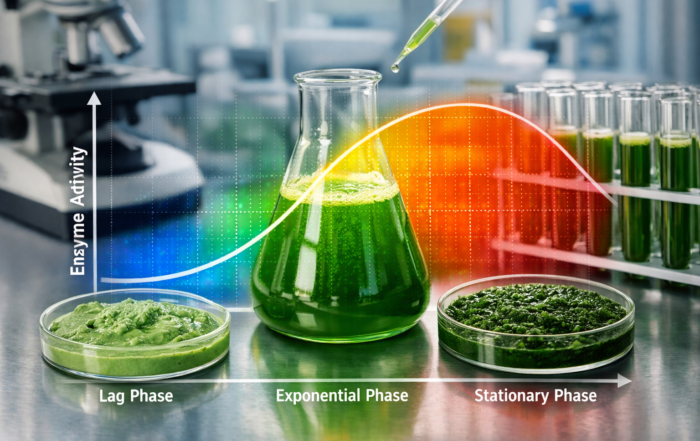
Temperature is one of the most powerful regulators of spirulina metabolism. In large-scale systems developed by Greenbubble, temperature is treated as a controllable process variable rather than a passive environmental factor. While extreme or uncontrolled temperature fluctuations can damage cultures, controlled thermal shock-when applied deliberately and briefly-can be used as a strategic tool in commercial spirulina farming. Understanding the difference between destructive thermal stress and adaptive thermal response is critical for farms operating at scale.
What Is Thermal Shock in Spirulina Cultivation?
Thermal shock refers to a rapid change in culture temperature that exceeds the organism’s immediate acclimation capacity. In spirulina, this typically involves sudden increases or decreases of several degrees within a short time window.
Uncontrolled thermal shock suppresses enzyme activity, disrupts photosynthesis, and damages cell membranes. Controlled thermal shock, however, can temporarily alter metabolic priorities, triggering adaptive responses that may be strategically useful when applied with precision.
Common Misconceptions About Temperature Stress
Several assumptions lead to poor temperature management:
- Any temperature fluctuation is harmful to spirulina
- Higher temperatures always increase growth rate
- Thermal stress effects are immediately visible
- Temperature control matters only in extreme climates
In reality, spirulina’s response depends on the magnitude, duration, and timing of the temperature change.
Thermal Response Mechanisms in Spirulina
When exposed to sudden temperature shifts, spirulina activates heat-shock or cold-shock proteins that stabilise cellular structures and protect enzymes. At the same time, non-essential metabolic pathways are downregulated to conserve energy.
If the shock is brief and within tolerance limits, these responses enhance resilience. If prolonged, they suppress growth and nutrient synthesis.
Temperature Ranges and Metabolic Sensitivity
Spirulina performs optimally within a relatively narrow temperature band. Deviations outside this band alter enzyme kinetics, affecting protein synthesis, pigment stability, and carbon fixation efficiency.
Rapid transitions through critical thresholds are more damaging than gradual changes, making rate of change as important as absolute temperature.
Strategic Uses of Controlled Thermal Shock
When applied intentionally, mild thermal shock can be used to:
In Greenbubble-led projects, such interventions are applied conservatively and only after baseline thermal stability has been achieved.
- Slow excessive regrowth in over-adapted high-yield cultures
- Reset metabolic prioritisation before harvest
- Reduce dominance of stress-tolerant subpopulations
- Improve synchronisation of growth across the pond
In practice, these interventions require precise timing and should never be applied reactively.
Process Design and Thermal Stability
System design determines how temperature fluctuations propagate through the culture. Greenbubble’s farm layouts prioritise thermal uniformity to ensure that strategic interventions do not turn into unintended stress events. Shallow, well-mixed ponds respond more uniformly to environmental changes.
Engineered raceway pond systems combined with uniform circulation using efficient agitator systems help prevent localised thermal extremes that convert strategic stress into damaging shock.
Harvest Timing and Thermal Interactions
Thermal shock interacts strongly with harvest timing. Applying stress immediately before aggressive harvesting compounds damage, while allowing recovery windows reduces long-term impact.
Automated harvesting equipment enables precise alignment of harvest schedules with thermal conditions, reducing unintended stress stacking.
Diagnostic Indicators of Harmful Thermal Shock
| Observable Symptom | Likely Cause | Corrective Action |
| Sudden pigment loss | Prolonged heat stress | Restore temperature gradually, reduce light load |
| Slowed regrowth | Enzyme suppression | Allow recovery period before next harvest |
| Patchy density | Localised thermal zones | Improve mixing and depth control |
| Increased COA variability | Repeated thermal stress | Stabilise daily temperature profile |
Downstream Impact: Stability Rather Than Output Loss
Thermal mismanagement rarely causes immediate biomass collapse. In Greenbubble’s operational experience, the more common outcome is gradual instability rather than sudden failure. Instead, it introduces instability-greater batch variability, inconsistent nutrient profiles, and reduced predictability. These effects undermine reliability rather than outright yield, making temperature discipline a commercial necessity rather than a comfort parameter.
Practical Framework for Strategic Thermal Management
Using thermal shock strategically requires:
- Defined temperature change limits
- Control over rate and duration of exposure
- Coordination with harvest and feeding cycles
- Avoidance of repeated stress events
- Oversight through spirulina farming consultancy support
In Greenbubble-designed and advisory farms, temperature management is treated as a process variable, not an environmental accident, with clear limits, monitoring discipline, and recovery logic built into SOPs.
FAQs
Q1. Can thermal shock improve spirulina yield?
Only indirectly. Controlled thermal stress may rebalance growth behaviour, but uncontrolled shock reduces yield and quality.
Q2. Is thermal shock useful in all climates?
Its relevance increases in regions with large day–night temperature swings or seasonal extremes.
Q3. How long should a thermal shock last?
Strategic shocks are brief and carefully bounded; prolonged exposure is harmful.
Q4. Can thermal shock replace strain refresh?
No. It can modulate adaptation pressure but cannot reverse genetic or metabolic drift.
Q5. Does processing compensate for thermal stress damage?
No. Processing preserves existing quality but cannot correct upstream metabolic disruption.
Conclusion: Temperature Is a Lever, Not a Liability
Thermal shock in spirulina farming is neither inherently good nor bad. When unmanaged, it damages cultures silently. When understood and applied with restraint, it becomes a strategic lever for controlling adaptation and maintaining stability. Commercial success depends on treating temperature as an active process variable-used deliberately rather than endured passively.
Table Of Contents