Karnataka is one of the most interesting states in India for spirulina. Few places offer this combination: a large nutraceutical and health-food brand ecosystem in Bengaluru, strong food science institutions, a sugar belt that supplies potential organic inputs, semi-arid plains with abundant sunshine, and a coastline with export access.
Karnataka is also one of the most varied states to farm in. A site near Kalaburagi faces conditions completely unlike a site near Mangaluru, and a farm on the Bengaluru plateau behaves differently again. Choosing the wrong region or design for your location can hold a farm back for years.
We have delivered spirulina projects in Karnataka, including farms in the Hubli region, and we have built farms across India and in more than 10 countries. Our customers account for more than 90% of India’s spirulina production. This guide lays out the real opportunities and challenges of spirulina farming in Karnataka, region by region, along with the costs and returns you should plan for.
Karnataka at a Glance for Spirulina Farmers
| Factor | Karnataka’s position |
|---|---|
|
Sunlight |
Strong across the interior plains, and weaker during the monsoon on the coast and in the Malnad |
|
Temperature |
Hot summers in North Karnataka, moderate on the Bengaluru plateau |
|
Rainfall |
Very high on the coast and in the Malnad, low to moderate in the northern and eastern interior |
|
Water |
Variable, with hard-rock aquifers, deep borewells and quality issues in some districts |
|
Buyers |
Strong nutraceutical, health-food, D2C and startup brand base in Bengaluru |
|
Export access |
New Mangalore Port, Bengaluru air cargo and road links to Chennai port |
|
Inputs |
A large sugar and agro-processing sector, useful for sourcing organic carbon inputs |
Six Opportunities for Spirulina in Karnataka
1. Bengaluru’s Brand Ecosystem Is on Your Doorstep
Bengaluru is home to a large number of nutraceutical, health-food, fitness and D2C wellness brands, and many of them need reliable, tested spirulina. A Karnataka-based producer can build long-term supply relationships with brands that value traceability and consistent quality.
This opens up two routes: supplying bulk powder to brands, or offering private label manufacturing. Learn more in private label spirulina manufacturing: what brands expect.
2. The North Karnataka Plains Suit Spirulina Well
Districts across North Karnataka have strong sunlight, low rainfall and warm temperatures for much of the year. These semi-arid conditions are close to ideal for spirulina, which grows best at 30 to 37°C and relies on sunlight as its most economical energy source. Commercial farms don’t need artificial lighting. See spirulina farming in semi-arid climates.
3. The Sugar Belt Can Support Organic Production
Organic spirulina needs organic carbon sources. Sugars and other dissolvable plant materials can serve this role. Karnataka’s large sugarcane and agro-processing sector, especially around Belagavi, Bagalkot and Mandya, makes such inputs easier to source locally.
Every input must be tested for pesticides, heavy metals, microbial load and toxins before it goes into a pond. An untested input can undo an organic certification. Read spirulina and carbon sources: organic options explained.
4. Strong Science and Skills Base
Karnataka has major food science, agricultural and biotechnology institutions, along with a large pool of trained graduates. Spirulina farms need skilled operators and qualified lab staff, and finding that talent is often easier here than in other states. For training options, see spirulina training in Karnataka.
5. Institutional Nutrition Demand
Government and institutional nutrition programmes buy certified, food-safe spirulina at around ₹900 to ₹1,300 per kg, usually through tenders. Producers with consistent quality and full documentation can compete for this large-volume demand. See spirulina for schools and mid-day meals.
6. Export Routes by Sea and Air
New Mangalore Port, Bengaluru’s international air cargo facilities and road links to Chennai port give Karnataka producers several export routes. Export buyers pay ₹800 to ₹1,000 per kg for certified organic spirulina with full traceability.
Five Challenges, and How We Solve Them
Challenge 1: Heavy Rainfall on the Coast and in the Malnad
Coastal Karnataka and the Malnad region receive some of the heaviest rainfall in India. Long monsoon months bring:
- Dilution of pond culture and nutrients
- Extended cloud cover that slows growth
- Higher contamination risk from runoff
- High humidity, which makes drying and storage harder
How we solve it: Wherever possible, we steer commercial farms away from the highest-rainfall zones. Where a coastal or Malnad site is unavoidable, we design covered ponds, strong drainage and controlled drying environments. Even then, these regions remain harder places to farm consistently.
Challenge 2: Summer Heat in North Karnataka
Summer temperatures in districts such as Kalaburagi, Raichur, Ballari and Vijayapura can climb above 40°C. Spirulina culture begins to bleach above 40°C.
How we solve it:
- Hourly temperature monitoring
- Shade nets deployed on hot days to keep culture below 38°C
- Agitator speed and run time adjusted to help control temperature
- Deeper water in summer for extra thermal buffer
- Cold culture reserves ready to add when ponds heat up
- Larger raceway ponds, which hold temperature far more steadily
Learn more in what’s the ideal temperature for spirulina growth.
Challenge 3: Cooler Conditions on the Bengaluru Plateau
The Bengaluru region’s pleasant climate is great for living but slightly cooler than ideal for spirulina. Winter mornings are cool, and average temperatures sit below spirulina’s optimal 35 to 37°C for part of the year. Growth can slow, especially from December to February.
How we solve it: Polyhouse structures help retain heat, and pond depth and harvest schedules are adjusted by season. The plateau’s easy access to Bengaluru buyers can offset somewhat lower yields, but the numbers need to be planned realistically.
Challenge 4: Groundwater Quality and Availability
Much of Karnataka sits on hard-rock aquifers. Borewells in parts of the state are deep, yields can be unreliable, and some districts have groundwater quality problems. Spirulina absorbs what is in its water, so any heavy metals or contaminants will end up in your product.
How we solve it: Every project starts with full water testing. We recommend groundwater filtered through sand and UV, a reliable top-up source for evaporation losses, and regular retesting. Read why water quality is critical in spirulina farming.
Challenge 5: Contamination From Nearby Land Use
Karnataka’s mix of intensive agriculture, industry and mining creates site-specific risks:
- Agricultural belts: herbicides such as 2,4-D can drift into ponds and inhibit growth
- Mining regions: dust and heavy metal exposure need careful assessment
- Industrial areas: effluents and air pollution raise contamination risks
How we solve it: Site selection comes first. We test water, assess neighbouring land use and design protections into the farm before construction begins. Learn more in identifying and preventing microbial contaminants in spirulina.
Region-by-Region Guide to Spirulina in Karnataka
| Region | Example districts | Opportunities | Challenges | General suitability |
|---|---|---|---|---|
|
North Karnataka plains |
Kalaburagi, Raichur, Vijayapura, Bagalkot, Koppal, Bidar |
Strong sunlight, low rainfall, land availability |
Hot summers and variable groundwater |
Strong, with heat management |
|
Central Karnataka |
Chitradurga, Davanagere, Tumakuru, Haveri |
Good sunlight, moderate climate, good road access |
Water availability in some areas |
Strong |
|
North-west |
Belagavi, Dharwad, Hubballi region |
Sugar belt inputs, balanced climate, established farming base |
Monsoon rain in western parts |
Good |
|
Bengaluru and south interior |
Bengaluru Rural, Ramanagara, Kolar, Chikkaballapur, Mandya, Mysuru |
Closest to buyers, skilled workforce, pleasant climate |
Cooler plateau temperatures, deep borewells, land costs |
Moderate to good, with seasonal planning |
|
Ballari mining region |
Ballari and surrounding areas |
Hot, dry and sunny |
Dust and heavy metal risk near mining zones |
Only after careful site assessment |
|
Coastal Karnataka |
Udupi, Dakshina Kannada, Uttara Kannada |
Port access and coastal aquaculture buyers |
Very heavy rainfall and high humidity |
Challenging |
|
Malnad |
Shivamogga, Chikkamagaluru, Kodagu, Hassan |
Good water availability |
Heavy rain, cloud cover, cooler temperatures |
Not generally recommended |
This is a general guide. The final decision always rests on site water testing, local weather data and nearby land use.
A Karnataka Spirulina Calendar
| Season | Months | What to expect | Key actions |
|---|---|---|---|
|
Winter |
December to February |
Slower growth, especially on the plateau |
Polyhouse protection, adjusted harvest frequency |
|
Summer |
March to May |
Strong growth, with heat stress in the north |
Hourly monitoring, shade nets, depth control |
|
Southwest monsoon |
June to September |
Heavy rain on the coast and in the Malnad, moderate inland |
Rain protection, drainage, salinity and nutrient checks |
|
Post-monsoon |
October to November |
Good growing conditions, with some northeast monsoon rain in the south-east |
High production and certification batches |
How Much Does a Spirulina Farm Cost in Karnataka?
Setup Cost for a 1-Acre Farm
| Component | Estimated cost (₹) |
|---|---|
|
Pond construction |
15 to 18 lakh |
|
Buildings |
10 to 20 lakh |
|
Agitation systems |
5 to 8 lakh |
|
Harvesting and dewatering equipment |
10 to 12 lakh |
|
Drying system (RWD or vacuum) |
10 to 18 lakh |
|
Packaging and cleanroom |
6 to 8 lakh |
|
Automation (IoT and SCADA) |
3 to 5 lakh |
|
Lab and quality control |
10 to 12 lakh |
|
Certification and documentation |
4 to 6 lakh |
|
Total |
73 lakh to 1.07 crore |
In Karnataka, budget more for:
- Land costs near Bengaluru, which are significantly higher than in North Karnataka
- Polyhouse structures on the plateau and in wetter regions
- Borewell development and water storage where groundwater is deep or unreliable
- Rain protection and drainage in higher-rainfall areas
Annual Operating Costs
| Expense | 1 acre (₹ per year) | 2 to 3 acres (₹ per year) |
|---|---|---|
|
Power and accessories |
6.47 lakh |
11.87 lakh |
|
Nutrients |
18 lakh |
51 lakh |
|
Testing and chemicals |
2.75 lakh |
2.75 lakh |
|
Salaries |
18 lakh |
24 lakh |
|
Miscellaneous |
5 lakh |
5 lakh |
|
Packing |
3 lakh |
4 lakh |
|
Certifications and audits |
Included in miscellaneous |
7 lakh |
|
Total |
About 53 lakh |
About 1.06 crore |
Realistic Returns for a Karnataka Spirulina Farm
| Farm size | Setup cost | Annual revenue | Total annual costs | Annual result |
|---|---|---|---|---|
|
1 acre |
₹1.07 crore |
₹75 lakh |
₹83.22 lakh |
Loss of about ₹8.2 lakh |
|
3 acres |
₹2.1 crore |
₹2 crore |
₹1.22 crore |
Profit of about ₹78 lakh (about 37% ROI) |
| Farm size | Investment range | Break-even | Best suited for |
|---|---|---|---|
|
1 acre |
₹75 to 95 lakh |
Little or no ROI |
Training or niche local sales |
|
2 to 3 acres |
₹1.5 to 2.5 crore |
About 3 years |
Commercial, export-ready production |
|
5+ acres |
₹2 crore and above |
Depends on contracts |
Only with assured buyers |
We recommend 2 to 3 acres as the starting point for a commercial farm in Karnataka. One practical approach is to farm in North or Central Karnataka, where land is more affordable and the climate is stronger, and sell into the Bengaluru market.
Who Buys Spirulina From Karnataka Farms?
| Buyer type | Typical price (₹/kg) | Grade required |
|---|---|---|
|
Nutraceutical and supplement brands |
800 to 1,500 |
Certified organic, high phycocyanin |
|
Domestic supplement manufacturers |
600 to 800 |
Standard commercial grade |
|
Export traders |
800 to 1,000 |
USDA or EU Organic, full traceability |
|
Government and institutional programmes |
900 to 1,300 |
Certified, food-safety compliant |
|
Cosmetic and skincare formulators |
Powder: 800 to 1,000. Extract: 5,000 to 8,000 |
Low heavy metals, standardised |
|
Poultry and aquaculture feed |
400 to 600 |
Consistent carotenoids |
The premium buyers all expect the same things: certification, consistent quality and a lab-tested COA for every batch. That requires automated harvesting and processing, low-temperature drying and an in-house lab. For organic requirements, read what makes spirulina organic: a compliance checklist.
Our Work in Karnataka
We have helped Karnataka businesses build commercial spirulina operations from the ground up. You can explore our Avani Nutraceuticals project in Karnataka and our work with Hosmani Nutraceuticals in Hubli. To see how a Karnataka farm can grow over time, read how Hosmani Nutraceuticals moved from pilot to full scale.
Government Support for Spirulina Farms in Karnataka
There is no Karnataka-specific spirulina subsidy, but producers may be able to access:
- Central food processing schemes such as PMFME
- State agri-business, food processing and startup support programmes
- MSME schemes for small-scale processing units
- Post-harvest infrastructure support for dryers, storage and packing
Scheme rules change frequently, so confirm current eligibility with the relevant departments. Subsidies typically cover only part of the cost and require a detailed project report. See our guide to government subsidies for spirulina cultivation.
How We Help You Build a Spirulina Farm in Karnataka
Karnataka’s opportunities are real, but so are its regional differences. The right design for a farm in Raichur is very different from the right design near Bengaluru.
When you work with us, we:
- Help you choose the right region and site, with full water testing and land-use assessment
- Design raceway ponds for local conditions, from heat control in the north to polyhouse protection on the plateau
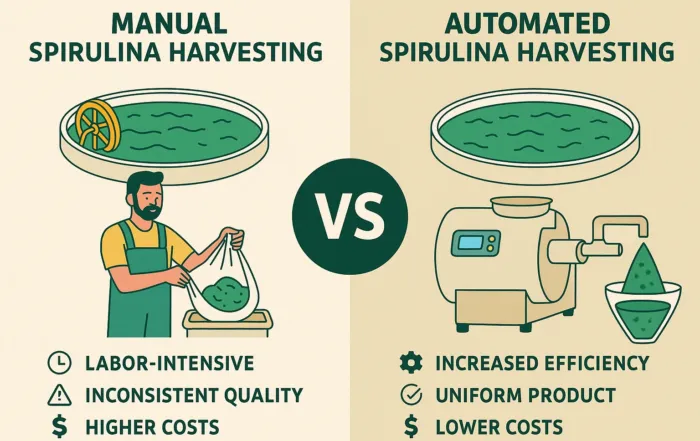
- Integrate automated harvesting, dewatering and RWD drying into one continuous line
- Set up your in-house lab, so every batch has a COA
- Guide your organic input sourcing and testing protocols
- Train your team and support you through stabilisation and certification
We have been recognised as Best Microalgae Company by the European Algae Biomass Association in Paris. Our turnkey spirulina farming solutions start from ₹1 crore / US $200,000, and our spirulina farming consultancy can help you evaluate your land and plans before you invest.
Frequently Asked Questions
Is Karnataka good for spirulina farming?
Yes, especially in North and Central Karnataka, where sunlight is strong and rainfall is lower. Coastal and Malnad regions are more challenging because of heavy rainfall.
Can I start a spirulina farm near Bengaluru?
Yes, but plan for cooler plateau temperatures, higher land costs and deep borewells. Many producers farm in North or Central Karnataka and sell into Bengaluru.
How much does a spirulina farm cost in Karnataka?
A properly built 1-acre farm costs about ₹73 lakh to ₹1.07 crore. A commercially viable 2 to 3 acre farm typically requires ₹1.5 to 2.5 crore.
Who buys spirulina in Karnataka?
Bengaluru’s nutraceutical and health-food brands, supplement manufacturers, export traders, institutional nutrition programmes, cosmetic formulators and feed companies.
Is organic spirulina farming possible in Karnataka?
Yes. Organic carbon sources can often be sourced locally, but every input must be tested, and the farm must follow certified organic protocols.
Karnataka: A State of Many Spirulina Possibilities
Karnataka offers something for almost every kind of spirulina business: sun-drenched northern plains for high-output farming, a sugar belt for organic inputs, Bengaluru’s brand ecosystem for premium sales, and multiple export routes.
Success comes down to matching the farm to the region. Choose a site with strong sunlight and clean water, build at a commercially viable scale, protect the culture from local extremes, and produce the consistent, certified quality that Karnataka’s buyers expect. That is exactly what we help our customers do.
Make us your source on Google
Table Of Contents