Gujarat has built its reputation on turning opportunity into enterprise. From dairy cooperatives to pharmaceutical clusters to some of India’s busiest ports, the state has a habit of building industries that reach far beyond its borders. Spirulina fits naturally into that story.
For a spirulina producer, Gujarat offers something few other states can match: a strong growing climate combined with a ready market and a direct route to export. A farm here can be close to nutraceutical manufacturers, feed companies and international shipping, all at once.
It also comes with its own challenges: salinity in coastal groundwater, cyclone exposure along the coast, heavy monsoon rain in the south, and industrial pollution risks near manufacturing belts. We’ve built spirulina farms across India and in more than 10 countries, and our customers produce over 90% of India’s spirulina. This guide explains how to set up a spirulina farm in Gujarat the right way, from choosing your region to finding your buyers.
Why Gujarat Is a Strong Market for Spirulina
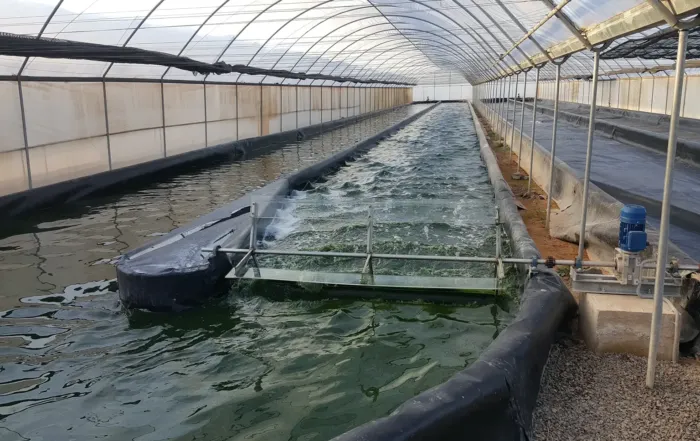
Most spirulina guides start with climate. In Gujarat, the bigger advantage is the market around you.
| Gujarat advantage | What it means for spirulina producers |
|---|---|
|
Major ports such as Mundra, Kandla, Pipavav and Hazira |
Direct export routes to international buyers |
|
Pharmaceutical and nutraceutical clusters around Ahmedabad, Vadodara, Ankleshwar and Vapi |
Nearby buyers for supplement-grade spirulina and extracts |
|
Coastal aquaculture, especially in South Gujarat |
Demand for spirulina in shrimp and fish feed |
|
Strong poultry and animal feed industry |
Large-volume buyers for feed-grade spirulina |
|
Proximity to Mumbai |
Access to one of India’s largest consumer and brand markets |
|
Established industrial infrastructure |
Easier access to packaging, logistics and processing services |
|
Strong solar power adoption |
Potential to lower long-term power costs |
In many states, new producers struggle to find buyers. In Gujarat, the bigger question is usually which buyers to target.
Who Buys Spirulina in and Around Gujarat?
| Buyer type | Typical price (₹/kg) | Grade required | Order pattern |
|---|---|---|---|
|
Nutraceutical and supplement brands |
800 to 1,500 |
Certified organic, high phycocyanin |
100 kg to multi-tonne, recurring |
|
Domestic supplement manufacturers |
600 to 800 |
Standard commercial grade |
50 to 500 kg per order |
|
Export traders and international buyers |
800 to 1,000 |
USDA or EU Organic, full traceability |
Multi-tonne, contract-based |
|
Food and beverage colour buyers |
E6: ₹5,000, E18: ₹8,000, E40: ₹24,000 |
Phycocyanin extract |
Smaller, variable volumes |
|
Poultry and aquaculture feed companies |
400 to 600 |
Consistent carotenoids |
Large volume, lower margin |
|
Cosmetic and skincare formulators |
Powder: 800 to 1,000. Extract: 5,000 to 8,000 |
Standardised extract, low heavy metals |
Smaller volumes, high purity |
|
Government and institutional programmes |
900 to 1,300 |
Certified, food-safety compliant |
Large volume, tender-based |
The Value-Added Opportunity: Phycocyanin
Gujarat’s industrial and pharmaceutical ecosystem makes it especially well placed for phycocyanin, the natural blue pigment in spirulina used as a food colourant and in cosmetics. Extract grades sell at many times the price of standard powder. Producing extract-grade raw material requires high-phycocyanin spirulina, gentle low-temperature drying and tight quality control. Learn more in the science behind phycocyanin in spirulina.
The Aquaculture Link
South Gujarat’s coastal shrimp and fish farming creates steady demand for spirulina as a feed ingredient. Feed-grade spirulina earns lower prices but moves in large volumes, which can give a farm a stable base market. See spirulina for poultry and animal feed.
The Export Advantage
Being close to major ports shortens transit times and reduces inland logistics costs. Export buyers, however, demand certified product, full traceability and consistent lab results. Read exporting organic spirulina from India to the world and the top spirulina export markets for Indian producers.
Is Gujarat’s Climate Right for Spirulina?
For most of the state, yes. Spirulina grows best at 30 to 37°C, and Gujarat stays warm for much of the year. Winters are generally milder than in northern India, which means less of a seasonal slowdown.
The challenges differ by region:
- Summer heat: temperatures in North Gujarat, Kutch and Ahmedabad can exceed 45°C. Culture bleaches above 40°C, so heat management is essential.
- Monsoon rainfall: South Gujarat receives heavy rain, which dilutes pond culture, reduces sunlight and increases contamination risk.
- Cyclones: coastal Saurashtra and Kutch face periodic cyclones from the Arabian Sea, which bring strong winds and heavy rain.
- Groundwater salinity: seawater intrusion has made groundwater saline in parts of the coast.
- Industrial pollution: farms near chemical and manufacturing zones face a risk of heavy metal and pollutant contamination.
Which Region of Gujarat Is Best for Spirulina?
| Region | Example districts | Strengths | Watch-outs | General suitability |
|---|---|---|---|---|
|
Central Gujarat |
Anand, Kheda, Vadodara, Ahmedabad (outskirts) |
Good climate, water access, strong buyer and logistics network |
Summer heat and industrial pollution near some belts |
Strong |
|
North Gujarat |
Mehsana, Patan, Banaskantha, Sabarkantha |
Strong sunlight, low rainfall, available land |
Very hot summers and variable groundwater quality |
Good, with heat and water management |
|
Saurashtra |
Rajkot, Amreli, Bhavnagar, Junagadh |
Sunny, semi-arid, good land availability |
Coastal salinity and cyclone exposure |
Good inland, with care on the coast |
|
Kutch |
Bhuj, Anjar, Mundra area |
Excellent sunlight, close to ports |
Saline groundwater, extreme heat, cyclones, water scarcity |
Possible, but only with strong engineering |
|
South Gujarat |
Surat, Navsari, Valsad, Bharuch |
Near aquaculture buyers and Mumbai |
Heavy monsoon, humidity, industrial zones |
Moderate, with strong monsoon protection |
This is a general guide. The final decision always depends on site water tests, local weather data and distance from pollution sources. See the role of climate and geography in large-scale spirulina farming.
A Common Misconception: Can You Use Seawater?
Gujarat’s long coastline and salt pan heritage lead many people to assume spirulina can be grown in seawater. It can’t, at least not directly.
Spirulina is salt-tolerant, but it grows best at relatively low salinity. Growth is strongest at around 5.8 to 11.7 ppt of sodium chloride and falls at 17.5 to 23.4 ppt. Seawater is far saltier than that. Mildly brackish groundwater may be usable after testing, but the water must also be free of heavy metals and other contaminants that would end up in the final product.
Groundwater is usually the most consistent source. Any canal or surface water used for top-up must be tested regularly and kept potable. Learn more in how to avoid heavy metals and contamination in spirulina farming.
Step-by-Step Setup Guide for a Gujarat Spirulina Farm
Step 1: Choose Your Target Market First
Decide who you’ll sell to before you design the farm. Export, nutraceutical, extract and feed buyers each need different grades, certifications and volumes. Your market choice shapes everything that follows, from drying method to lab setup.
Step 2: Select and Test the Site
- Test groundwater fully for heavy metals, salinity and contaminants
- Stay well away from industrial effluent zones and heavy air pollution
- Check cyclone and flood history for coastal sites
- Test for herbicides if the land is near intensive farming
- Confirm road access to your likely buyers and ports
See the ideal site parameters for a spirulina plant.
Step 3: Plan the Right Scale
For commercial viability, plan for 2 to 3 acres. That is enough for up to 20 raceway ponds plus harvesting, drying, packing, storage and an on-site lab.
Step 4: Design Ponds for Gujarat’s Conditions
- Commercial raceway ponds are typically 1,000 to 4,000 square metres each, with sloped bottoms
- Larger ponds hold temperature more steadily through hot summers
- Shade nets and polyhouse structures control heat and protect against rain and dust
- Coastal sites need structures built to withstand strong winds
- South Gujarat sites need drainage and rain protection to prevent pond overflow and dilution
Step 5: Install Automated Harvesting and Processing
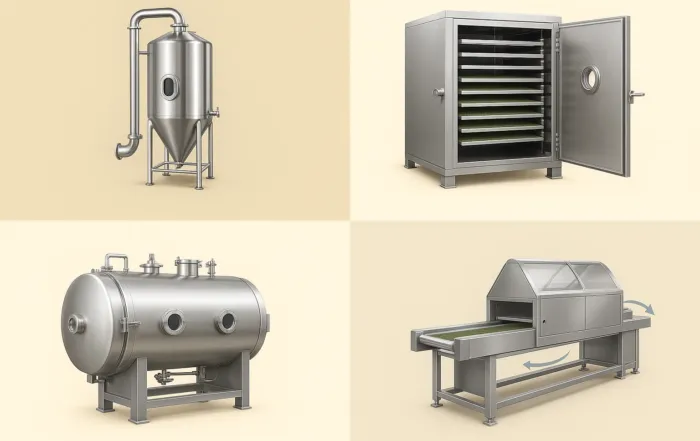
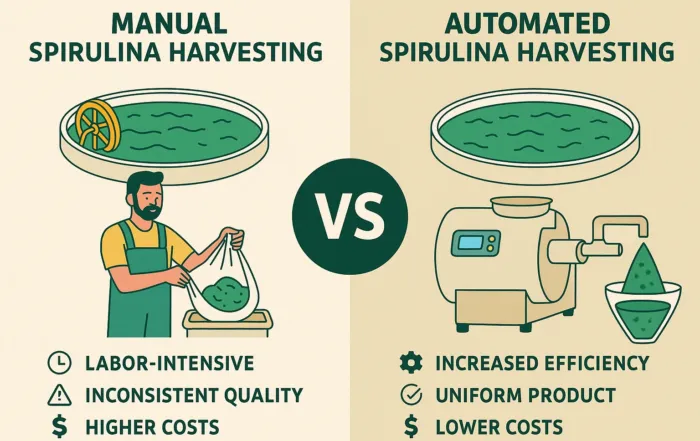
Automation is not optional for a commercial farm aiming at export and nutraceutical buyers. Manual harvesting leads to contamination, inconsistent quality and failed audits. A complete line includes:
- 80-mesh pre-filtration
- A 500-mesh rotary drum harvesting system built in SS 316
- A dewatering unit producing a cake of about 20% solids
- Low-temperature drying, such as Refractance Window Drying, keeping spirulina below 45°C
- Air classifier or ball mill powdering with nitrogen flushing
- Sieving and metal detection
- Hygienic packing systems using vacuum-sealed multi-layer foil bags
We use automation for harvesting and processing, not for culturing. Sunlight remains the most economical energy source, and commercial farms don’t need artificial lighting.
Step 6: Build an In-House Lab
Every batch should be tested before sale. Your lab should have separate analytical and microbiological sections and follow HACCP guidelines. It must be able to test protein, moisture, pigments, microbial counts and more, with heavy metals checked against specification.
Step 7: Train Your Team
Well-trained operators know how to manage temperature through agitation and pond depth, control contamination, calibrate equipment, and keep HACCP-compliant records. Skilled people matter as much as good equipment.
Step 8: Get Certified
For export and premium buyers, plan for FSSAI licensing, food safety systems such as HACCP or ISO 22000, and organic certification if you target the organic market. Organic certification typically costs ₹1.75 to 3 lakh a year, and ISO 22000 setup costs ₹80,000 to ₹1.5 lakh, with audit fees extra. Read how to set up an export-ready spirulina unit.
How Much Does a Spirulina Farm Cost in Gujarat?
Setup Cost for a 1-Acre Farm
| Component | Estimated cost (₹) |
|---|---|
|
Pond construction |
15 to 18 lakh |
|
Buildings |
10 to 20 lakh |
|
Agitation systems |
5 to 8 lakh |
|
Harvesting and dewatering equipment |
10 to 12 lakh |
|
Drying system (RWD or vacuum) |
10 to 18 lakh |
|
Packaging and cleanroom |
6 to 8 lakh |
|
Automation (IoT and SCADA) |
3 to 5 lakh |
|
Lab and quality control |
10 to 12 lakh |
|
Certification and documentation |
4 to 6 lakh |
|
Total |
73 lakh to 1.07 crore |
In Gujarat, it’s wise to budget more for:
- Wind-resistant structures at coastal sites
- Rain protection and drainage in South Gujarat
- Water treatment where groundwater is saline
- Solar power, which increases upfront cost but can reduce yearly power bills
Annual Operating Costs
| Expense | 1 acre (₹ per year) | 2 to 3 acres (₹ per year) |
|---|---|---|
|
Power and accessories |
6.47 lakh |
11.87 lakh |
|
Nutrients |
18 lakh |
51 lakh |
|
Testing and chemicals |
2.75 lakh |
2.75 lakh |
|
Salaries |
18 lakh |
24 lakh |
|
Miscellaneous |
5 lakh |
5 lakh |
|
Packing |
3 lakh |
4 lakh |
|
Certifications and audits |
Included in miscellaneous |
7 lakh |
|
Total |
About 53 lakh |
About 1.06 crore |
Lab testing for a full COA panel costs about ₹15,000 to ₹30,000 per batch when done externally, which is one reason an in-house lab pays for itself over time.
Realistic Returns for a Gujarat Spirulina Farm
| Farm size | Setup cost | Annual revenue | Total annual costs | Annual result |
|---|---|---|---|---|
|
1 acre |
₹1.07 crore |
₹75 lakh |
₹83.22 lakh |
Loss of about ₹8.2 lakh |
|
3 acres |
₹2.1 crore |
₹2 crore |
₹1.22 crore |
Profit of about ₹78 lakh (about 37% ROI) |
| Farm size | Investment range | Break-even | Best suited for |
|---|---|---|---|
|
1 acre |
₹75 to 95 lakh |
Little or no ROI |
Training or niche local sales |
|
2 to 3 acres |
₹1.5 to 2.5 crore |
About 3 years |
Commercial and export-ready production |
|
5+ acres |
₹2 crore and above |
Depends on contracts |
Only with assured international buyers |
Gujarat’s buyer ecosystem can improve on these figures. Access to premium nutraceutical, extract and export buyers helps a well-run farm sell more of its output at the upper end of the price range. For ways to improve margins, read spirulina farming profit per acre and how to maximise it.
Planning for Gujarat’s Seasonal Risks
| Season | Months | Risk | What to do |
|---|---|---|---|
|
Summer |
April to June |
Heat above 45°C, especially in the north and in Kutch |
Hourly monitoring, shade nets, pond depth control, agitator management, cold culture reserves |
|
Pre-monsoon and monsoon |
June to September |
Cyclones on the coast, heavy rain in the south |
Wind-rated structures, rain covers, drainage, salinity and nutrient checks |
|
Post-monsoon |
October to November |
Generally favourable |
Maximise production and run certification batches |
|
Winter |
December to February |
Mild slowdown on cooler nights |
Maintain culture health and adjust harvest frequency |
For coastal farms, cyclone preparedness should be part of the operating plan: securing structures, protecting culture reserves and safeguarding stored product. See how to build a crisis response plan for spirulina farms.
Government Support for Spirulina Farms in Gujarat
There is no Gujarat-specific spirulina subsidy, but producers may be able to access:
- Central food processing schemes such as PMFME
- State industrial and agro-processing support for processing infrastructure
- MSME schemes for small-scale units
- Post-harvest infrastructure support for dryers, storage and packing
Scheme details change often, so confirm current eligibility with the relevant departments. Subsidies usually cover only part of the cost and require a detailed project report. Read our guide to government subsidies for spirulina cultivation.
How We Help You Build a Spirulina Farm in Gujarat
Gujarat’s market advantages only pay off if your farm consistently produces the quality those buyers demand. That depends on getting the design, equipment and processes right from the start.
When you work with us, we:
- Assess your site, including water testing, climate data, cyclone exposure and nearby pollution risks
- Match the farm to your market, whether export, nutraceutical, extract-grade or feed
- Design ponds and structures for local conditions, from heat control in the north to rain and wind protection on the coast
- Integrate automated harvesting, dewatering, drying and packing into one continuous line
- Set up your in-house lab so every batch has a COA
- Train your team and support you through stabilisation and certification
We have been recognised as Best Microalgae Company by the European Algae Biomass Association in Paris. Our turnkey spirulina farming solutions start from ₹1 crore / US $200,000, and our spirulina farming consultancy can help you evaluate your land and market before you invest.
Frequently Asked Questions
Is Gujarat good for spirulina farming?
Yes. Gujarat combines a warm climate with strong access to nutraceutical, feed and export buyers. Farms need careful planning for heat, water quality, monsoon rain and cyclone exposure.
Which part of Gujarat is best for spirulina farming?
Central Gujarat generally offers the best balance of climate, water access and buyers. North Gujarat and inland Saurashtra also work well with good heat and water management.
Can spirulina be grown with seawater in Gujarat?
Not directly. Spirulina grows best at much lower salinity than seawater. Mildly brackish groundwater may be usable after testing and treatment.
How much does it cost to start a spirulina farm in Gujarat?
A properly built 1-acre farm costs about ₹73 lakh to ₹1.07 crore. A commercially viable 2 to 3 acre farm typically requires ₹1.5 to 2.5 crore.
Can I export spirulina from Gujarat?
Yes, and Gujarat’s ports make it easier. Export buyers require certifications such as USDA or EU Organic, full traceability and lab-tested batches.
Gujarat: Where Spirulina Meets Its Market
Gujarat gives spirulina producers a rare combination: a climate that supports year-round growth, and a market ecosystem of nutraceutical manufacturers, feed companies and export ports right on the doorstep.
Turning that advantage into profit comes down to building at the right scale, protecting your farm from the state’s heat, salinity, rain and cyclones, and producing consistent, certified spirulina that premium buyers trust. Get those fundamentals right, and a Gujarat spirulina farm can serve markets far beyond the state.
Make us your source on Google
Table Of Contents