Growing spirulina is only half the business. The other half, the half that decides whether you’re profitable, is who you sell to and at what price. Many farmers produce decent biomass and then sell it as an undifferentiated commodity for a fraction of what it could fetch. This guide maps India’s spirulina buyers, explains why prices vary so widely, and lays out exactly how farmers can move up the value chain and sell at better prices.
Who Actually Buys Spirulina in India
Spirulina isn’t sold into a single market. It flows into several distinct buyer segments, each with different quality demands and very different price points.
| Buyer Segment | What They Buy | Price Level | Quality Demand |
| Nutraceutical & supplement brands | High-grade powder for tablets, capsules | Highest | COA, certifications, consistency |
| Food & beverage companies | Food-grade powder for functional foods | High | Food-safety compliance |
| Cosmetics & wellness | Pigment-rich powder for masks, serums | High | Purity, phycocyanin content |
| Exporters (US, EU, Japan) | Certified, traceable biomass | Premium | Organic + international certification |
| Animal & aqua feed | Bulk biomass | Lowest | Basic, price-driven |
The gap between the top and bottom of this table is enormous. Commodity feed-grade powder trades in a low band, while certified, high-phycocyanin export-grade material commands multiples of that. Which band you land in isn’t luck, it’s a function of quality, documentation, and how you sell.
Why Spirulina Prices Vary So Much
Indian spirulina powder is listed across an extremely wide price range, from very low bulk rates to premium organic pricing. The spread reflects one thing above all: grade. And grade is set by the production and quality standards this guide to spirulina quality control and safety in mass production explains in detail.
The factors that move a farmer from the bottom band to the top:
- Protein content: premium buyers expect above 60%; a Certificate of Analysis proving 65% fetches more than unverified powder
- Phycocyanin level: the blue pigment (target 10% or higher) is a headline value driver, especially for nutraceutical and cosmetic buyers
- Drying method: refractive window drying that preserves phycocyanin protects the colour and nutrients that justify premium pricing, while high-heat drying degrades them
- Contamination and heavy metals: clean results (lead below 0.20 ppm, absent pathogens) are non-negotiable for premium and export sales
- Certification: organic and food-safety certification unlock the highest bands
The Single Biggest Lever: Quality Documentation
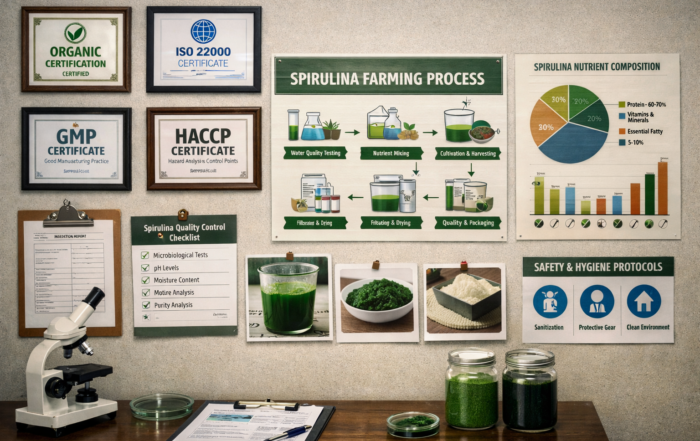
Here’s the hard truth many farmers learn too late: buyers don’t pay for claims, they pay for proof. A batch that looks good but arrives without a Certificate of Analysis gets commodity pricing. The same batch with a full COA, protein above 60%, phycocyanin at or above 10%, heavy metals within limits, pathogens absent, can access premium buyers.
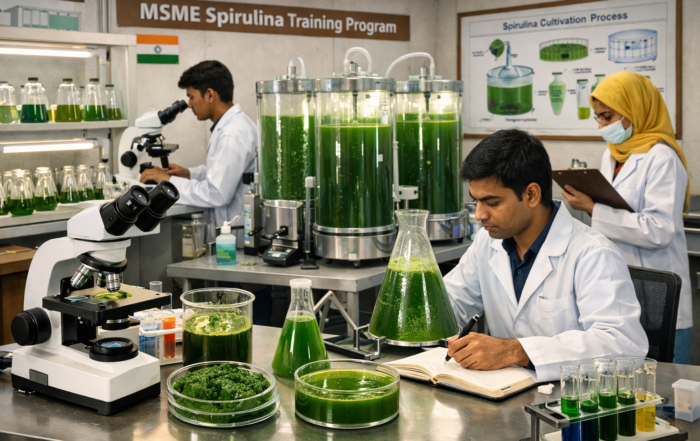
An in-house lab is mandatory for certification and for generating a COA on every batch. This isn’t overhead; it’s the tool that moves your product up the price ladder. Farms that skip it are structurally locked into the lowest-margin feed segment.
How Farmers Can Sell at Better Prices
Moving up the value chain is a deliberate strategy, not an accident. The levers that work:
- Produce to a grade, not just a quantity. Target the protein, phycocyanin, and purity specs premium buyers require, and prove them with a COA. Consistent grade is what turns a one-off sale into a repeat contract.
- Get certified. Organic and food-safety certification (backed by traceability and batch testing) are the entry ticket to nutraceutical, food, and export buyers. Never label a product organic without certification, doing so is a punishable offence in India, not a shortcut.
- Dry it right. Because automation-driven consistency in production and controlled drying preserve phycocyanin and colour, they directly protect the attributes buyers pay premiums for.
- Sell direct, skip the middleman. Selling raw biomass to an aggregator captures the least value. Building relationships with nutraceutical brands, food companies, or exporters, or developing your own branded product, captures far more.
- Target export where you can meet the bar. Exporters serving the US, EU, and Japan pay premium rates, but only for certified, traceable, consistently high-grade material. Meeting that bar is demanding, but it’s where the best prices live.
| Strategy | Effort | Price Impact |
| Sell bulk to aggregators | Low | Lowest price |
| Produce certified food-grade + COA | Medium | Significant uplift |
| Supply nutraceutical/cosmetic brands direct | Medium-High | High uplift |
| Export certified organic | High | Highest price |
The Scale Connection
Selling at better prices also depends on being able to supply reliably. Buyers want consistent volume and consistent quality, which is why sub-scale farms struggle even when their product is good. A 1-acre farm rarely produces enough certified, uniform biomass to hold a premium contract, while a commercial 2 to 3 acre farm returning around 37% ROI can. Price and scale reinforce each other: scale earns you access to better buyers, and better buyers make scale profitable.
Positioning Your Farm to Win Better Buyers
The farmers who consistently sell at the top of the market do three things: they produce to a verifiable grade, they get certified, and they build direct buyer relationships instead of dumping biomass into the commodity pool. Getting there is easier with production systems built for consistency and compliance from day one.
Greenbubble, a turnkey spirulina farm infrastructure company, helps farmers build for premium markets through end-to-end spirulina farming consultancy and complete turnkey spirulina farm solutions, including the lab, drying, and quality systems that unlock better pricing. With 10+ years of experience, operations across 10+ countries, recognition as Best Microalgae Company by the European Algae Biomass Association in Paris, and a customer base that accounts for more than 90% of India’s spirulina production, its designs are built to reach the buyers who pay the most. See real deployments on the Greenbubble spirulina project case studies page.
Frequently Asked Questions
Who are the main buyers of spirulina in India?
Nutraceutical and supplement brands, food and beverage companies, cosmetics makers, exporters, and animal-feed producers. The first four pay premium prices; feed buyers pay the least.
Why do spirulina prices vary so much?
Grade. Certified, high-protein, high-phycocyanin powder with a Certificate of Analysis commands far more than unverified commodity biomass. Quality documentation is the main price driver.
How can a farmer get a higher price?
Produce to a verifiable grade, obtain organic and food-safety certification, dry using phycocyanin-preserving methods, and sell direct to premium buyers or export markets rather than to aggregators.
Is exporting worth it?
Yes, if you can meet the bar. Export buyers in the US, EU, and Japan pay premium rates, but demand certification, traceability, and consistent high quality.
Do I need a lab to sell at better prices?
Effectively, yes. An in-house lab lets you generate a COA for every batch, which is what premium and export buyers require before they’ll pay premium prices.
The Bottom Line
The difference between a struggling spirulina farm and a profitable one often isn’t the growing, it’s the selling. India’s spirulina buyers span a huge price range, and where you land is decided by grade, certification, drying quality, and how directly you sell. Produce to a provable standard, get certified, protect your phycocyanin, and build relationships with buyers who pay for quality. Do that, and you stop selling a commodity and start selling a premium product.
Make us your source on Google
Table Of Contents