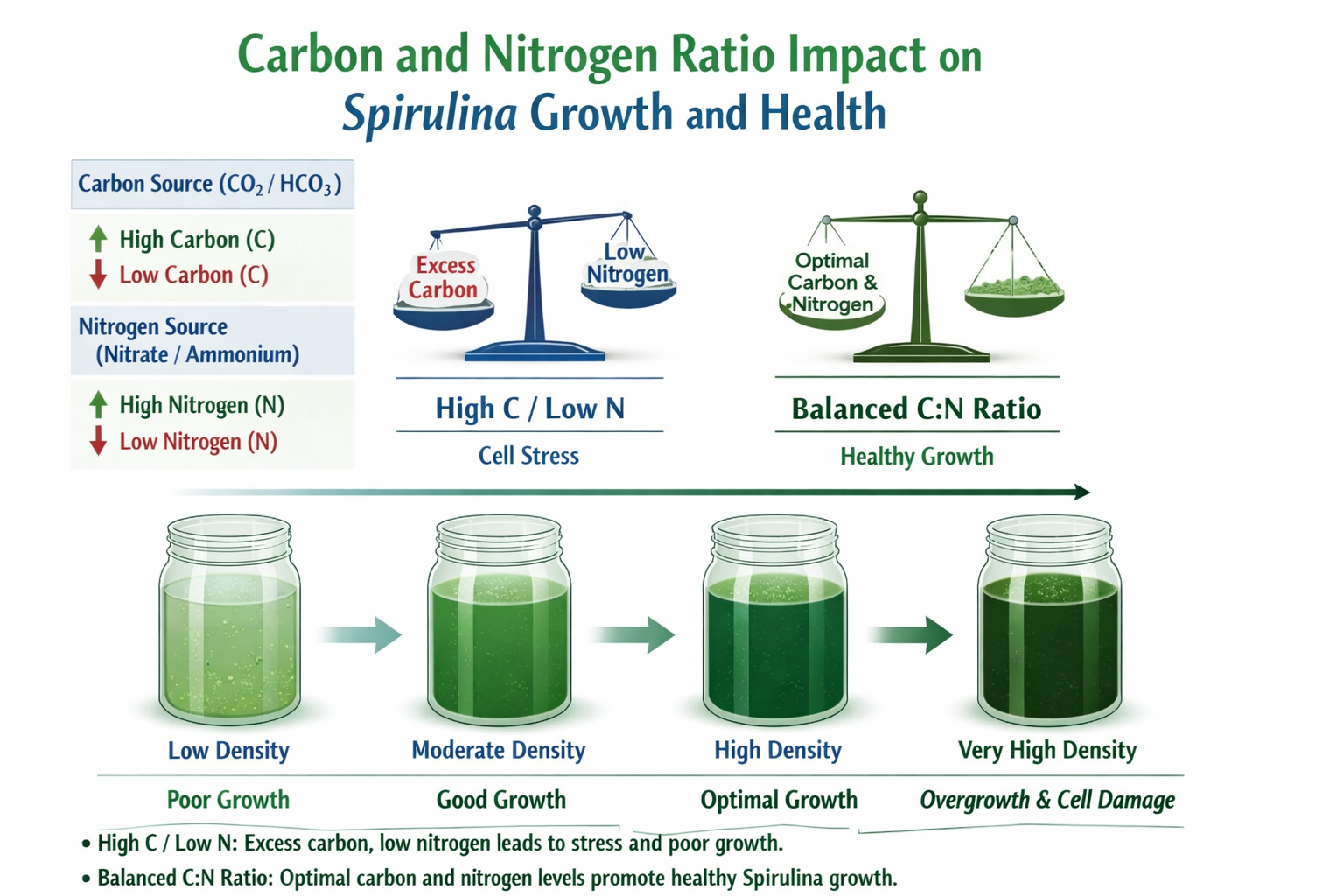
In high-density spirulina cultivation, yield limitations are rarely caused by light or temperature alone. More often, productivity bottlenecks emerge from imbalances in nutrient assimilation-particularly the relationship between carbon and nitrogen. The carbon–nitrogen (C:N) ratio governs how spirulina allocates energy between biomass expansion, protein synthesis, and metabolic stability. In commercial farms operating at scale, managing this ratio is not an optimisation tactic; it is a foundational requirement for consistent yield and quality.
Why the Carbon–Nitrogen Balance Matters at High Density
As culture density increases, spirulina’s metabolic demand for carbon and nitrogen rises non-linearly. Carbon drives photosynthesis and energy storage, while nitrogen determines protein synthesis and cellular growth. When either element becomes limiting, metabolism shifts toward survival rather than productivity.
High-density systems magnify these effects. Minor imbalances that go unnoticed in low-density ponds quickly translate into protein drift, pigment loss, and unstable growth curves when biomass concentration is pushed higher.
Common Misconceptions Around C:N Ratio Management
Several misconceptions persist in commercial operations:
- Increasing nitrogen alone will boost protein content
- Carbon availability is rarely limiting in open ponds
- Fixed nutrient dosing schedules are sufficient
- C:N ratio matters only during the growth phase
In practice, these assumptions lead to metabolic stress, inefficient nutrient use, and escalating operating costs.
Carbon Metabolism in Spirulina Cultures
Carbon is assimilated through photosynthesis and stored primarily as glycogen. This stored carbon fuels night-time metabolism, repair processes, and early-morning growth before photosynthesis ramps up. In high-density cultures, carbon depletion occurs faster due to increased biomass competing for available bicarbonate or organic carbon sources.
Without timely carbon replenishment, spirulina reduces protein synthesis and pigment production even if nitrogen remains available.
Nitrogen Assimilation and Protein Synthesis
Nitrogen availability directly controls protein formation. Spirulina assimilates nitrogen primarily in nitrate form, incorporating it into amino acids and enzymes. However, nitrogen assimilation is energy-intensive and depends on adequate carbon availability.
Excess nitrogen in a carbon-limited system does not increase protein content. Instead, it accumulates unused in the medium, raising costs and increasing the risk of metabolic imbalance.
Optimal Carbon–Nitrogen Ratios in Commercial Ponds
Field observations from large-scale farms indicate that maintaining a balanced C:N ratio is more effective than maximising individual nutrient concentrations. While exact ratios vary with temperature, light intensity, and culture density, stable systems consistently show:
- Adequate carbon availability during peak photosynthesis
- Sufficient nitrogen to support protein synthesis without excess
- Dynamic adjustment of inputs based on pH trends and growth rate
In engineered raceway pond systems, these adjustments are easier to implement due to uniform mixing and predictable flow patterns.
Interaction Between C:N Ratio and pH Dynamics
pH serves as a real-time indicator of carbon consumption. Rising pH reflects carbonic acid depletion during active growth. In high-density cultures, rapid pH escalation signals carbon limitation even when nitrogen levels appear adequate.
Precision mixing using efficient agitator systems helps distribute nutrients evenly and prevents localised depletion zones that accelerate metabolic stress.
C:N Ratio in Continuous Harvesting Models
Continuous harvesting increases nutrient turnover and shortens recovery windows. Removing biomass also removes embedded carbon and nitrogen, altering the internal nutrient balance of the culture.
Automated harvesting equipment allows precise control over harvest volumes, enabling operators to align carbon and nitrogen replenishment with actual biomass removal rather than estimated schedules.
Organic Cultivation and C:N Sensitivity
Organic spirulina systems operate under stricter input constraints. Carbon sources and nitrogen inputs must be certified, limiting corrective flexibility. Using approved organic feed inputs requires tighter monitoring of nutrient utilisation to avoid imbalances that cannot be easily corrected.
Greenbubble integrates C:N management into organic SOPs to maintain protein consistency without violating certification requirements.
Nutrient Imbalance and Protein Recovery Efficiency
C:N imbalance primarily affects how much of the grown biomass converts into recoverable protein, not just total biomass. Cultures grown under nitrogen excess or carbon limitation often show acceptable growth but poor protein recovery efficiency during downstream analysis.
From a commercial perspective, this means higher cultivation cost per unit of usable protein. Even when yields look strong on paper, the economics weaken because buyers pay for protein content, not wet biomass. Poor C:N discipline therefore erodes margins quietly, through lower value extraction, not obvious production failure.
Indicative C:N Ratio Behaviour in High-Density Spirulina Systems
| Indicative C:N Behaviour | Observed Culture Response | Impact on Quality & Yield | Operational Interpretation |
| Carbon-limited, nitrogen sufficient | Rapid pH rise, slower regrowth | Protein % drift, pigment reduction | Increase carbon availability before adding nitrogen |
| Carbon sufficient, nitrogen-limited | Stable pH, pale culture colour | Lower protein content, slower biomass gain | Adjust nitrogen input cautiously |
| Balanced carbon and nitrogen | Stable pH trend, uniform growth | Consistent protein, pigments, COA | Target operating zone for commercial farms |
| Excess nitrogen, carbon constrained | Nutrient accumulation, stress signs | No protein gain, higher operating cost | Reduce nitrogen dosing, rebalance inputs |
| Excess carbon, limited nitrogen | Darker culture, inefficient growth | Wasted carbon input, poor ROI | Optimise nitrogen supply to match carbon |
Practical Guidelines for Managing C:N Ratio at Scale
Effective C:N ratio management in high-density spirulina farms typically involves:
- Monitoring pH trends as a proxy for carbon consumption
- Adjusting carbon inputs dynamically with growth rate
- Avoiding excess nitrogen dosing without confirmed carbon availability
- Synchronising nutrient replenishment with harvest cycles
- Using data-driven oversight through spirulina farming consultancy support informed by Greenbubble’s operational experience
These practices prioritise long-term stability over short-term yield spikes.
FAQs
Q1. Does increasing nitrogen always raise protein content?
No. Protein synthesis depends on both nitrogen availability and sufficient carbon-derived energy. Excess nitrogen without carbon support does not improve protein levels.
Q2. How can farmers detect carbon limitation early?
Rapid pH rise during active growth is one of the earliest indicators of carbon depletion, especially in high-density systems.
Q3. Are fixed nutrient dosing schedules effective?
Fixed schedules often fail in high-density or continuous harvesting systems. Dynamic dosing based on real-time indicators produces more stable results.
Q4. Why are organic systems more sensitive to C:N imbalance?
Organic systems have limited corrective inputs, making precise nutrient balance essential to prevent irreversible quality drift.
Q5. Can processing technology compensate for poor C:N control?
No. Processing preserves existing quality but cannot restore protein or pigment losses caused by upstream metabolic imbalance.
Conclusion: Nutrient Balance Defines the Ceiling of Productivity
In high-density spirulina cultivation, the carbon–nitrogen ratio defines how far productivity can be pushed without sacrificing quality. Farms that manage this balance proactively achieve stable yields, consistent protein levels, and predictable economics. Treating C:N ratio as a controllable process variable-rather than a background parameter-is what separates scalable, export-ready operations from those that plateau early.
Table Of Contents