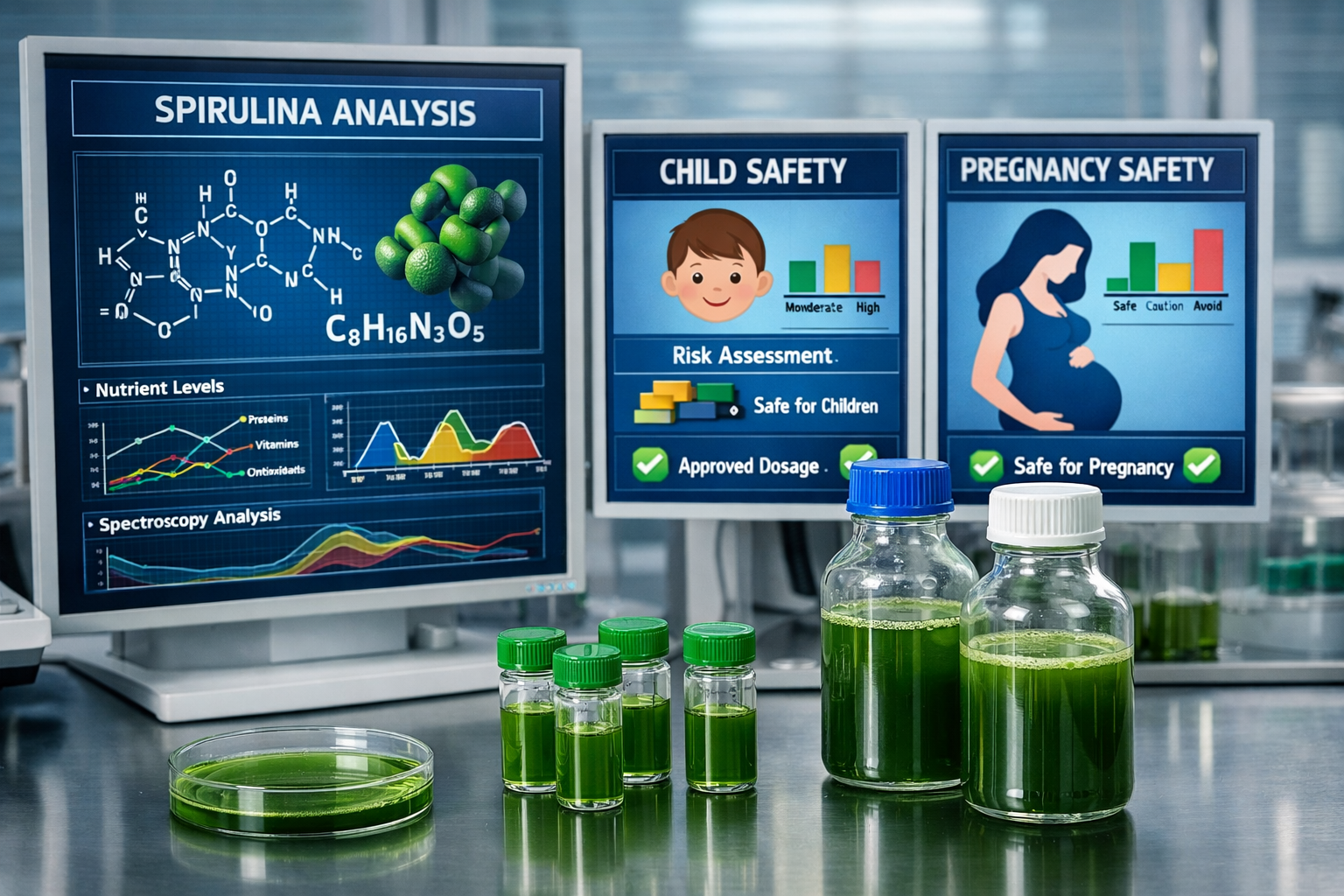
Spirulina is widely promoted as a nutrient-dense natural supplement, often described as a “superfood” because of its high protein content, vitamins, minerals, and bioactive compounds. This popularity naturally raises an important and sensitive question: is spirulina safe for pregnant women and for children?
When it comes to pregnancy and early childhood, safety standards are far more stringent than for general adult consumption. Nutrient needs are different, tolerance levels are narrower, and the consequences of contamination or overdosing are significantly higher. Therefore, the safety of spirulina in these groups cannot be evaluated based only on its nutritional profile-it must also be assessed through quality, purity, dosage, and regulatory context.
This article examines spirulina safety during pregnancy and for kids from a scientific and practical standpoint, separating potential benefits from real risks and explaining why sourcing and processing standards are critical.
Understanding What Spirulina Contains
Spirulina (Arthrospira) is a microscopic cyanobacterium rich in both macro- and micronutrients. Its composition explains why it attracts interest for maternal and child nutrition-but also why caution is required.
Key components include:
- High-quality protein with essential amino acids
- Iron, calcium, magnesium, and trace minerals
- B-complex vitamins and antioxidants
- Pigments such as phycocyanin and chlorophyll
While these nutrients are beneficial in principle, their concentration and bioavailability vary depending on cultivation and processing methods.
Spirulina During Pregnancy: What Needs Special Attention
Pregnancy is a physiologically sensitive period. Any supplement consumed during this time must meet higher safety thresholds.
Potential Nutritional Benefits
Spirulina is often discussed in the context of pregnancy because it contains:
- Iron, which supports increased maternal blood volume
- Protein, which contributes to fetal tissue development
- Antioxidants that may help counter oxidative stress
However, these potential benefits do not automatically make spirulina a recommended supplement during pregnancy.
Safety Considerations and Risks
The main safety concerns related to spirulina during pregnancy are not inherent to spirulina itself, but to how it is produced.
Key risks include:
- Heavy metal contamination (lead, mercury, arsenic)
- Microbial contamination if hygiene is inadequate
- Presence of toxins from contaminating algae species
- Overconsumption of certain micronutrients
Pregnant women are particularly vulnerable to these risks because contaminants can cross the placental barrier.
What Current Evidence Suggests
Scientific literature generally indicates that spirulina can be safe when it is:
- Produced under controlled conditions
- Tested for contaminants
- Consumed in moderate amounts
However, large-scale, definitive clinical trials specifically focused on pregnancy are limited. As a result, most medical professionals advise that pregnant women consult a healthcare provider before consuming spirulina supplements.
Is Spirulina Safe for Children?
Children have different nutritional requirements and lower tolerance thresholds compared to adults. This makes dosage and purity especially important.
Potential Benefits for Kids
In controlled settings, spirulina has been studied for its potential role in:
- Supporting protein intake
- Addressing certain micronutrient deficiencies
- Complementing diets with limited diversity
Some nutrition programs and research studies have explored spirulina supplementation in children under medical or institutional supervision.
Key Safety Concerns for Children
For children, the primary concerns include:
- Risk of contamination due to lower body weight
- Immature detoxification systems
- Inappropriate dosage leading to gastrointestinal discomfort
Children should never consume spirulina sourced from unverified or informal supply chains.
Why Quality and Source Matter More Than the Ingredient
When discussing spirulina safety, the most important factor is not whether spirulina is “natural,” but how it is cultivated, processed, and tested.
High-quality spirulina intended for sensitive groups must meet strict criteria:
- Controlled water quality during cultivation
- Absence of toxic algae contamination
- Verified heavy metal and microbial test reports
- Gentle drying methods that avoid degradation
This is why professionally managed systems-such as those aligned with Greenbubble-style production frameworks-emphasise quality control and traceability at every stage rather than relying on post-hoc testing alone.
Who Should Avoid Spirulina
While spirulina may be considered under supervision in some cases, there are groups for whom spirulina consumption is generally discouraged unless explicitly advised by a medical professional.
These include:
- Pregnant women with autoimmune conditions, as spirulina may stimulate immune activity
- Individuals with known allergies to algae or iodine sensitivity
- Children with metabolic or renal disorders where mineral balance is tightly regulated
- Pregnant women already on iron or micronutrient supplementation at therapeutic doses
- Anyone advised by a healthcare provider to avoid supplements due to high-risk pregnancy or medical complications
In these situations, the potential risks of spirulina intake may outweigh any nutritional benefit.
Quality Checklist for Pregnancy and Child Use
When spirulina is evaluated for use during pregnancy or for children, quality expectations must be significantly higher than for general adult supplementation.
| Quality Parameter | Why It Matters for Pregnancy & Kids |
| Heavy metal testing | Prevents placental transfer and toxicity risk |
| Microbial safety | Reduces infection and gut irritation risk |
| Absence of toxic algae | Ensures no cyanotoxin exposure |
| Controlled drying method | Preserves nutrients without heat damage |
| Batch-wise COA | Enables traceability and accountability |
| Transparent sourcing | Reduces risk from informal supply chains |
Only spirulina that meets these criteria should even be considered for sensitive population groups, and always with medical guidance.
Dosage Considerations
Dosage plays a critical role in safety, especially for pregnancy and childhood use.
General principles include:
- Lower doses compared to adult supplementation
- Gradual introduction rather than sudden intake
- Monitoring for any adverse reactions
There is no universally accepted dosage standard for pregnant women or children, reinforcing the need for medical guidance.
Regulatory and Medical Perspective
Spirulina is typically classified as a dietary supplement, not a medicine. This means regulatory oversight varies by country.
Important implications include:
- Supplements are not regulated as strictly as pharmaceuticals
- Quality varies widely between manufacturers
- Medical endorsement depends on individual health context
Healthcare professionals often focus on risk minimisation rather than potential benefit when advising pregnant women and parents.
Common Myths Around Spirulina, Pregnancy, and Kids
| Myth | Reality |
| Spirulina is always safe because it is natural | Natural does not guarantee safety or purity |
| More nutrients mean better outcomes | Excess intake can create imbalances |
| All spirulina products are the same | Quality depends heavily on production standards |
Practical Guidelines for Parents and Expecting Mothers
While individual advice should always come from a healthcare professional, practical considerations include:
- Choosing spirulina only from suppliers with full testing transparency
- Avoiding products without batch-wise COA documentation
- Not using spirulina as a replacement for prescribed supplements
- Being cautious of exaggerated health claims
FAQs
Q1. Is spirulina recommended during pregnancy?
Spirulina is not universally recommended during pregnancy and should only be consumed after consulting a healthcare professional.
Q2. Can children take spirulina daily?
Children should only take spirulina under medical or nutritional supervision and in appropriate doses.
Q3. What is the biggest safety risk with spirulina?
Contamination with heavy metals or toxins due to poor-quality production is the primary risk.
Q4. Does cooking or processing spirulina make it safer?
Proper processing improves safety, but contamination risks must be addressed at the cultivation stage.
Q5. How can I verify spirulina quality?
Look for third-party lab reports, traceability, and controlled production practices.
Conclusion
Spirulina has a strong nutritional profile that makes it an ingredient of interest for maternal and child nutrition, but safety depends far more on quality, dosage, and medical context than on nutrient content alone.
For pregnant women and children, spirulina should never be treated as a casual supplement. Carefully sourced spirulina produced under controlled, transparent systems-such as those following Greenbubble-aligned production principles-offers a safer foundation, but individual medical guidance remains essential.
Table Of Contents