Introduction
In an era of rapid climate change, land degradation, and water scarcity, spirulina farming has gained recognition as one of the most sustainable agricultural systems in the world. Spirulina — a microscopic cyanobacterium rich in protein, vitamins, and antioxidants — offers not only health benefits but also a scalable, eco-friendly solution to modern agricultural challenges. Unlike traditional livestock or crop farming, spirulina cultivation uses limited land and water, generates minimal waste, and can even contribute to carbon capture and circular economy models.
As global awareness grows, governments and businesses are recognizing spirulina as a key ingredient in future food systems, supporting both environmental sustainability and food security. It has become a major component of green protein movements in countries such as India, the USA, France, and Japan.
For insight into large-scale cultivation and yield optimization, see The Ultimate Guide to Mass Producing Spirulina: Key Steps for Commercial Success.
Environmental Advantages of Spirulina Farming
Spirulina’s sustainability lies in its resource efficiency and environmental adaptability. It grows rapidly in controlled ponds, requires minimal land, and converts CO₂ into oxygen at exceptionally high rates — all while producing one of the most nutrient-dense foods known to humankind.
1. Water Efficiency and Recycling
Conventional crops like soy or livestock consume vast amounts of freshwater, leading to depletion of aquifers and loss of biodiversity. Spirulina, however, thrives in alkaline or brackish water and can recycle up to 90% of its water using closed-loop systems.
| Comparison | Water Required per kg Protein | Water Recyclability | Typical Water Source |
| Spirulina | ~1,500 liters | 85–90% | Borewell / Alkaline Water |
| Soy | ~9,000 liters | 30–40% | Freshwater |
| Beef | ~15,000 liters | Negligible | Surface Water |
This makes spirulina ideal for semi-arid, saline, or nutrient-depleted areas, reducing the need for freshwater resources.
2. Minimal Land Requirement
Land scarcity is one of the biggest barriers to sustainable food production. Spirulina’s productivity per acre outperforms almost every conventional protein source.
| Crop | Protein Yield (tons/acre/year) | Land Requirement vs. Spirulina | Remarks |
| Spirulina | 5–7 | 1x | Highest yield per area |
| Soy | 0.25–0.3 | 20x | Requires fertile land |
| Beef | 0.03 | 200x | Requires grazing land & water |
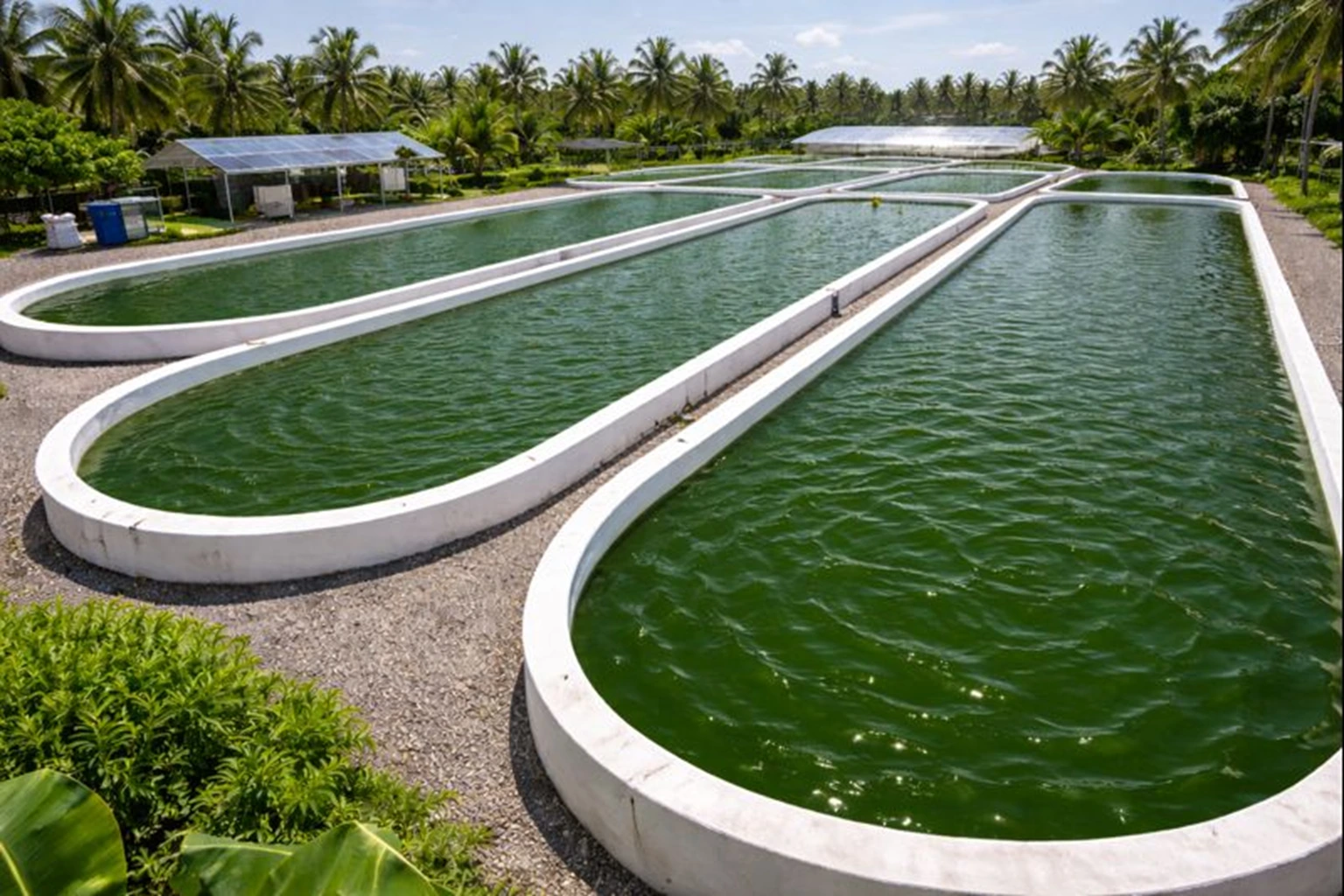
Even in limited spaces, modular raceway ponds can produce consistent biomass throughout the year, making spirulina a land-use-efficient alternative for future protein systems.
3. Carbon Sequestration and Climate Mitigation
Spirulina captures and converts CO₂ through photosynthesis at rates far higher than trees or crops. A single 1-acre spirulina farm can absorb and capture 1.8–2 tons of CO₂ per month, significantly reducing atmospheric greenhouse gases. This makes it a viable solution for carbon credit projects and sustainability-linked investments.
Learn more in The Future of Carbon Capture Projects: A Key to Combatting Climate Change.
4. Renewable Energy Integration
Modern spirulina facilities now integrate solar, wind, and hybrid power systems to minimize carbon footprints. Energy-efficient processes such as Refractive Window Drying (RWD) and vacuum drying preserve nutrients while reducing energy consumption. These green technologies ensure spirulina farming aligns with global renewable energy goals. (Spirulina Drying Methods: Comparison)
Sustainable Farming and Processing Practices
A truly sustainable spirulina farm focuses on minimizing inputs, reusing outputs, and maintaining consistent ecological balance.
1. Closed-Loop Nutrient and Water Management
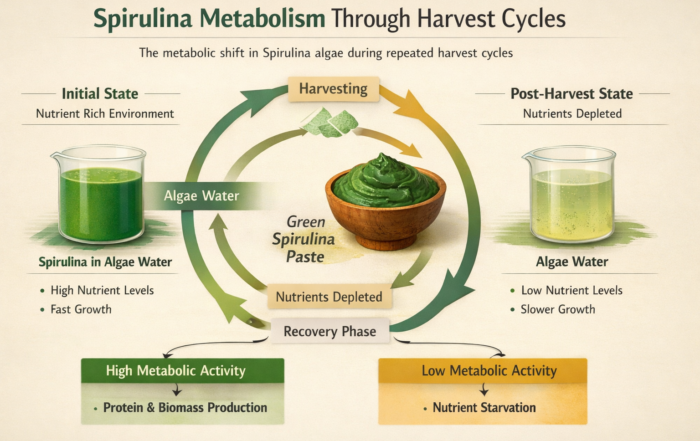
Spirulina systems use nutrient recycling protocols — water is filtered after each harvest and returned to the ponds after nutrient balancing. This practice reduces effluent discharge and ensures zero contamination of nearby ecosystems.
2. Organic and Non-Toxic Nutrient Sources
Sustainable spirulina farms rely on OMRI-approved organic fertilizers and avoid synthetic urea or harmful salts. This maintains water quality, supports organic certification, and aligns with USDA Organic and EU Organic standards. (Spirulina Quality Control in Mass Production: Ensuring Consistency and Safety)
3. Zero-Waste Utilization
Byproducts such as residual biomass, wash water, and even CO₂-rich exhaust air can be reused. Residual biomass becomes biofertilizer, and filtered wash water is repurposed for nutrient replenishment. This results in nearly zero solid or liquid waste output.
4. Automation and Smart Systems
Automated monitoring systems ensure stable culture parameters and reduce manual error. IoT and SCADA-enabled farms optimize pH control, nutrient dosing, and agitation patterns — significantly improving efficiency. (Automation in Spirulina Farming: How Technology Can Boost Mass Production)
Socioeconomic and Community Sustainability
Sustainability isn’t just environmental — it extends to human welfare and economic growth.
Employment and Rural Development
Spirulina farms create stable rural employment across production, lab analysis, and packaging. In many developing regions, they empower women and smallholders by offering training and franchise opportunities.
Nutritional Impact and Food Security
Rich in protein, vitamins, and iron, spirulina is a crucial supplement in malnutrition programs run by UNICEF and WHO. Local spirulina cultivation ensures community access to affordable, nutrient-dense food.
Inclusive Growth
Unlike industrial agriculture, spirulina cultivation has a low entry barrier — modular ponds can start small and scale up gradually. Cooperative and MSME models make it accessible to small farmers while ensuring collective benefits.
Export and Revenue Potential
Certified organic farms can target global nutraceutical and superfood markets, earning premium returns. (Spirulina Farming for Export to the US and Europe)
Environmental Challenges and Solutions
Despite its promise, spirulina farming faces certain sustainability challenges that require innovation and responsible management.
| Challenge | Impact | Sustainable Solution |
| High Energy Use in Drying | Increases carbon footprint | Adopt RWD and solar-assisted dryers |
| Water Contamination | Can degrade product quality | Use RO and UV filtration; frequent testing |
| Certification Costs | Limits access for small farms | Introduce group certification and subsidies |
| Knowledge Gaps | Reduces efficiency and yield | Conduct government-backed training programs |
For more on addressing scale and efficiency, refer to Challenges and Solutions in Scaling Spirulina Farming for Mass Production.
Future Outlook for Sustainable Spirulina Farming
As sustainability transitions from a niche to a necessity, spirulina will play a key role in the future of climate-resilient agriculture. Research is now focused on integrating AI, machine learning, and satellite monitoring to enhance yield prediction and climate adaptation.
Emerging innovations include:
- Vertical spirulina farms using stacked photobioreactors for urban agriculture.
- AI-driven nutrient optimization for automated culture management.
- Desalination-based water reuse in coastal and arid regions.
- Carbon-neutral certification programs supported by carbon credit frameworks.
Additionally, collaboration between private investors, MSMEs, and government-backed bioeconomy programs is fostering scalable, export-ready projects. See Integrated Agriculture Businesses: A Sustainable Farming Model with Spirulina Farming.
FAQs
Q1: Why is spirulina considered an environmentally friendly protein source?
Spirulina requires less land and water than traditional agriculture, recycles its resources, and actively removes CO₂ from the atmosphere, reducing overall emissions.
Q2: Can spirulina farms run entirely on renewable energy?
Yes. Solar, wind, or hybrid power can efficiently operate cultivation, drying, and packaging systems with minimal infrastructure costs.
Q3: What happens to waste produced during spirulina processing?
Almost nothing goes to waste — byproducts such as residual biomass become organic fertilizer, and filtered water is reused for cultivation.
Q4: How does spirulina farming contribute to carbon neutrality?
It absorbs more CO₂ during photosynthesis than it emits during production, making it an active carbon sink and part of carbon credit programs.
Q5: Is organic spirulina more sustainable than conventional?
Yes. Organic production ensures non-toxic nutrient sources, compliance with environmental laws, and higher long-term soil and water health.
Q6: Can small-scale farmers enter the sustainable spirulina market?
Absolutely. Modular farming designs, shared processing units, and microfinance schemes allow smallholders to participate in this green economy.
Conclusion
Spirulina farming stands as one of the most sustainable agricultural practices globally — combining ecological efficiency, economic opportunity, and social inclusiveness. From carbon absorption and water recycling to renewable energy use and rural empowerment, it exemplifies how technology and biology can work together for a greener future.
By embracing automation, renewable infrastructure, and organic certification, spirulina producers can align with global sustainability goals while feeding the world responsibly. As the planet seeks climate-positive protein sources, spirulina offers not only a nutritious food but also a blueprint for regenerative and resilient farming.
Table Of Contents