Spirulina production proposals are often written to look attractive rather than accurate. Many focus heavily on projected yields, optimistic ROI timelines, and headline costs, while underplaying technical risk, compliance gaps, and operational fragility.
Reading a spirulina proposal like an investor means looking past numbers on paper and understanding how risk, control, and accountability are actually distributed across the system.
This article explains how investors evaluate spirulina production proposals, what to scrutinise beyond surface-level claims, and how to identify whether a project is structurally investable or fundamentally fragile.
Start With What the Proposal Emphasises and What It Avoids
The first signal in any proposal is balance. Documents that devote excessive space to profit projections but little to process design are usually masking risk.
Investor-style readers look for clarity on:
- Physical system design, not just financial models
- Assumptions behind yield estimates
- Explicit treatment of failure scenarios
- Transparency around operating expenditure
If technical sections are vague or relegated to annexures, risk is being deferred to the operator.
Evaluate Scale Assumptions Carefully
Proposals often present a one-acre reference model and extrapolate linearly to three or five acres. In spirulina farming, scale is not linear.
Key questions investors ask include:
- How do raceway pond hydraulics change with length and width?
- How does agitation power scale without thermal stress?
- What harvesting throughput is required at peak biomass?
- Does drying capacity scale with production, or become a bottleneck?
If scale effects are not addressed explicitly, expansion risk is high.
Yield Numbers Without Process Control Are Meaningless
High yield figures are easy to print and hard to sustain. Investors focus on how yield stability is maintained.
A credible proposal explains:
- How mixing is stabilised across ponds using efficient agitator design
- How harvesting equipment minimises biomass damage
- How assisted dewatering systems reduce residence time and microbial load
- How drying conditions are controlled and validated
Without these mechanisms, yield projections are theoretical.
CapEx Breakdown Suggests Design Maturity
Investors analyse capital allocation patterns. A proposal that underinvests in drying, quality control, or packaging while overspending on ponds or land signals imbalance.
Healthy proposals show:
- Realistic investment in spirulina drying equipment
- Dedicated budget for packing systems
- Allowance for lab infrastructure and testing
- Contingency for automation and control upgrades
CapEx distribution reveals whether the project is engineered or improvised.
Operating Costs Tell the Real Story
Most failed projects underestimate operating expenditure.
Investor review focuses on:
- Labour dependence versus automation
- Nutrient cost assumptions
- Testing and certification expenses
- Power consumption under peak load
- Maintenance and replacement cycles
If OpEx appears artificially low, it usually indicates hidden labour, quality, or compliance risk.
Compliance and Certification Are Structural, Not Optional
Serious investors expect compliance to be designed into the proposal.
Red flags include:
- Certification described as a later add-on
- No mention of audit readiness
- Absence of documentation and traceability planning
- No clarity on export requirements
Compliance gaps translate directly into market access risk.
Risk Allocation: Who Absorbs Failure?
Investor-grade proposals clearly allocate risk.
Look for answers to:
- What happens if yields drop?
- Who bears the cost of contamination events?
- How are rejected batches handled?
- Is there buffer capacity in drying and storage?
Proposals that push all downside risk onto the operator are structurally weak.
Promotional Proposal vs Investor-Grade Proposal
| Dimension | Promotional Proposal | Investor-Grade Proposal |
| Yield projections | Aggressive, headline-focused | Conservative, process-backed |
| Scale logic | Linear extrapolation | Engineering-based scaling |
| Drying strategy | Sun or generic drying | Validated low-temperature systems |
| OpEx assumptions | Minimised or vague | Detailed and stress-tested |
| Compliance | Treated as future step | Designed into base system |
| Risk handling | Downside ignored | Explicit failure scenarios |
Proposal Red Flags Investors Notice Immediately
Certain patterns trigger immediate caution:
- Guaranteed ROI or fixed payback claims
- Absence of downside scenarios
- Reliance on sun drying or manual harvesting
- No explanation of shelf-life validation
- Vague references to “future automation”
These signals indicate promotional intent rather than investment readiness.
How Greenbubble Interprets Production Proposals
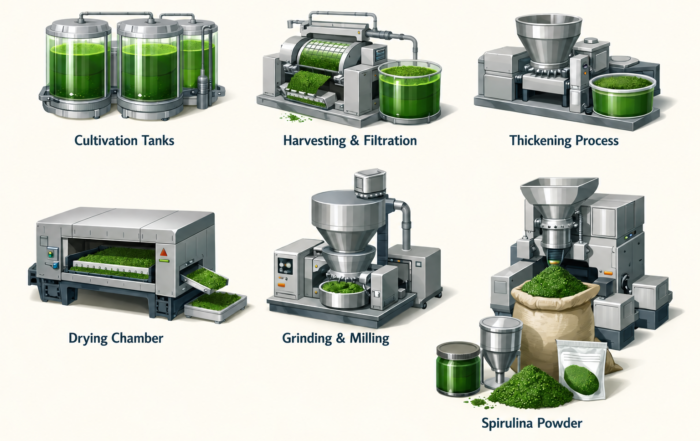
Greenbubble evaluates spirulina proposals through a system-level risk lens. Assessment begins with cultivation architecture such as raceway ponds, then moves through agitation dynamics, harvesting equipment, assisted dewatering systems, drying technologies, and packing systems.
Rather than validating headline numbers, Greenbubble focuses on whether control mechanisms are sufficient to sustain quality, certification, and scalability. This evaluation framework underpins both spirulina farming consultancy and spirulina farming turnkey solutions delivered for commercial projects.
FAQs
Q1. Should investors trust yield numbers in proposals?
Only if yield stability mechanisms are clearly explained.
Q2. Is a low-cost proposal always unattractive?
Not necessarily, but it often shifts risk rather than eliminating cost.
Q3. What section of a proposal matters most?
Process design and operating assumptions matter more than ROI tables.
Q4. Can proposals be compared directly?
Only after normalising assumptions around scale, drying, and compliance.
Q5. When should expert review be sought?
Before signing, especially for multi-acre or export-oriented projects.
Conclusion: Read Proposals for Risk, Not Optimism
An investor-grade reading of a spirulina production proposal prioritises control, resilience, and accountability over optimism. Projects that appear modest on paper but are well engineered often outperform ambitious proposals that lack structural depth. Reading proposals through a risk-first lens protects capital and increases the probability of long-term success.
Make us your source on Google
Table Of Contents