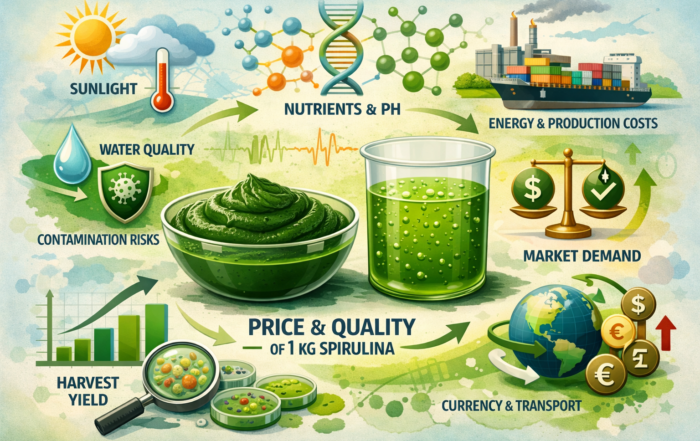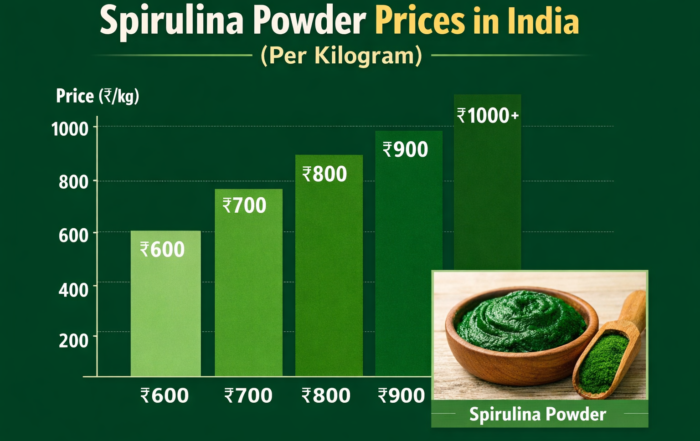
One of the most confusing realities for spirulina producers is price volatility that appears disconnected from production costs. Even when farms achieve stable yields, predictable operating expenses, and consistent quality, market prices can rise or fall sharply.
This disconnect leads many operators to assume pricing is irrational or manipulated. In reality, spirulina price behaviour is driven far more by market structure and demand segmentation than by farm-level cost curves.
This article explains why spirulina prices fluctuate despite relatively stable production costs and what producers and investors must understand to protect margins.
Stable Costs Do Not Mean Stable Prices
Once a spirulina farm reaches operational stability, major cost drivers – labour, nutrients, power, water, and maintenance – tend to flatten. Well-designed systems built around standardised raceway ponds, efficient agitator systems, harvesting equipment, assisted dewatering systems, spirulina drying equipment, and packing systems often show predictable unit costs.
However, pricing is determined downstream, where factors unrelated to production cost dominate.
Market Segmentation Drives Price Divergence
Spirulina does not trade as a single commodity. Prices differ dramatically based on end-use segments:
- Nutraceutical-grade spirulina
- Feed-grade spirulina
- Pharmaceutical or extract-grade spirulina
Each segment has its own buyers, volumes, quality thresholds, and pricing logic. Oversupply in one segment can depress prices even if production costs remain unchanged.
Inventory Cycles and Release Timing
Spirulina is not sold continuously at the moment of harvest. Inventory build-up and release cycles strongly influence pricing.
Price pressure increases when:
- Multiple producers release inventory simultaneously
- Buyers delay procurement expecting lower prices
- Importers draw down existing stock before reordering
- More production in the world during summer seasons.
These cycles create short-term price swings unrelated to farm economics.
Quality Tier Compression
Price volatility is often caused by quality-tier overlap. When nutraceutical-grade material is diverted into feed markets due to temporary demand softness, it increases apparent supply and pushes prices down.
This compression:
- Masks true demand at the premium end
- Distorts price signals
- Penalises producers with higher-quality systems
Producers without clear market alignment are most exposed to this risk.
Buyer Concentration and Negotiation Power
In many markets, spirulina buyers are more concentrated than producers. Large distributors and brand owners exert pricing pressure by:
- Aggregating demand
- Delaying contracts
- Benchmarking against lower-grade imports
This imbalance allows prices to move independently of production cost stability.
Currency, Trade, and Regulatory Effects
Spirulina pricing is also influenced by macro factors:
- Currency fluctuations in export markets
- Changes in import regulations or testing regimes
- Temporary trade restrictions or certification delays
These external variables create volatility even when farms operate smoothly.
Why Cost-Efficient Farms Still Suffer Margin Stress
Producers often assume that lowering costs insulates them from price swings. In practice:
- Price drops tend to exceed marginal cost savings
- Quality misalignment reduces bargaining power
- Short-term contracts amplify volatility exposure
Cost control is necessary but insufficient without market strategy.
Investor Perspective: Price Risk Is Structural
Investors evaluate spirulina projects based on resilience to price volatility, not just production efficiency.
Key questions include:
- Which demand segment anchors pricing?
- How defensible is the quality tier?
- What inventory buffer exists?
- Are contracts spot-based or structured?
Projects aligned with nutraceutical demand and supported by consistent quality systems tend to absorb price swings better than those chasing volume alone.
How Greenbubble Designs for Price Resilience
Greenbubble approaches spirulina projects with an emphasis on price resilience rather than cost minimisation alone. By aligning system architecture – raceway ponds, efficient agitator systems, harvesting equipment, assisted dewatering systems, spirulina drying equipment, and packing systems – with specific market segments, pricing exposure is reduced.
Through spirulina farming consultancy and spirulina farming turnkey solutions, Greenbubble helps producers design systems that maintain bargaining power even during market volatility.
FAQs
Q1. Are spirulina prices volatile globally?
Yes, but volatility varies significantly by segment and region.
Q2. Does better quality always mean higher prices?
Only when sold into the correct market segment.
Q3. Can long-term contracts stabilize prices?
They reduce volatility but may cap upside.
Q4. Is feed spirulina pricing more stable?
Usually lower but less volatile than nutraceutical pricing.
Q5. What is the biggest driver of price swings?
Demand segmentation and inventory cycles.
Conclusion: Prices Reflect Markets, Not Farms
Spirulina price volatility is not a failure of production economics – it is a reflection of fragmented markets, segmented demand, and buyer behaviour. Farms that understand this distinction design systems and strategies that protect margins even when prices fluctuate.
Make us your source on Google
Table Of Contents