Designing a spirulina pond is the cornerstone of successful organic cultivation. The pond’s structure, materials, and automation systems directly impact yield, water conservation, and compliance with international standards. The emphasizes that the latest organic pond designs must support sustainable carbon and nutrient management, automation integration, and zero contamination protocols.
A properly designed pond ensures maximum efficiency, nutrient circulation, and light utilization, while remaining compliant with USDA Organic, EU Organic, and HACCP requirements.
For details on post-setup expansion, refer to When to Scale Your Spirulina Farm.
Spirulina Pond Design Specifications
| Pond Feature | Recommended Specification | Purpose |
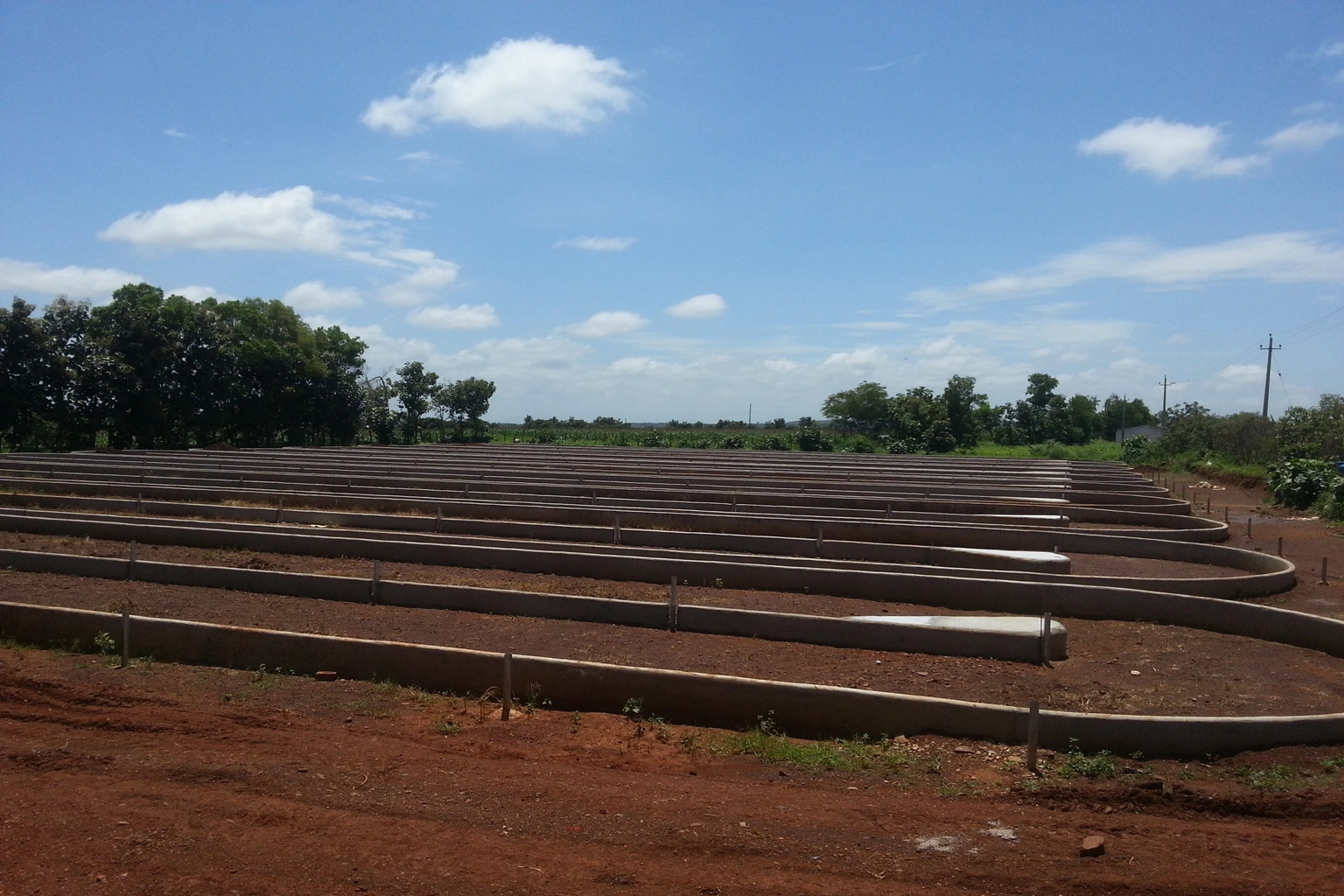
| Shape | Rectangular with rounded edges | Prevents stagnation and supports even agitation |
| Dimensions | 100 m (L) × 10 m (W) × 0.4 m (D) | Ensures optimal light and aeration |
| Slope | 1–2% gradient | Promotes smooth biomass collection |
| Lining | Food-grade HDPE or epoxy-coated concrete | Prevents leaching and supports organic compliance |
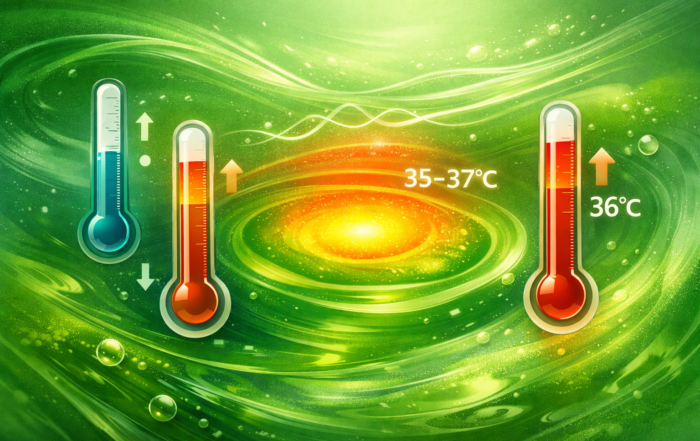
| Temperature Range | 30–35°C | Ideal for stable growth and pigment formation |
| Climate Type | Semi-arid to tropical | Avoid frost-prone or extreme heat zones (>45°C) |
A 3-acre farm layout typically accommodates up to 20 raceway ponds, along with a harvesting unit, drying zone, packaging area, storage, and an on-site lab for COA testing.
Construction Materials and Equipment
- Use food-grade HDPE liners or reinforced concrete with food-safe epoxy.
- Equip each pond with SS 316 stainless steel paddle wheels, agitators, and connecting shafts to eliminate corrosion. (Why SS 316 Is the Standard for Spirulina Equipment)
- Avoid aluminum, painted metal, or galvanized iron parts.
- Install PVC-U or HDPE pipelines for nutrient and water flow.
- Implement a solar or hybrid power system to operate paddles and filtration units.
Nutrient Management for Organic Certification
Carbon and Nitrogen Sources
- Use sodium bicarbonate as the primary carbon source, adjusting dose based on pH trends.
- Replace synthetic urea or ammonium nitrate with OMRI-approved nitrate-based or organic fertilizers.
- Organic alternatives like sugar-based carbon or dissolved plant extracts can supplement bicarbonate when pH drops.
Phosphates and Minerals
- Include potassium phosphate, magnesium sulfate, iron sulfate, zinc, and selenium in carefully measured proportions.
- For organic operations, use phosphate rock and naturally derived minerals instead of chemical salts.
Automation and Monitoring Systems
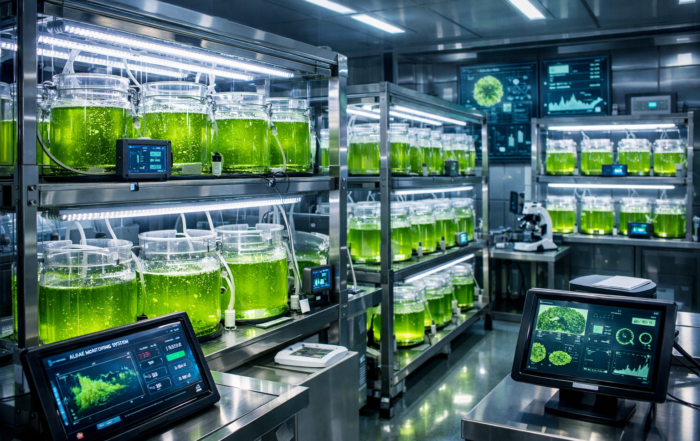
Manual systems can’t maintain precision in pH, temperature, or salinity — automation is now considered essential.
| Parameter | Recommended Range | Monitoring Method |
| pH | 9.0–11.0 | IoT-based sensors for real-time adjustment |
| Salinity | 4–20 PPT | Automated salinity probes |
| Temperature | 30–37°C | Smart thermal controllers |
| Paddle Speed | 15–20 rpm | SCADA-controlled agitators |
Automation reduces human error, ensures consistent COA quality, and improves labor efficiency by up to 30%. (Automation in Spirulina Farming at Greenbubble: How Technology Can Boost Mass Production)
Water Source and Filtration Setup
- Use borewell water filtered through sand and UV systems to remove suspended solids and microbes.
- Maintain RO purification for chemical safety and organic certification.
- Integrate nutrient recycling tanks and sedimentation basins for closed-loop water use.
- Recycle 80–90% of water, ensuring minimal wastage and environmental sustainability.
Learn more about sustainability and resource efficiency in Is Spirulina Farming Sustainable?.
Harvesting and Drying System Design
- Use 500-mesh or finer nylon filters or rotary drum filtration systems for biomass collection.
- Employ SS 316 ball mills or air classifier mills for grinding under GMP conditions.
- For nutritional-grade spirulina, use Greenbubbles Refractance Window Drying (RWD) to preserve color and protein content.
- For animal feed, solar drying is permitted under controlled conditions.
- Small-scale batches can use vacuum drying for optimal nutrient retention.
After drying, transfer biomass directly into cleanroom packaging areas. (Building a Cleanroom for Spirulina Packaging)
Cost and Operational Overview (1 acre)
Project Investment
| Component | Estimated Cost (INR) |
| Pond construction
Building Agitation systems |
₹15–18 Lakhs
₹10–20 Lakhs ₹5–8 Lakhs |
| Harvesting and dewatering equipment | ₹10–12 Lakhs |
| Drying system (RWD/Vacuum) | ₹10–18 Lakhs |
| Packaging + cleanroom | ₹6–8 Lakhs |
| Automation (IoT/SCADA) | ₹3–5 Lakhs |
| Lab + QC setup | ₹10–12 Lakhs |
| Certification & documentation | ₹4–6 Lakhs |
| Total Investment | ₹73 to 107 Lakhs |
| Project Operating Expenditure: | Per year (1 acre) |
| Power Consumption and accessories | 6,46,926 |
| Nutrient Cost | 18,00,000 |
| Testing and other Chemicals | 2,75,000 |
| Salaries | 18,00,000 |
| Miscellenous expenses | 5,00,000 |
| Packing | 3,00,000 |
| Total | 53,21,926 |
| Category | Amount (₹ Lakhs) |
| Setup Cost (CapEx) | 107.00 |
| Revenue | 75.00 |
| Plant Costs | |
| Power Consumption & Accessories | 6.47 |
| Nutrient Cost | 28.00 |
| Testing & Chemicals | 2.75 |
| Salaries | 15.00 |
| Miscellaneous | 5.00 |
| Packing | 4.00 |
| Certifications | 3.00 |
| Maintenance & Replacements | 4.00 |
| Total Plant Costs | 68.22 |
| Business Overheads | |
| Office & Management | 3.00 |
| Marketing & Sales | 8.00 |
| Insurance | 2.00 |
| Freight | 2.00 |
| Total Overheads | 15.00 |
| Total Operating Cost (OpEx) | 83.22 |
| Net Profit (EBITDA) | -8.22 |
| ROI (Net Profit ÷ CapEx) | -7.7% |
👉 Observation: The 1-acre model is not viable with these assumptions (loss of ₹8.22 L per year).
FAQs
Q1: What climate is ideal for organic spirulina ponds?
Semi-arid to tropical regions with 30–35°C average temperature and low frost risk are best for consistent yield.
Q2: Can concrete ponds be organic-certified?
Yes, if coated with food-grade epoxy to prevent leaching and maintain chemical neutrality.
Q3: How is carbon added to organic ponds?
By dosing sodium bicarbonate or organic sugars based on real-time pH monitoring.
Q4: What is the recommended pond setup for a 3-acre farm?
A 3-acre farm can house 20 raceway ponds, harvesting and drying areas, a packaging unit, and an in-house lab for COA testing.
Q5: Is automation mandatory for organic certification?
While not mandatory, automation is strongly recommended under 2025 standards for ensuring consistent COA quality and minimizing manual contamination risks.
Conclusion
The spirulina pond design framework blends engineering precision with organic integrity. By adopting food-grade materials, SS 316 equipment, renewable energy, and automated controls, farmers can meet the highest standards of quality and sustainability.
From construction and nutrient management to drying and packaging, each element contributes to consistent yields, environmental compliance, and global market readiness. A well-designed, automated, and organic-certified pond system is the foundation for long-term success in modern Greenbubble’s spirulina farming.
Table Of Contents