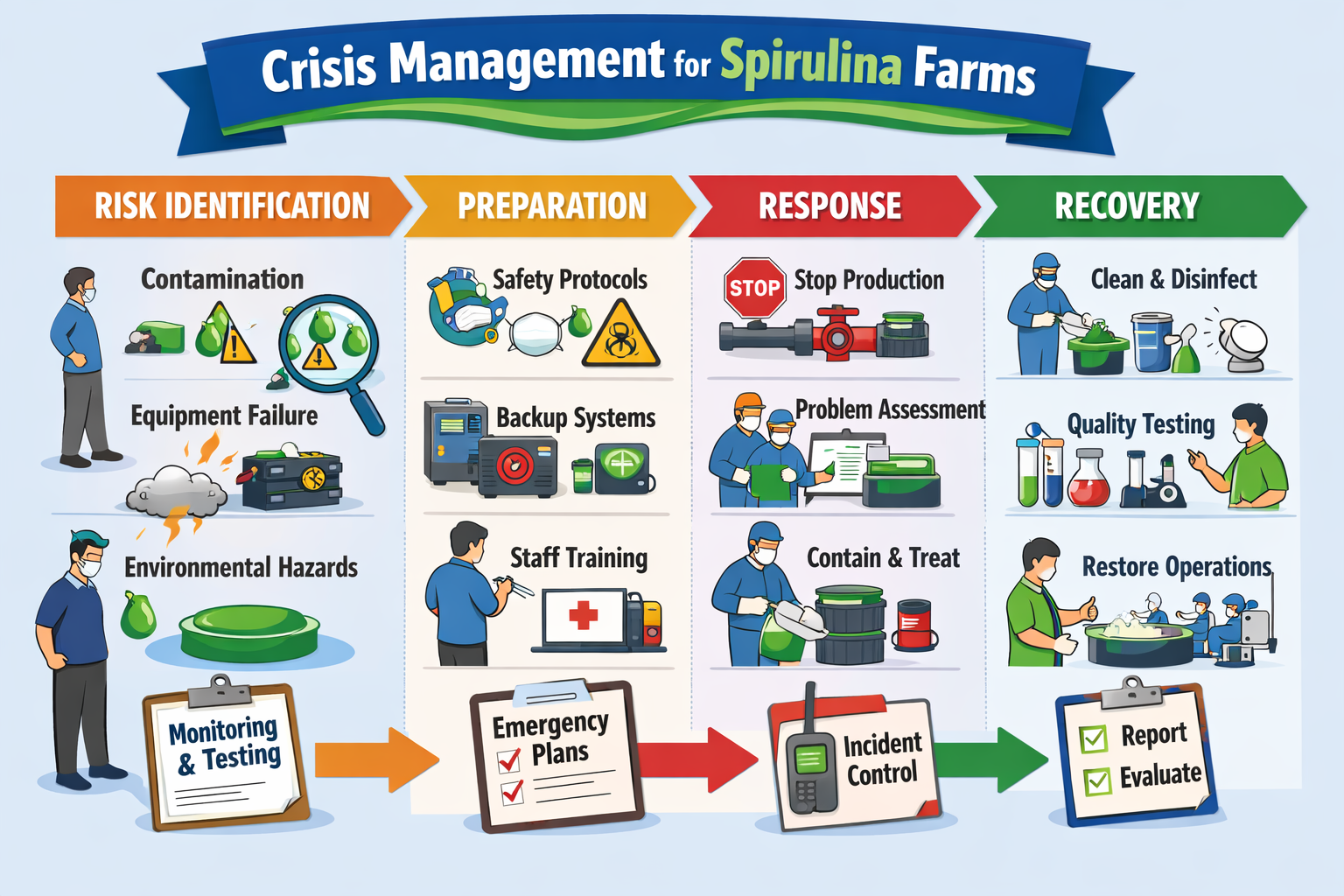
In commercial spirulina production, crisis is not a matter of if – but when.
Biological contamination, export shipment rejection, product recall, regulatory notice, equipment failure, cyber breach, or liquidity stress can emerge suddenly and escalate rapidly across departments.
What separates stable operations from collapsing ones is not luck.
It is preparation.
Farms without a structured crisis response plan react emotionally, issue fragmented instructions, and lose control of communication.
Farms with structured crisis architecture respond systematically, contain damage early, and preserve buyer confidence.
At Greenbubble, crisis planning is embedded into farm design from inception – because operational resilience must be engineered, not improvised.
A robust crisis response plan must address biological, regulatory, financial, operational, legal, and communication dimensions simultaneously.
1. Define Crisis Categories and Escalation Levels
The first step is classification. Not every deviation is a crisis.
A clear tiered system prevents overreaction to minor events and underreaction to major threats.
Primary crisis categories for spirulina farms include:
- Biological contamination (algae bloom, microbial spike)
- Heavy metal exceedance
- Export shipment rejection
- Product recall notification
- Major equipment breakdown
- Regulatory inspection notice
- Data breach or documentation compromise
- Severe cash-flow disruption
- Natural disaster affecting infrastructure
Each category should be assigned escalation levels:
- Level 1: Operational deviation (internally contained)
- Level 2: Compliance-sensitive event (requires documentation review)
- Level 3: External exposure (buyer or regulator involved)
- Level 4: Public or legal impact (recall, litigation, suspension)
Escalation clarity prevents decision paralysis.
2. Establish a Crisis Response Team (CRT)
Every commercial spirulina farm should formally designate a Crisis Response Team.
The CRT must be pre-authorized to make containment decisions without delay.
Core roles typically include:
- Technical lead (biological control and process stabilization)
- Compliance officer (regulatory liaison and documentation control)
- Operations head (production containment and equipment control)
- Finance lead (liquidity monitoring and insurance coordination)
- Legal advisor (contractual and liability exposure review)
- Communication coordinator (buyer and stakeholder interface)
Authority lines must be documented in advance.
During crisis, hierarchy ambiguity amplifies damage.
3. The First 24 Hours Protocol
The first 24 hours determine crisis scale.
A structured timeline should be defined:
Hour 0-2:
- Halt affected production line or pond
- Isolate impacted batch
- Secure digital and physical documentation
- Notify CRT members
Hour 2-6:
- Conduct preliminary lab testing
- Review process logs (pH, temperature, moisture, heavy metals)
- Freeze related inventory movement
- Assess exposure radius
Hour 6-24:
- Initiate formal root cause analysis
- Inform affected buyers if necessary
- Notify insurance provider where applicable
- Prepare regulatory response draft (if required)
Infrastructure such as optimized raceway ponds, automated harvesting equipment solutions, and traceable automated packing systems significantly accelerate containment and traceability.
Speed reduces multiplier effect.
4. Biological Containment Strategy
Biological crises escalate rapidly if uncontrolled.
If contamination is suspected:
- Halt harvesting from affected pond
- Segregate downstream batches
- Conduct parallel lab verification
- Inspect agitation velocity and hydraulic circulation
- Verify nutrient dosing history
- Inspect insect barrier integrity
Controlled processing systems such as assisted dewatering systems and calibrated spirulina drying equipment reduce cross-batch contamination risk.
Containment must be physical, procedural, and documented.
5. Regulatory and Export Crisis Handling
When regulatory deviation or shipment rejection occurs:
- Suspend dispatch of related lots
- Secure batch COA records
- Conduct internal retesting
- Activate legal and insurance notification
- Prepare corrective action documentation
Communication must be evidence-based.
Speculative explanations increase liability.
Compliance buffers and structured documentation integrated through spirulina farming turnkey solutions significantly reduce escalation probability.
6. Root Cause Analysis Discipline
Every crisis must transition into structured root cause analysis (RCA).
RCA must evaluate:
- Supplier input traceability
- Nutrient calibration records
- Harvesting hygiene discipline
- Drying temperature and moisture validation
- Equipment calibration logs
- Staff shift patterns
Corrective action must include measurable control reinforcement, not symbolic response.
Without verifiable data, RCA becomes narrative instead of analysis.
7. Communication Architecture During Crisis
Crisis communication must follow predefined layers:
Internal Communication:
- Notify key managers only
- Avoid rumor circulation
- Provide factual updates
Buyer Communication:
- Inform impacted buyers promptly
- Provide documented evidence
- Outline containment steps
Regulatory Communication:
- Follow legal advice
- Submit structured reports
- Maintain written documentation trail
Public Communication (if recall or media exposure occurs):
- Controlled messaging
- Avoid defensive language
- Emphasize corrective discipline
Silence creates suspicion.
Over-disclosure creates legal vulnerability.
Balance is strategic.
8. Financial Shock Absorption Planning
Crisis events require liquidity.
Financial preparedness should include:
- Minimum 90-day operating buffer
- Emergency capital reserve
- Pre-approved credit line
- Insurance alignment with liability exposure
Liquidity enables rational decision-making.
Without financial buffer, operational panic leads to cost-cutting that increases long-term risk.
Structured advisory through spirulina farming consultancy integrates financial modeling with operational resilience.
9. Documentation Lockdown and Legal Protection
During crisis, documentation becomes evidence.
Immediate steps:
- Lock batch manufacturing records
- Back up digital systems
- Preserve retained samples
- Freeze data editing permissions
- Archive lab reports securely
Tampering or retroactive modification can escalate regulatory action and legal exposure.
Documentation integrity is legal armor.
10. Crisis Simulation and Training Culture
Preparedness requires rehearsal.
Annual drills should include:
- Mock contamination scenario
- Simulated export rejection
- Product recall drill
- Equipment breakdown emergency
- Cybersecurity breach simulation
Each drill should measure:
- Detection speed
- Containment effectiveness
- Documentation retrieval time
- Communication clarity
- Financial readiness
Metrics convert preparedness into measurable performance.
Crisis Response Planning Matrix
| Crisis Type | First Action | Containment Step | Financial Impact | Long-Term Corrective Action |
| Biological Contamination | Halt harvesting | Isolate pond | Batch loss | Recalibrate parameters, sanitation upgrade |
| Heavy Metal Deviation | Suspend dispatch | Retest and verify | Shipment hold | Supplier audit and buffer margin increase |
| Shipment Rejection | Freeze related lots | Notify insurer | Revenue delay | Strengthen compliance control |
| Recall Notice | Activate CRT | Trace distribution | Refund and logistics cost | Revise traceability SOP |
| Equipment Failure | Stop affected line | Repair and assess | Production downtime | Upgrade maintenance system |
| Liquidity Stress | Freeze non-critical expense | Activate credit line | Cash-flow gap | Improve financial forecasting |
Structured mapping reduces improvisation and emotional response.
11. Post-Crisis Reinforcement Loop
A crisis response plan is incomplete without post-event strengthening.
Every crisis should result in:
- SOP revision and documentation update
- Staff retraining and accountability review
- Infrastructure or equipment upgrade where necessary
- Insurance and liability coverage reassessment
- Buyer reassurance and confidence rebuilding
Greenbubble emphasizes converting crisis into structural improvement rather than reputational damage.
Crisis can expose weakness.
Or refine architecture.
Frequently Asked Questions
Q1. What is the most common crisis in spirulina farms?
Biological contamination, heavy metal deviation, and export shipment rejection are among the most frequent operational crises.
Q2. How quickly should crisis response begin?
Immediate containment should begin within hours of detection. Delayed response increases exposure across biological and financial domains.
Q3. Should small farms also build crisis plans?
Yes. Even small-scale exporters face regulatory and recall risks once products enter structured supply chains.
Q4. Does automation reduce crisis probability?
Yes. Automation strengthens consistency, traceability, and documentation accuracy, significantly reducing deviation risk.
Q5. How often should crisis drills be conducted?
At least annually, and after any major process change or infrastructure upgrade.
Conclusion
Crisis response in spirulina farming is not about reacting to disaster.
It is about building systems capable of absorbing shock without systemic failure.
Farms built with engineered infrastructure, automation discipline, compliance buffers, liquidity reserves, documentation integrity, and structured crisis protocols are significantly more resilient.
At Greenbubble, crisis architecture is embedded into spirulina farm design from day one – because resilience is not an emergency action.
It is a strategic design philosophy.
Table Of Contents