Continuous harvesting is often promoted as a way to maximise output from a spirulina farm. In commercial systems designed and operated by experienced solution providers such as Greenbubble, harvesting is treated as a biological control variable rather than a simple throughput lever. In commercial reality, however, harvesting is not merely a mechanical activity-it directly influences the biology of the culture itself. Spirulina is a living, responsive organism, and repeated biomass removal alters its metabolic balance in ways that directly affect quality, stability, and long-term profitability. This article examines how spirulina metabolism adapts under continuous harvest cycles and why understanding these changes is essential for large-scale, export-oriented farms.
Why Metabolism Matters More Than Yield Charts
Most yield discussions focus on kilograms per day or tons per acre per year. What they fail to address is how spirulina achieves that growth at a cellular level. Spirulina is an obligate photoautotroph that depends on light-driven carbon fixation and tightly regulated nutrient assimilation. When biomass is removed continuously, the culture reallocates its internal resources to prioritise survival and regrowth. If this reallocation is unmanaged, farms may maintain volume output while silently losing nutritional quality and batch consistency.
This metabolic response becomes visible only at scale. Small farms harvesting infrequently may never notice these shifts. Commercial farms running daily or near-daily harvest cycles, however, operate at the edge of the organism’s physiological limits. Understanding metabolism is therefore not academic-it is operational.
What Most Sources Get Wrong About Continuous Harvesting
Several misconceptions continue to circulate around continuous harvesting in spirulina farming:
- Continuous harvesting automatically increases growth rate and profitability
- Daily harvesting has no effect on nutritional quality
- Spirulina metabolism self-corrects without intervention
- Laboratory testing alone is sufficient to control quality drift
In practice, each of these assumptions leads to metabolic stress, gradual nutrient depletion, and long-term instability in commercial systems.
Operational View of Spirulina Metabolism
From a production standpoint, spirulina metabolism can be simplified into three interlinked processes: carbon fixation, nitrogen assimilation, and energy storage. Light energy drives the reduction of carbon dioxide into carbohydrates, primarily stored as glycogen. Nitrogen assimilation supports protein synthesis, while pigment production such as phycocyanin and chlorophyll reflects the overall metabolic health of the culture.
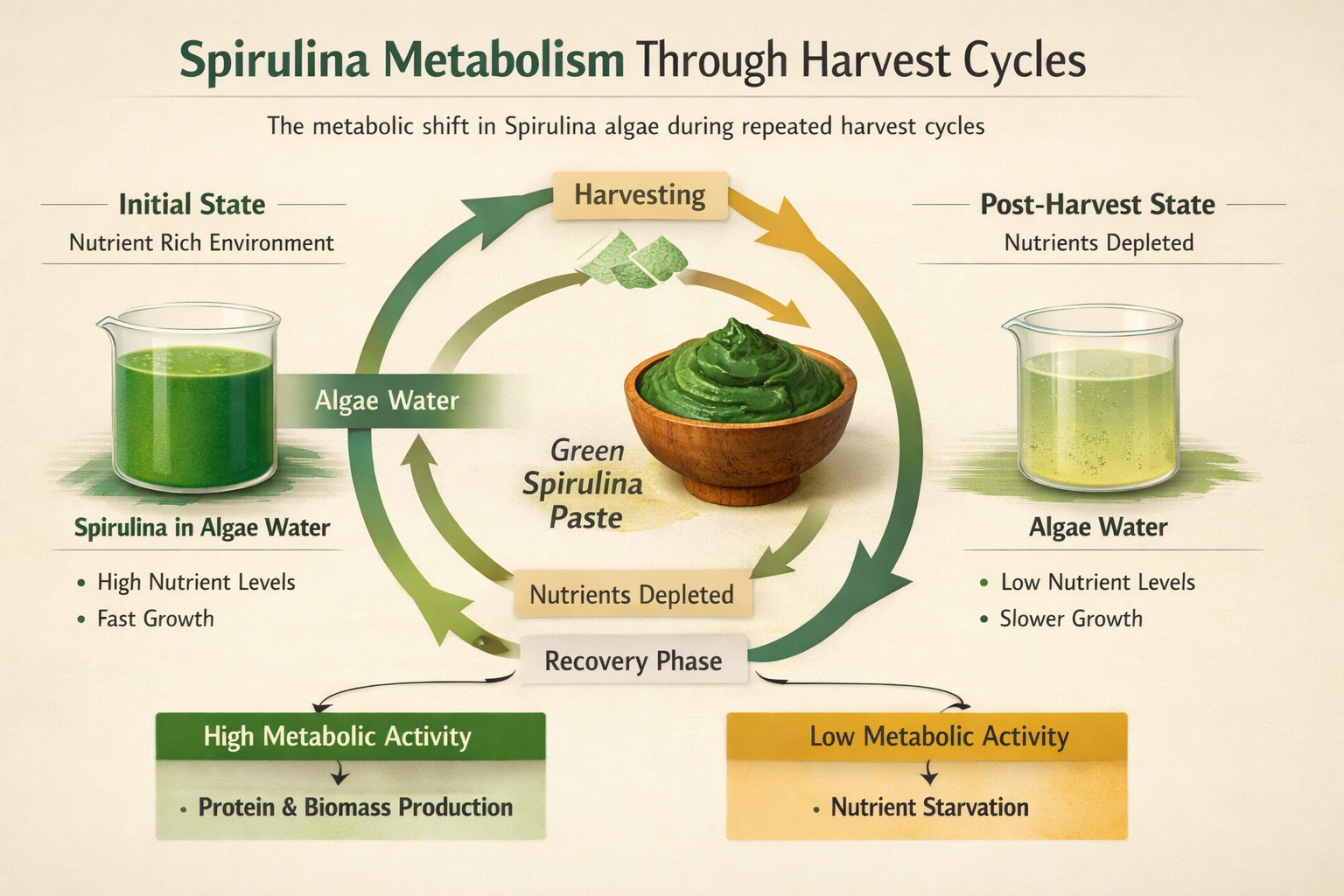
Under stable conditions, these processes remain balanced. Continuous harvesting disrupts this balance by removing biomass faster than internal reserves can be replenished, forcing the culture into a constant regeneration mode.
Metabolic Changes Under Continuous Harvest Cycles
Under continuous harvesting, spirulina undergoes measurable metabolic shifts that affect both quality and consistency.
Key changes include:
- Faster depletion of internal carbon reserves
- Early nitrogen stress affecting protein synthesis
- Reduced pigment production, especially phycocyanin
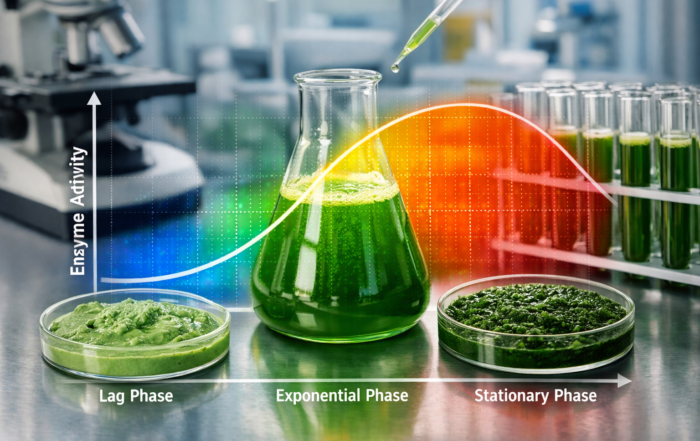
- Gradual decline in enzyme activity related to energy storage
These changes often appear in COA results before visible biomass loss is observed.
Harvest Frequency and Metabolic Stress
The relationship between harvest frequency and metabolic stress is non-linear. Daily harvesting without recovery periods accelerates carbon and nitrogen depletion. Alternate-day harvesting allows partial metabolic recovery, while batch harvesting provides the most stable internal balance but reduces operational throughput.
Aggressive harvesting strategies often show short-term gains in biomass output but lead to long-term declines in pigment concentration and fatty acid profiles, particularly gamma-linolenic acid. Growth rate alone is therefore a poor indicator of metabolic health.
Role of pH, Temperature, and Carbon Availability
In raceway-based systems such as those built using engineered raceway pond systems, metabolic stability depends heavily on how pH, temperature, and carbon availability interact under continuous harvesting.
pH trends are one of the most reliable indirect indicators of spirulina metabolism. Rising pH reflects bicarbonate consumption during active growth. Under continuous harvesting, rapid pH rise without corresponding biomass recovery signals carbon limitation. Temperature amplifies these effects; even small deviations above optimal ranges accelerate metabolic stress.
Automation plays a critical role here. Precision agitation using efficient agitator systems helps regulate temperature, release excess dissolved oxygen, and maintain uniform nutrient distribution-functions that directly influence metabolic balance. Manual systems cannot adjust carbon dosing, agitation speed, or water depth with the precision required to stabilise metabolism. Continuous monitoring allows operators to respond before metabolic imbalance becomes irreversible.
Continuous Harvesting in Organic Systems
Organic spirulina farms face additional constraints. Input options are limited, and corrective interventions must comply with organic standards. This makes organic systems more sensitive to metabolic drift. Continuous harvesting without precise control often leads to faster quality degradation in organic farms compared to conventional ones.
Documentation requirements further increase the cost of metabolic mismanagement. Quality drift in organic systems is not only a production issue but also a compliance risk.
Designing Processes to Protect Metabolism
At Greenbubble, continuous harvesting protocols are designed around metabolic stability rather than maximum daily extraction. This approach is reflected in how harvest percentages, recovery windows, and automation logic are defined during farm design and commissioning.
Protecting spirulina metabolism requires deliberate process design supported by integrated harvesting and processing infrastructure. Automated harvesting equipment and assisted dewatering systems reduce handling stress and minimise metabolic shock during biomass removal. Harvest percentages must be capped to allow recovery. Carbon and nutrient replenishment must be aligned with harvest schedules rather than fixed calendars, particularly in organic systems using certified organic feed inputs where corrective flexibility is limited. Recovery windows should be built into SOPs, especially during periods of high temperature or light intensity.
Equally important is the human element. Turnkey system design and long-term process support through specialised spirulina farming consultancy support ensure that metabolic indicators are interpreted correctly and acted upon in time. Trained operators are essential to interpret metabolic indicators and adjust systems proactively. Automation provides data, but expertise determines outcomes.
Key Metabolic Indicators to Monitor
| Parameter | Ideal Range | What Deviation Indicates | Corrective Action |
| pH trend | 9.0–11.0 | Carbon depletion or stress | Adjust carbon dosing and harvest rate |
| Protein content | ≥60% | Nitrogen stress | Rebalance nutrients and allow recovery |
| Phycocyanin | ≥10% | Metabolic fatigue | Reduce harvest intensity and stabilise temperature |
| Temperature | 30–37°C | Thermal stress | Modify agitation, shading, or depth |
Why Small Farms Rarely Detect Metabolic Collapse
Low-throughput farms often mask metabolic issues because production volumes are small and batch variability is tolerated. Without baseline COA comparisons or export-grade consistency requirements, quality drift goes unnoticed. Larger farms, operating under stricter customer and certification scrutiny, are forced to confront these biological limits.
Commercial Implications of Metabolic Mismanagement
In continuous harvesting systems, metabolic fatigue does not immediately reduce output volume. Instead, it expresses itself as batch variability. Protein percentages fluctuate between harvests, pigment intensity becomes inconsistent, and COA values begin to drift even when daily yield appears stable.
This variability increases downstream risk long before processing begins. Buyers experience inconsistency across lots, forcing tighter incoming inspection, renegotiated specifications, or outright rejection. In export-oriented operations, metabolic instability becomes a commercial liability not because biomass is low, but because predictability is lost.
Here, the downstream cost is not processing loss-it is loss of reliability.
FAQs
Q1. Does continuous harvesting always reduce spirulina quality?
Continuous harvesting does not automatically reduce quality, but unmanaged harvesting almost always does. When biomass is removed faster than carbon and nitrogen reserves are replenished, spirulina reallocates energy toward survival and regrowth. This metabolic shift reduces protein concentration, pigment synthesis, and batch consistency unless harvest rates are carefully controlled.
Q2. How often can spirulina be harvested without causing metabolic stress?
There is no universal harvest frequency. The safe interval depends on pond size, temperature stability, carbon dosing strategy, and automation level. Commercial farms typically limit harvest percentages per cycle and build recovery windows into their SOPs rather than harvesting aggressively every day.
Q3. Why does phycocyanin drop before biomass output declines?
Phycocyanin synthesis is metabolically sensitive and responds early to stress. Under continuous harvesting, spirulina prioritises cell division over pigment accumulation, causing pigment levels to fall while biomass output appears stable.
Q4. Are organic spirulina farms more affected by continuous harvesting?
Yes. Organic farms have fewer corrective options because inputs are restricted by certification rules. This makes precise monitoring, controlled harvesting, and disciplined recovery periods even more critical to avoid long-term metabolic drift.
Q5. Can laboratory testing alone prevent metabolic collapse?
No. Lab testing detects quality issues after they occur. Preventing metabolic collapse requires real-time monitoring of pH, temperature, carbon availability, and harvest intensity, combined with trained operators who can act before stress becomes irreversible.
Conclusion: Managing, Not Maximising, Continuous Harvesting
Greenbubble’s work across large-scale spirulina projects reinforces a consistent lesson: continuous harvesting succeeds only when it respects the biological limits of spirulina metabolism. Treating harvesting as a controlled, data-driven process-supported by automation, in-house labs, and trained operators-is what separates stable, export-ready farms from those that struggle with quality drift and declining returns.
Continuous harvesting can support stable, high-volume production only when aligned with spirulina’s metabolic capacity. Treating harvest frequency as a purely mechanical decision ignores the biological consequences that ultimately determine quality and profitability. Commercial success depends on respecting these limits through automation, skilled oversight, and disciplined process design. In spirulina farming, metabolism sets the ceiling that no amount of harvesting can overcome.
Table Of Contents