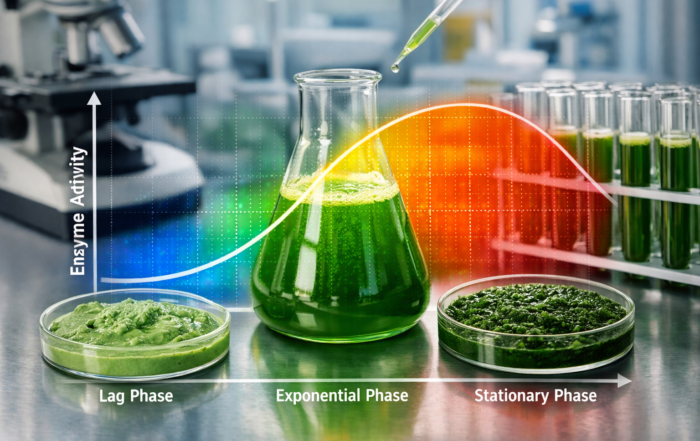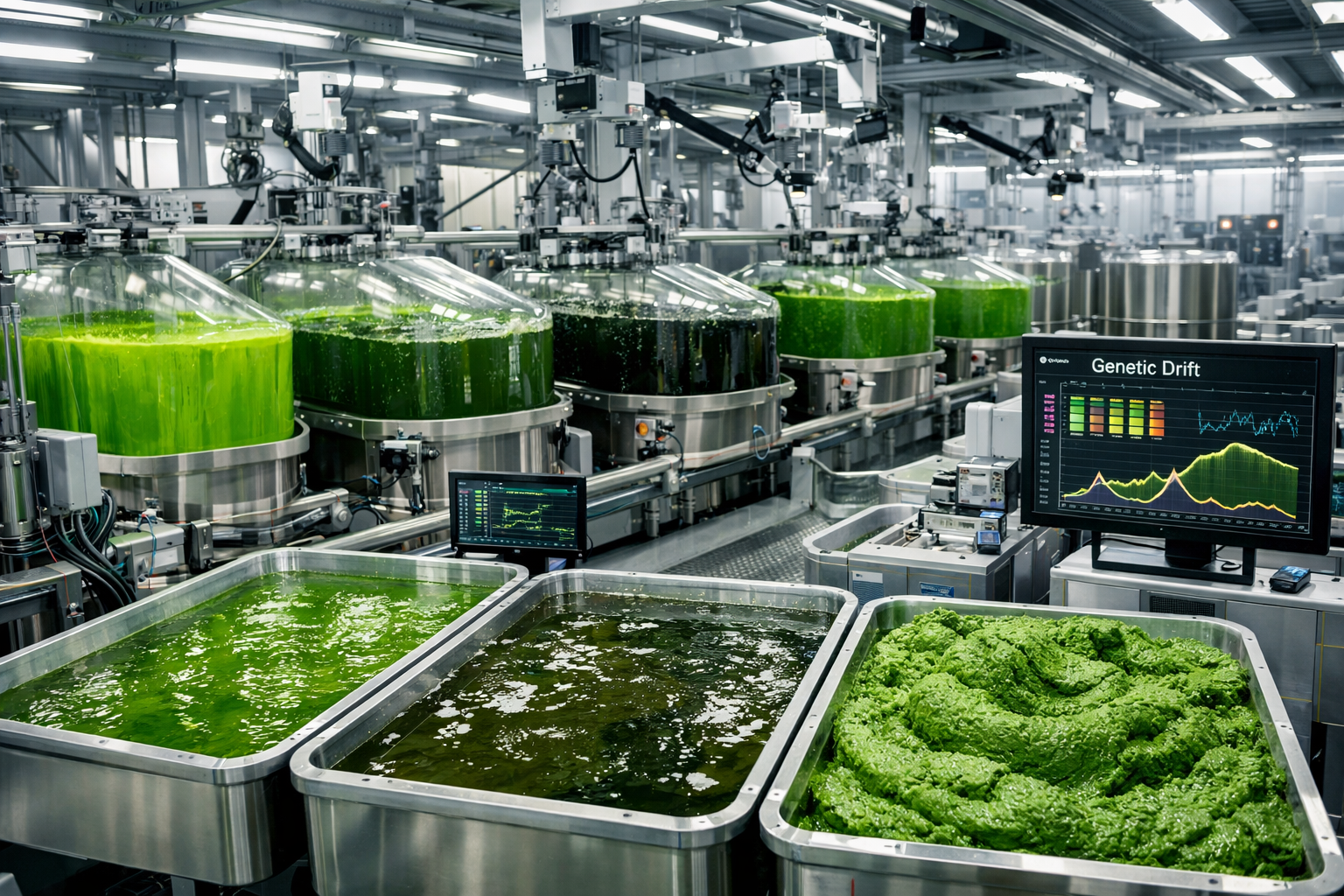
In long-term spirulina cultivation, declining performance is often blamed on nutrients, climate, or contamination. A less visible but equally critical factor is genetic drift. Over extended production cycles, spirulina cultures can gradually diverge from their original genetic and physiological profile, leading to reduced productivity, inconsistent quality, and higher operational risk. In commercial farms, understanding and controlling genetic drift is essential for sustaining yield and maintaining export-grade consistency.
Why Genetic Stability Matters in Commercial Spirulina Farming
Spirulina is typically propagated through repeated vegetative reproduction. While this allows rapid scaling, it also means that any genetic or physiological bias introduced over time is perpetuated across generations. In high-density, continuously harvested systems, selective pressure favours traits linked to survival rather than productivity.
Over months or years, this process results in cultures that are genetically similar but metabolically inferior-slower growth, lower protein synthesis, and reduced pigment content. These changes are gradual, making them difficult to detect without structured monitoring.
Common Misconceptions About Genetic Drift
Several assumptions obscure the role of genetic drift in spirulina farms:
- Genetic drift occurs only in laboratory cultures
- Regular nutrient adjustment prevents genetic changes
- Declining yield is always caused by contamination
- Spirulina cultures remain stable indefinitely if conditions are controlled
In reality, even well-managed ponds exert selective pressure that can reshape culture behaviour over time.
How Genetic Drift Develops in Long-Term Cultures
Genetic drift in spirulina is driven by repeated selection under specific operating conditions. Continuous harvesting removes the fastest-growing biomass first, subtly favouring strains that tolerate stress over those that maximise productivity. Over time, this skews the population toward robustness at the expense of yield and nutritional quality.
Environmental factors such as temperature fluctuations, nutrient imbalance, and prolonged high-density operation accelerate this process. Unlike acute contamination, genetic drift does not cause sudden crashes; instead, it manifests as slow, persistent underperformance.
Early Indicators of Genetic Drift
Detecting genetic drift early requires attention to trend-based indicators rather than single data points. Common warning signs include:
- Gradual decline in specific growth rate despite stable inputs
- Progressive reduction in protein percentage
- Lower phycocyanin content across successive batches
- Increased sensitivity to temperature or pH fluctuations
These symptoms often appear even when standard quality parameters remain within acceptable ranges.
Diagnostic Indicators of Genetic Drift in Commercial Ponds
| Drift Indicator | Likely Underlying Cause | Practical Corrective Action |
| Slower regrowth after harvest | Selection for stress-tolerant cells | Reduce harvest intensity and allow recovery cycles |
| Falling protein percentage | Carbon–nitrogen imbalance over time | Rebalance nutrient inputs and review SOPs |
| Declining phycocyanin levels | Chronic light or temperature stress | Adjust agitation, shading, and photoperiod discipline |
| Increased sensitivity to pH swings | Long-term selective pressure | Refresh culture from master inoculum |
| Stable biomass but falling quality | Genetic drift without contamination | Schedule controlled reinoculation and reset density |
Interaction Between Genetic Drift and Process Design
Process design can either amplify or suppress genetic drift. Uniform mixing and predictable hydrodynamics in engineered raceway pond systems reduce micro-environmental stress that accelerates selection pressure.
Precision circulation using efficient agitator systems ensures even exposure to light and nutrients, limiting the advantage of stress-tolerant subpopulations.
Role of Harvesting Strategy in Genetic Stability
Harvesting strategy strongly influences genetic outcomes. Continuous, aggressive harvesting disproportionately removes fast-dividing cells, leaving behind slower-growing but stress-resistant populations.
Automated harvesting equipment allows controlled harvest fractions and recovery windows, reducing selective bias. Manual harvesting, by contrast, often lacks the precision required to maintain genetic balance.
Nutrient Management and Genetic Drift
Chronic nutrient imbalance reinforces selective pressure. Carbon limitation, nitrogen excess, or repeated pH stress events favour survival traits over productivity traits. Using validated organic feed inputs within disciplined dosing protocols helps maintain metabolic uniformity across generations.
Greenbubble integrates nutrient and harvest management into unified SOPs to reduce long-term genetic divergence in commercial farms.
Preventing Genetic Drift in Commercial Operations
Effective genetic drift prevention focuses on reducing selective pressure and periodically resetting the culture baseline. Key measures include:
- Maintaining controlled harvest percentages
- Avoiding prolonged operation at maximum density
- Periodic re-inoculation from master cultures
- Consistent environmental control and monitoring
- Data-driven process audits supported by spirulina farming consultancy support
These practices are standard in export-oriented farms where consistency is non-negotiable.
Genetic Drift and Loss of Standardisation
Genetic drift expresses downstream not as acute quality failure, but as loss of standardisation. Cultures affected by drift produce acceptable material that no longer matches historical baselines-colour tones shift, protein ratios narrow, and growth response to inputs becomes unpredictable.
This undermines long-term customer relationships. Specifications that were once met comfortably now require frequent adjustments, exceptions, or manual intervention. In regulated or export markets, genetic drift increases audit scrutiny because historical consistency can no longer be demonstrated with confidence.
The downstream consequence of genetic drift is therefore erosion of process credibility.
Practical Framework for Genetic Stability
Long-term genetic stability in spirulina farms is achieved through:
- Defined culture lifecycle limits
- Scheduled strain refresh cycles
- Continuous trend analysis of growth and quality metrics
- Integration of design, automation, and SOP discipline
This systems-level approach reflects how Greenbubble designs and operates commercial spirulina farms for longevity, where genetic stability is treated as a core process parameter rather than a downstream quality concern.
FAQs
Q1. Is genetic drift the same as contamination?
No. Genetic drift involves gradual internal changes within the culture population, whereas contamination introduces external organisms that compete with or damage spirulina.
Q2. How long does it take for genetic drift to become noticeable?
In high-density, continuously harvested systems, measurable effects can appear within months if corrective strategies are not in place.
Q3. Can genetic drift be reversed?
Drift cannot be reversed within the same population. Prevention relies on reinoculation from stable master cultures and reducing selective pressure.
Q4. Do small farms experience genetic drift?
Yes, but it is often masked by low throughput and infrequent performance benchmarking.
Q5. Does automation help reduce genetic drift?
Yes. Automation enables consistent harvesting, environmental control, and monitoring, reducing selective stress that drives drift.
Conclusion: Genetic Stability Is a Design Choice
Genetic drift in spirulina farming is not an unavoidable fate but a consequence of unmanaged selective pressure. Farms that treat culture stability as a design parameter-supported by automation, disciplined SOPs, and periodic reset strategies-maintain higher yields and consistent quality over time. In commercial spirulina cultivation, genetic stability is achieved not by chance, but by intent.
Table Of Contents