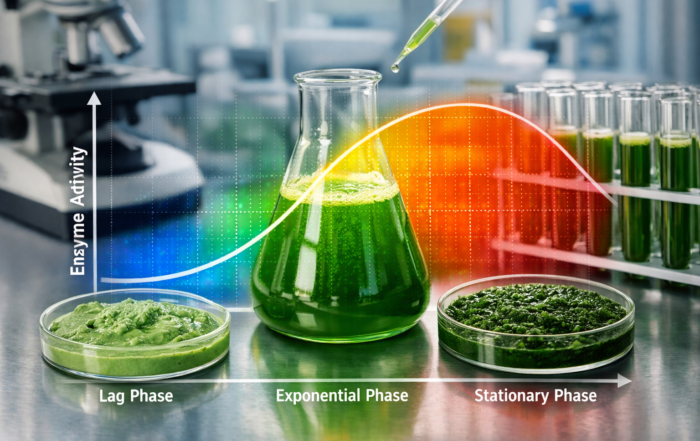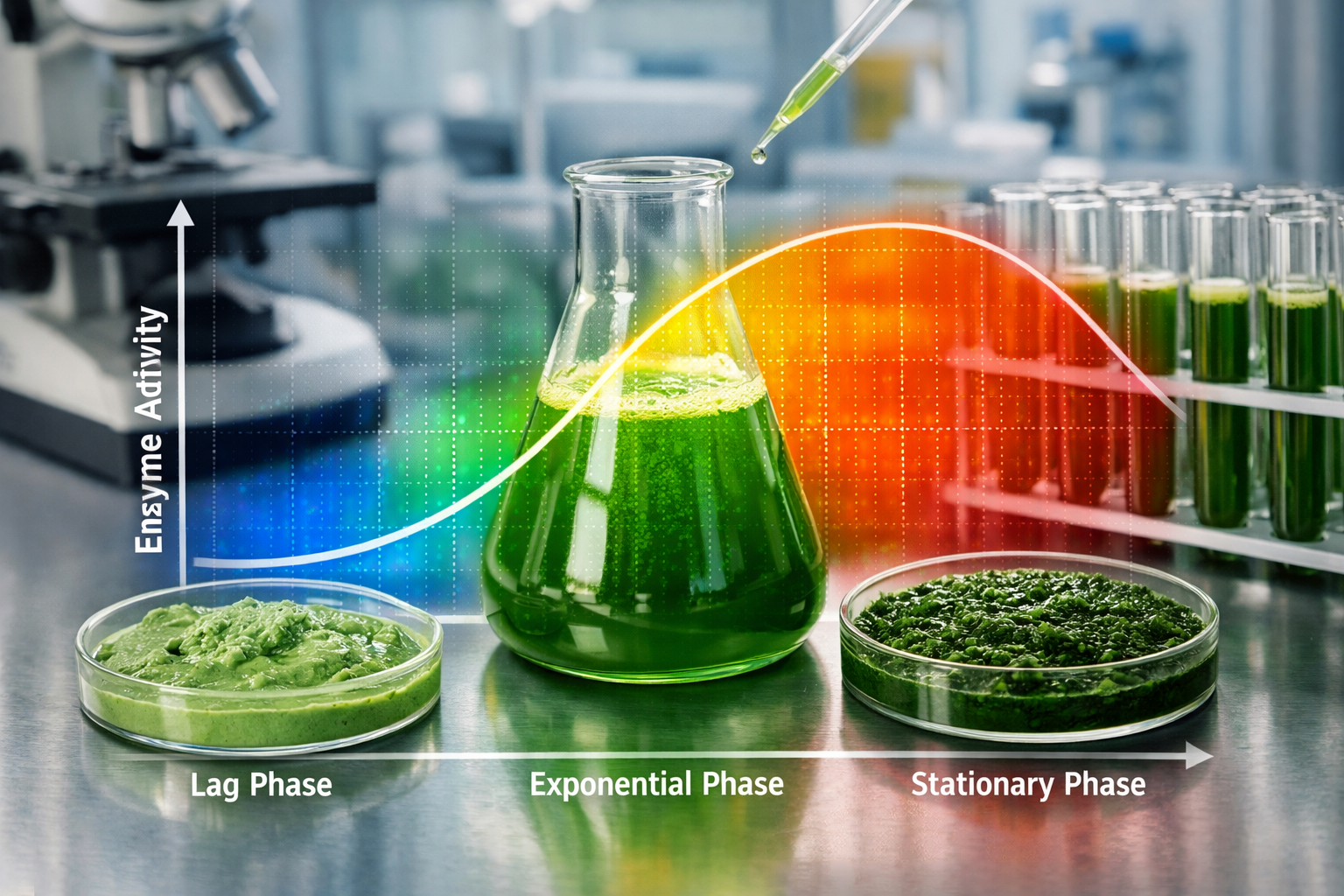
In commercial spirulina cultivation, growth is often described using visual density, optical depth, or biomass increase. These indicators, however, reflect outcomes rather than causes. Beneath visible growth lies a continuous shift in enzyme activity that determines how efficiently spirulina converts light, carbon, and nutrients into usable biomass. Mapping enzyme activity across growth phases provides a deeper, more reliable framework for managing productivity, quality, and long-term culture stability.
Why Enzyme Activity Matters More Than Growth Curves
Growth curves show how much biomass accumulates over time, but they do not explain why performance improves or deteriorates. Enzymes regulate every metabolic pathway in spirulina-from carbon fixation and nitrogen assimilation to pigment synthesis and energy storage. When enzyme activity falls out of sync with growth phase requirements, yield losses and quality drift follow, often before any visible signs appear.
In high-density, continuously operated systems, enzyme imbalance is one of the earliest indicators of metabolic stress.
Common Misconceptions About Enzymes in Spirulina Farming
Several misconceptions limit effective enzyme-level management:
- Enzyme activity remains constant throughout the culture lifecycle
- Nutrient availability alone determines metabolic performance
- Enzyme monitoring is only relevant in laboratory research
- Visual growth always reflects metabolic health
In reality, enzyme activity is dynamic and phase-dependent, responding rapidly to environmental and operational conditions.
Key Growth Phases in Spirulina Cultivation
For operational clarity, spirulina growth can be divided into four overlapping phases:
- Inoculation and adaptation phase
- Exponential growth phase
- High-density stabilisation phase
- Decline or stress phase
Each phase is characterised by a distinct enzyme activity profile that determines how the culture responds to inputs and harvesting.
Enzyme Activity During the Inoculation Phase
During inoculation, spirulina prioritises enzymes involved in cellular repair and adaptation. Carbonic anhydrase and early-stage nitrogen reductases dominate as cells adjust to new environmental conditions. Excessive harvesting or nutrient loading at this stage suppresses adaptive enzymes, delaying culture establishment.
Uniform hydrodynamics in engineered raceway pond systems support even enzyme activation across the pond, reducing adaptation stress.
Enzyme Activity in the Exponential Growth Phase
The exponential phase is driven by peak activity of photosynthetic enzymes and nitrogen assimilation pathways. Rubisco efficiency, nitrate reductase activity, and amino acid synthesis enzymes operate near optimal levels. This is the phase where biomass accumulation is most efficient.
Precision mixing using efficient agitator systems ensures uniform light exposure and nutrient access, preventing localised enzyme suppression.
Enzyme Dynamics in High-Density Stabilisation
As biomass density increases, enzyme priorities shift. Energy storage enzymes and stress-mitigation pathways become more active, while growth enzymes gradually plateau. If harvesting intensity is not adjusted, enzyme saturation leads to diminishing returns.
Automated harvesting equipment enables controlled biomass removal that aligns with enzyme recovery cycles rather than fixed schedules.
Enzyme Suppression During Stress and Decline Phases
Prolonged stress-caused by nutrient imbalance, temperature extremes, or photoperiod disruption-suppresses key enzymes involved in protein synthesis and pigment formation. Amylase activity increases as stored carbon is consumed, while biosynthetic enzymes decline.
This phase often precedes irreversible quality loss if corrective action is delayed.
Mapping Enzyme Activity to Operational Decisions
Effective enzyme mapping connects metabolic signals to farm actions. Rather than relying solely on biomass metrics, operators can adjust harvesting, nutrient dosing, and environmental controls based on inferred enzyme behaviour.
Greenbubble integrates enzyme-phase awareness into SOP design, allowing farms to anticipate metabolic shifts instead of reacting to quality failures.
Diagnostic Enzyme Indicators Across Growth Phases
| Growth Phase | Dominant Enzyme Activity | Observable Culture Behaviour | Operational Action |
| Inoculation | Adaptive enzymes, carbonic anhydrase | Slow initial growth | Avoid harvesting, stabilise conditions |
| Exponential | Photosynthetic and nitrogen enzymes | Rapid biomass increase | Optimise light and nutrients |
| High-density | Energy storage and stress enzymes | Stable but slowing growth | Moderate harvest and allow recovery |
| Stress/decline | Catabolic enzymes (amylase) | Quality drift, pigment loss | Reduce load, reset culture |
Downstream Consequences of Enzyme Misalignment
Enzyme imbalance does not immediately reduce biomass but affects how efficiently biomass converts into nutritional value. Cultures harvested during enzymatically suppressed phases show lower protein recovery, unstable pigment retention, and higher variability in COA results. The downstream cost is therefore reduced value extraction rather than visible production failure.
Practical Framework for Enzyme-Aware Farming
Implementing enzyme-aware cultivation involves:
- Aligning harvest timing with metabolic phase
- Avoiding fixed-input strategies across all phases
- Monitoring trends rather than single measurements
- Designing systems that minimise sudden environmental shifts
- Periodic audits supported by spirulina farming consultancy support
This approach prioritises consistency and predictability over maximum short-term output.
FAQs
Q1. Can enzyme activity be measured directly on farms?
Direct measurement is complex and costly. Most commercial farms infer enzyme activity through growth patterns, pH trends, and quality metrics.
Q2. Which growth phase is most sensitive to enzyme disruption?
The transition from exponential growth to high-density stabilisation is particularly sensitive, as enzyme saturation can occur quickly.
Q3. Does automation improve enzyme stability?
Yes. Automation reduces environmental fluctuations that suppress enzyme activity and enables phase-appropriate interventions.
Q4. Is enzyme mapping relevant for small farms?
The principles apply universally, but the benefits are most visible at commercial scale where variability has financial consequences.
Q5. Can processing correct enzyme-related quality loss?
No. Processing preserves existing quality but cannot restore nutritional losses caused by enzyme suppression upstream.
Conclusion: Enzymes Define the Invisible Limits of Growth
In spirulina farming, enzymes set the boundaries within which growth is efficient and quality is preserved. Mapping enzyme activity across growth phases allows commercial farms to operate within these limits rather than unknowingly exceeding them. By aligning operations with biological timing, farms achieve more stable yields, consistent quality, and stronger long-term economics.
Table Of Contents