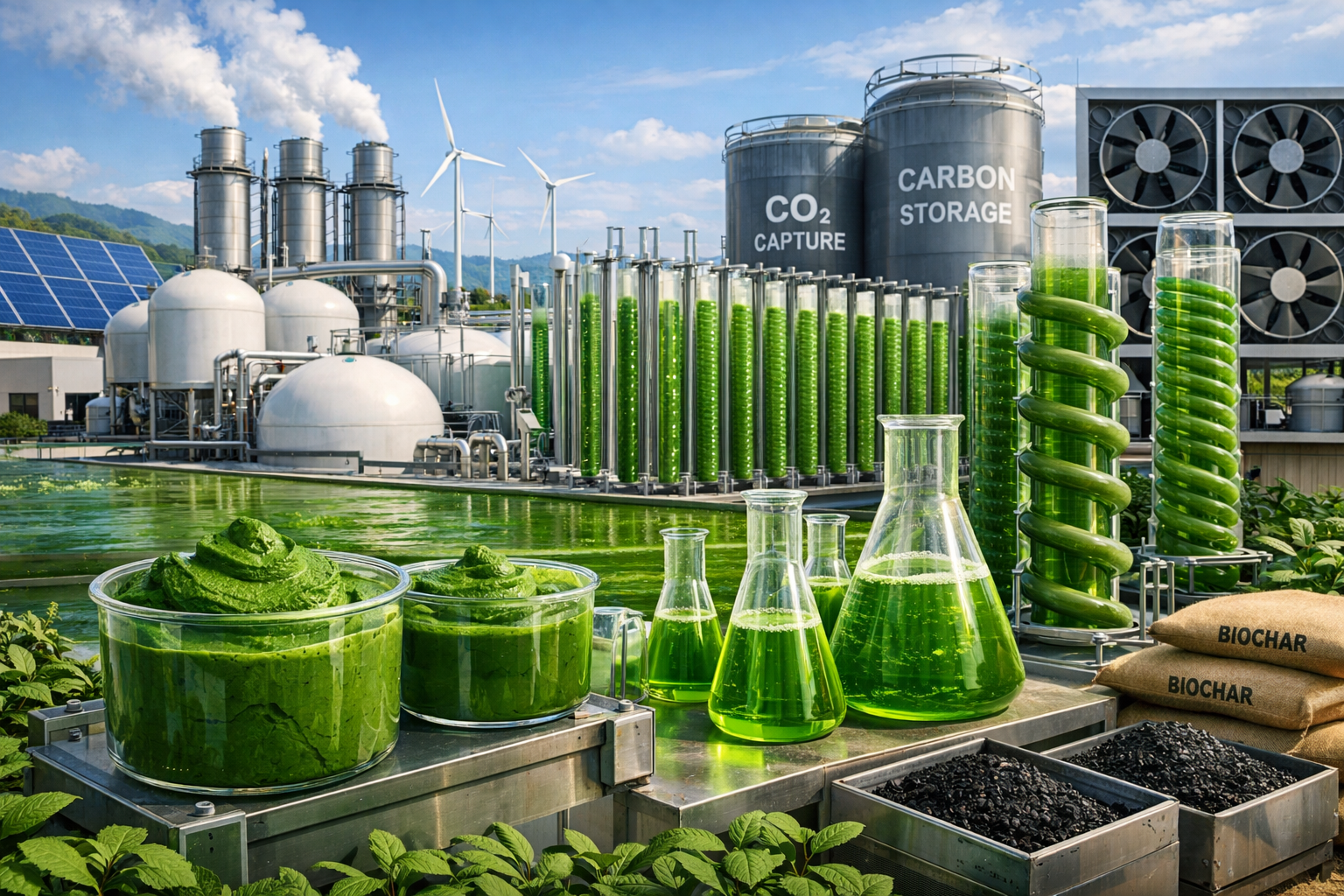
As climate regulation tightens and voluntary carbon markets expand, many commercial spirulina producers are asking a strategic question: can spirulina farms qualify for carbon credits?
Spirulina is widely recognized for its high photosynthetic efficiency and low land-use intensity compared to conventional protein sources. It absorbs carbon dioxide during growth and produces nutrient-dense biomass with minimal methane emissions.
However, carbon credit qualification is not based on biological absorption alone. It requires structured measurement, verification, additionality, and compliance with recognized carbon standards.
For commercial spirulina farms, carbon credit eligibility depends on how operations are engineered, monitored, and documented. At Greenbubble, production systems are designed with measurable efficiency and carbon transparency in mind, enabling farms to realistically evaluate participation in carbon markets.
1. Understanding Carbon Credits
Carbon credits represent verified reductions or removals of greenhouse gases, typically measured in metric tons of CO₂ equivalent (CO₂e).
One carbon credit equals one metric ton of CO₂e reduced or removed from the atmosphere.
Carbon credits fall into two broad categories:
- Compliance market credits (regulated by governments)
- Voluntary market credits (purchased by corporations for ESG goals)
Most agricultural and aquaculture operations, including spirulina farms, would participate in voluntary carbon markets rather than compliance schemes.
2. Does Spirulina Farming Remove Carbon?
Spirulina absorbs CO₂ through photosynthesis during biomass growth. This biological carbon uptake is measurable.
However, to qualify as a carbon removal project, farms must demonstrate:
- Net carbon removal after accounting for operational emissions
- Long-term carbon storage or displacement impact
- Verified baseline comparison
Because spirulina biomass is consumed, its stored carbon is eventually re-released into the atmosphere. Therefore, most spirulina farms cannot claim permanent carbon sequestration credits purely from biomass growth.
Carbon credit eligibility instead typically arises from emission reduction strategies.
3. Carbon Reduction Pathways in Spirulina Farming
Spirulina farms may qualify for credits through emission reduction rather than carbon storage.
Key pathways include:
Renewable Energy Integration
Replacing grid electricity with solar reduces Scope 2 emissions. When solar systems demonstrably reduce emissions compared to baseline grid usage, carbon reduction credits may be generated under specific methodologies.
Optimized infrastructure such as energy-efficient raceway ponds and calibrated efficient agitators reduces total kWh consumption, lowering carbon intensity.
Energy-Efficient Drying
Drying is typically the largest energy consumer. Upgrading to low-temperature spirulina drying equipment significantly reduces energy use per kilogram, lowering emissions relative to inefficient baselines.
Process Optimization
Improvements in dewatering, pump efficiency, and layout design can reduce total electricity consumption, strengthening emission reduction calculations.
Facilities engineered through spirulina farming turnkey solutions are better positioned to quantify measurable energy savings.
4. Carbon Credit Eligibility Requirements
To qualify for carbon credits, spirulina farms must demonstrate:
- Additionality: Emission reductions must be above business-as-usual operations.
- Measurability: Accurate data collection for energy use and emission factors.
- Verification: Third-party validation under recognized carbon standards.
- Permanence (if claiming removal credits): Long-term carbon storage.
- Avoidance of double counting: Emission reductions cannot be claimed by multiple parties.
Without structured documentation and monitoring systems, eligibility is unlikely.
5. Relevant Carbon Standards
Spirulina farms exploring carbon credits may consider standards such as:
- Verra (Verified Carbon Standard – VCS)
- Gold Standard
- Climate Action Reserve
- Regional renewable energy certificate (REC) frameworks
Most applicable methodologies would focus on renewable energy displacement or energy efficiency improvement rather than biological carbon sequestration.
6. Financial Feasibility of Carbon Credits for Spirulina Farms
Carbon credit revenue depends on:
- Total verified emission reductions (tons CO₂e)
- Carbon credit market price (varies widely, often $5–$30 per ton in voluntary markets)
- Project development and verification costs
Small farms may find verification costs outweigh credit revenue.
Medium to large-scale farms with substantial renewable integration or energy reduction programs are more likely to achieve financial viability.
Strategic evaluation through spirulina farming consultancy can determine whether credit development is economically justified.
7. Carbon Accounting as a Prerequisite
Before pursuing carbon credits, farms must conduct robust carbon accounting or Life-Cycle Assessment (LCA) to establish:
- Baseline energy consumption
- Baseline emission factors
- Reduction targets
- Monitoring mechanisms
Carbon credits are a monetization layer on top of disciplined energy management – not a substitute for it.
8. Risks and Challenges
Key risks include:
- High verification costs
- Regulatory changes in voluntary carbon markets
- Carbon price volatility
- Complex documentation requirements
- Reputational risk if claims are overstated
Greenwashing allegations can damage export relationships and buyer trust.
Carbon credit participation must be technically defensible.
9. Strategic Value Beyond Direct Revenue
Even if carbon credit income is modest, structured carbon accounting provides additional benefits:
- Stronger ESG reporting credibility
- Enhanced appeal to sustainability-focused buyers
- Improved investor confidence
- Competitive differentiation in export markets
Carbon discipline strengthens overall operational efficiency.
10. Carbon Credit Readiness Evaluation Matrix
| Criterion | Low Readiness | Moderate Readiness | High Readiness |
| Energy Monitoring | Manual records | Partial metering | Full sub-metering system |
| Renewable Integration | None | Partial solar | Major solar offset |
| Energy Intensity | >100 kWh/kg | 60–100 kWh/kg | <60 kWh/kg |
| Documentation | Limited | Structured logs | Audit-ready systems |
| Scale | Small (<10 tons/year) | Medium | Large-scale production |
High readiness farms have significantly better chances of qualifying for carbon credit programs.
Frequently Asked Questions
Q1. Can spirulina farms earn carbon credits from photosynthesis alone?
Generally no. Because spirulina biomass is consumed, the carbon absorbed during growth is eventually released. Credits usually depend on emission reduction strategies rather than carbon storage.
Q2. Is solar installation enough to qualify for carbon credits?
Not automatically. Emission reductions must be verified under approved methodologies and meet additionality criteria.
Q3. Are carbon credits financially significant for spirulina farms?
For small farms, revenue may be limited relative to verification costs. Larger operations with substantial emission reductions have better financial viability.
Q4. What is the first step toward carbon credit eligibility?
Implement structured carbon accounting and energy monitoring to establish a defensible baseline.
Q5. Do carbon credits improve export competitiveness?
Verified carbon reduction claims can enhance ESG positioning and buyer confidence, especially in sustainability-focused markets.
Conclusion
Spirulina farms can potentially qualify for carbon credits – but only under specific conditions involving measurable emission reductions, renewable integration, and verified documentation.
Biological carbon absorption alone is insufficient. Structured energy optimization, renewable deployment, and disciplined carbon accounting are essential prerequisites.
For commercial spirulina producers, carbon credits should be viewed as an advanced strategic layer built on operational efficiency – not as a shortcut to sustainability positioning.
Make us your source on Google
Table Of Contents