In commercial spirulina farming, yield optimization is often treated as a primary success metric. In large-scale operations designed for consistency, such as those developed by Greenbubble, yield is evaluated alongside nutritional performance rather than in isolation. Over time, however, many high-performing cultures begin to exhibit subtle nutritional decline despite stable or even increasing biomass output. This raises a critical question for large-scale producers: do adaptive, high-yield spirulina strains sacrifice nutritional density as they evolve under production pressure? Understanding this trade-off is essential for farms targeting consistent quality rather than short-term volume gains.
Why Adaptation Occurs in Commercial Spirulina Systems
Spirulina adapts continuously to its operating environment. High light exposure, frequent harvesting, elevated culture density, and nutrient regimes all create selective pressure. Over repeated growth cycles, strains that tolerate stress and regenerate quickly tend to dominate, even if they are less efficient at producing proteins or pigments.
This adaptive response is not genetic engineering; it is natural selection driven by farm conditions. The result is a culture optimised for survival and rapid regrowth rather than maximum nutritional expression.
Common Misconceptions About High-Yield Strains
Several assumptions drive aggressive yield optimisation strategies:
- Higher biomass automatically means higher nutritional output
- Adaptive strains improve overall farm efficiency
- Nutritional loss is caused mainly by processing methods
- Culture adaptation is always beneficial
In practice, adaptation often shifts metabolic priorities away from nutrient-dense synthesis toward structural growth and stress resistance.
Yield Adaptation Versus Nutritional Allocation
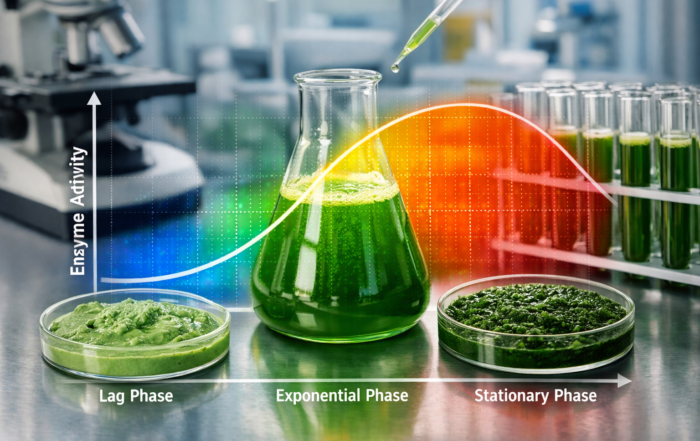
High-yield adaptive strains typically redirect metabolic energy toward rapid cell division and maintenance. Enzyme pathways supporting protein synthesis, phycocyanin accumulation, and fatty acid formation may downregulate over time.
This does not immediately reduce visible growth. Instead, nutritional density erodes gradually, appearing as lower protein percentage, reduced pigment intensity, or inconsistent COA profiles across batches.
Indicators That Yield Is Outpacing Nutritional Density
Early signs of imbalance between yield and nutrition include:
- Stable daily harvest volumes with declining protein percentage
- Reduced phycocyanin concentration despite normal colour
- Narrowing amino acid profiles
- Higher variability between consecutive COA reports
These indicators often emerge before any drop in biomass productivity.
Role of Process Design in Strain Adaptation
Process design strongly influences how spirulina adapts. Farm models that are engineered end-to-end, as seen in Greenbubble-designed systems, intentionally moderate selective pressure rather than maximising short-term output. Uniform mixing, predictable light exposure, and controlled harvest intensity reduce extreme selective pressure.
Engineered raceway pond systems and precision circulation using efficient agitator systems help maintain balanced growth conditions that discourage excessive stress-driven adaptation.
Harvest Strategy and Adaptive Pressure
Aggressive, continuous harvesting disproportionately removes fast-dividing cells, favouring strains that prioritise regrowth speed over nutrient accumulation. This pattern is commonly observed in farms that scale yield without integrating recovery logic into their harvest design. Over time, this skews population traits.
Automated harvesting equipment enables controlled harvest fractions and recovery windows, reducing adaptation pressure and preserving nutritional pathways.
Adaptive Strains in Organic Cultivation
Organic spirulina systems are particularly sensitive to adaptive drift. In practice, Greenbubble’s organic-aligned projects emphasise strain discipline and recovery cycles to prevent nutrition loss under certification constraints. With limited corrective inputs, adaptive strains that sacrifice nutritional density are harder to reverse.
Using certified organic feed inputs within disciplined SOPs helps slow undesirable adaptation, but periodic strain refresh remains essential.
Diagnostic Comparison: Yield Adaptation vs Nutritional Decline
| Observation | Likely Adaptive Cause | Corrective Action |
| Rising yield, falling protein | Selection for rapid regrowth | Reduce harvest intensity, refresh culture |
| Stable colour, lower phycocyanin | Pigment synthesis downregulation | Adjust photoperiod and recovery cycles |
| Faster recovery, lower density value | Structural growth preference | Rebalance nutrients and density |
| Inconsistent COA despite stable output | Adaptive population shift | Re-inoculate from master culture |
Numerical Benchmarking: Detecting Density Dilution Without Lab Overload
Commercial farms rarely have the luxury of running frequent, full-spectrum laboratory analyses. In Greenbubble-operated and advisory projects, this gap is addressed through numerical benchmarking rather than lab-heavy monitoring. Instead, experienced operators rely on a small set of numerical benchmarks to detect early nutritional dilution while yields still appear strong.
Common field-level indicators include:
| Benchmark Metric | What Is Monitored | Early Warning Signal |
| Protein % vs biomass output | Protein percentage relative to daily harvest volume | Stable or rising yield with declining protein % |
| Phycocyanin index trend | Simple absorbance or colour index over time | Gradual downward drift across batches |
| Recovery efficiency | Dry weight recovered per unit wet biomass | More biomass needed for same dry output |
| COA variance | Spread between consecutive COA results | Increasing variability without process changes |
| Input-to-output ratio | Nutrient input per kg usable product | Rising input cost without value gain |
When two or more of these indicators trend negatively together, farms can confidently infer nutritional density dilution without immediate lab confirmation. Targeted testing can then be used selectively rather than routinely.
Downstream Impact: Value Dilution Rather Than Yield Loss
The primary consequence of adaptive high-yield strains is not reduced output but diluted value. This distinction is central to how Greenbubble frames performance assessment for commercial spirulina farms. Buyers pay for protein content, pigment concentration, and consistency. When nutritional density declines, farms must sell more biomass to achieve the same revenue, eroding margins without obvious production failure.
This makes adaptive strain management a commercial decision rather than a purely biological concern.
Practical Framework for Managing Adaptive Drift
Maintaining nutritional density while sustaining yield requires:
- Defined limits on continuous operation duration
- Periodic strain benchmarking against master cultures
- Harvest discipline aligned with metabolic recovery
- Avoidance of chronic stress conditions
- Oversight through spirulina farming consultancy support
Greenbubble integrates adaptive-strain management into long-term farm design, prioritising nutritional consistency alongside yield targets.
FAQs
Q1. Do all high-yield spirulina strains lose nutritional density?
Not immediately. Nutritional decline occurs when adaptive pressure remains uncorrected over long periods.
Q2. Can processing restore lost nutritional density?
No. Processing preserves existing nutrients but cannot compensate for upstream metabolic shifts.
Q3. How often should cultures be refreshed?
Refresh frequency depends on density, harvest intensity, and stress levels, but periodic reinoculation is essential in commercial systems.
Q4. Are adaptive strains genetically modified?
No. Adaptation results from natural selection within production conditions, not genetic engineering.
Q5. Is adaptation always undesirable?
Moderate adaptation improves resilience, but unchecked adaptation reduces nutritional value.
Conclusion: Yield Without Density Is a False Optimisation
Adaptive spirulina strains demonstrate that yield alone is an incomplete measure of success. Without active management, high-yield cultures can quietly lose nutritional density, undermining product value and long-term profitability. Commercial spirulina farming succeeds when adaptation is guided deliberately-balancing productivity with nutritional integrity rather than trading one for the other.
Table Of Contents