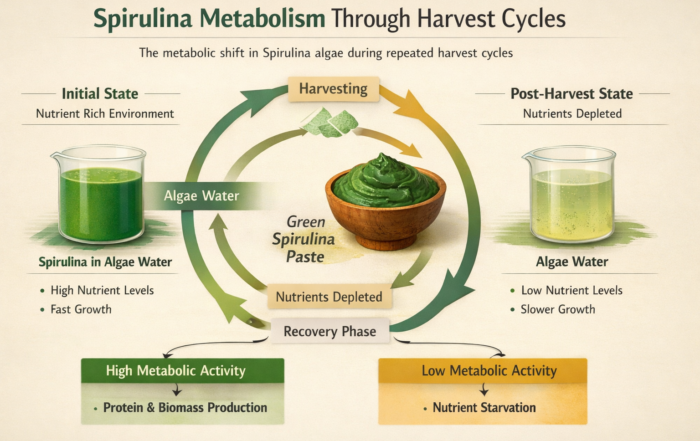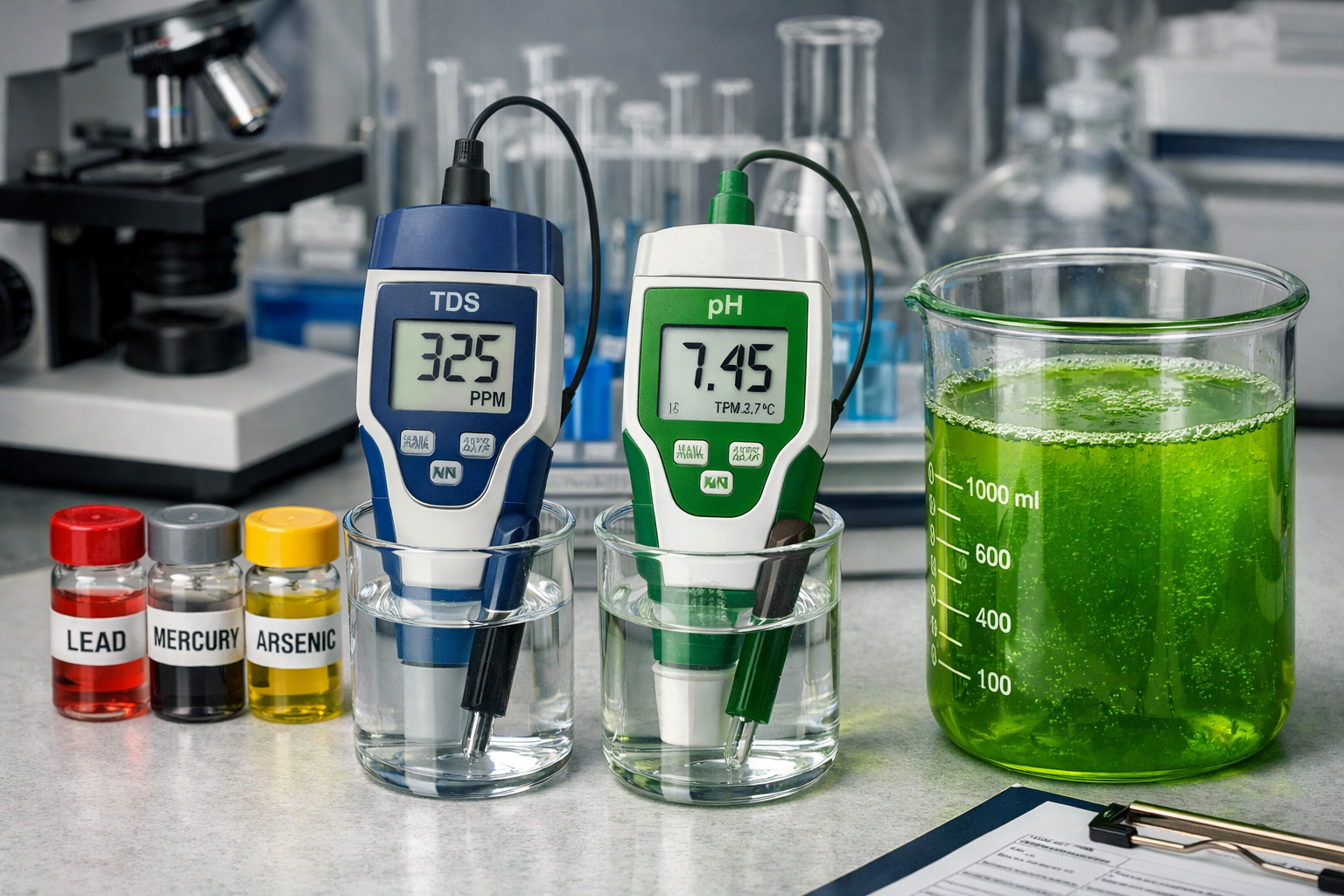
In spirulina farming, water is not just a medium-it is the production environment itself. Every aspect of spirulina growth, quality, safety, and certification is directly influenced by the quality of water used in cultivation. Unlike soil-based crops where contaminants may be buffered or diluted, spirulina is grown in an aqueous system where any impurity, imbalance, or fluctuation has immediate biological consequences.
For commercial and export-oriented spirulina farms, water quality management is one of the most critical-and most underestimated-factors determining long-term success. Farms that fail to treat water quality as a controlled input often face culture crashes, contamination, batch rejections, and certification failures. This article explains why water quality is central to spirulina farming, what parameters matter most, and how professional farms manage water as a core production variable.
Spirulina Grows in Water, Not on Land
Spirulina (Arthrospira) is cultivated in open or semi-controlled raceway ponds filled with nutrient-rich alkaline water. The organism absorbs nutrients, trace elements, and dissolved compounds directly from the water column. As a result:
- Any contaminant in water enters the biomass directly
- Nutrient imbalances reflect immediately in growth patterns
- Microbial contamination spreads rapidly
- Heavy metals and toxins bioaccumulate
This direct interaction makes water quality control far more critical than in conventional agriculture.
Key Water Quality Parameters in Spirulina Farming
Successful spirulina cultivation depends on maintaining multiple water parameters within a narrow operating range. Deviations-even if minor-can reduce productivity or compromise safety.
1) pH Level
Spirulina thrives in highly alkaline conditions.
| Parameter | Ideal Range | Impact if Out of Range |
| pH | 9.0 – 11.0 | Low pH encourages contaminants; high pH causes growth stress |
Maintaining stable alkalinity suppresses unwanted microorganisms and supports optimal photosynthesis.
2) Total Dissolved Solids (TDS)
TDS reflects the total concentration of dissolved salts and nutrients.
| Parameter | Typical Range | Risk if Uncontrolled |
| TDS | 10,000 – 20,000 ppm | Low TDS limits growth; high TDS stresses cells |
Excessive salinity can slow growth and reduce protein quality.
3) Water Temperature
Temperature affects metabolic activity and pigment stability.
| Parameter | Ideal Range | Effect of Deviation |
| Temperature | 30–35°C | Below range slows growth; above range causes bleaching |
Uncontrolled heating can destroy phycocyanin and reduce market value.
4) Water Transparency and Turbidity
Light penetration is essential for photosynthesis.
| Parameter | Target Condition | Risk |
| Transparency | Moderate, uniform | Excess turbidity reduces photosynthesis |
Suspended solids or algal debris interfere with light utilization.
Heavy Metals: The Hidden Risk
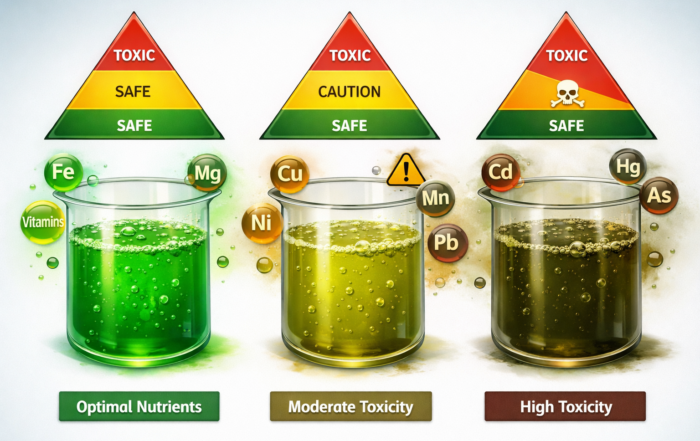
Water is the primary source of heavy metal contamination in spirulina farming. Metals such as lead, arsenic, mercury, and cadmium can enter ponds through groundwater, surface runoff, or poorly treated input water.
Once present, these metals bioaccumulate in spirulina biomass and are extremely difficult to remove.
| Metal | Source | Risk |
| Lead | Groundwater, pipes | Neurotoxicity |
| Arsenic | Soil leaching | Chronic toxicity |
| Mercury | Industrial runoff | Bioaccumulation |
Even trace contamination can result in batch rejection during COA testing.
Microbial Contamination and Water Hygiene
Although alkaline pH suppresses many pathogens, poor water quality can still allow contamination.
Common sources include:
- Untreated surface water
- Recycled water without filtration
- Organic debris accumulation
Professional farms use controlled water sourcing, filtration, and periodic sterilization protocols to maintain hygiene.
Water Source Selection: Why It Matters
Water sourcing decisions are closely linked to pond engineering. Raceway design, flow patterns, and mixing efficiency directly affect how quickly water parameters drift. Greenbubble’s professionally designed raceway ponds combined with efficient agitators help maintain uniform pH, temperature, and nutrient distribution across large pond areas.
Not all water sources are suitable for spirulina farming.
| Water Source | Suitability | Reason |
| Borewell water | Conditional | Requires heavy metal testing and other parameters monitoring |
| Surface water | High risk | Prone to contamination |
| RO-treated water | Preferred | Controlled purity |
Many commercial farms rely on treated water blended with mineral inputs to maintain consistency.
Role of Automation in Water Quality Control
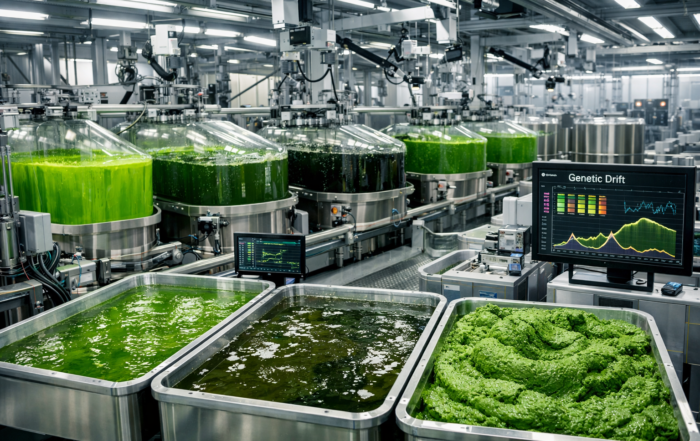
Modern spirulina farms rarely rely on manual checks alone. Automation ensures continuous stability of water parameters and creates audit-ready data trails. These systems are typically implemented through Greenbubble’s professional spirulina farming consultancy or end-to-end spirulina farming turnkey solutions, where water management is engineered from day one.
Manual monitoring is insufficient for commercial spirulina operations. Automation enables real-time control of water parameters.
Automated systems support:
- Continuous pH and temperature monitoring
- Automated nutrient dosing
- Early detection of deviations
- Data logs for audits
Such systems are typically deployed through professional spirulina farming consultancy and turnkey implementation models.
Water Quality and Certification Compliance
Water quality compliance does not stop at cultivation. Downstream processes such as harvesting, dewatering, drying, and packing must preserve the same hygiene standards. This is why Greenbubble’s certified harvesting equipment, assisted dewatering systems, low-temperature RWD drying systems, and hygienic packing systems are treated as extensions of water-quality control.
For farms targeting food, nutraceutical, or export markets, water quality documentation is mandatory.
Certifications require:
- Source water analysis reports
- Periodic heavy metal testing
- Microbial analysis
- Traceable water treatment SOPs
Any lapse in water quality records can lead to certification suspension.
Economic Impact of Poor Water Quality
Poor water control does not just affect biology-it affects the entire production economics. Farms without engineered water systems often experience inconsistent harvest cycles, higher rejection rates, and difficulty scaling production. In contrast, turnkey models that integrate water sourcing, treatment, pond design, and automation show more predictable yields and lower compliance risk.
Ignoring water quality is expensive.
Consequences include:
- Culture crashes and yield loss
- Reprocessing or disposal of contaminated batches
- Loss of buyer confidence
- Certification failures
In contrast, farms that treat water quality as an engineered input achieve stable yields and predictable economics.
Technical Expansion: Ions, Alkalinity & Buffer Systems
Beyond basic parameters like pH and TDS, commercial spirulina farming depends on precise ionic balance and alkalinity buffering.
Key Ions That Influence Spirulina Growth
| Ion | Typical Role | Risk if Imbalanced |
| Bicarbonate (HCO₃⁻) | Primary carbon source | Low levels reduce growth; excess causes pH spikes |
| Carbonate (CO₃²⁻) | pH buffering | Excess stresses cells |
| Sodium (Na⁺) | Osmotic balance | High levels increase salinity stress |
| Potassium (K⁺) | Enzyme activity | Deficiency slows metabolism |
| Magnesium (Mg²⁺) | Chlorophyll synthesis | Deficiency affects photosynthesis |
Bicarbonate Systems and Carbon Management
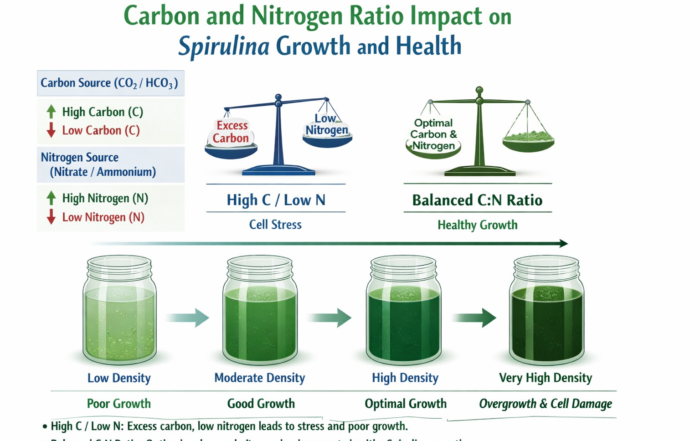
Most commercial farms rely on sodium bicarbonate-based systems to maintain alkalinity and supply carbon for photosynthesis. Proper dosing is critical:
- Under-dosing limits biomass productivity
- Over-dosing causes rapid pH drift and carbonate precipitation
Automated dosing linked to real-time pH sensors ensures stable carbon availability without shock loading.
Alkalinity Control Strategies Used in Professional Farms
- Gradual bicarbonate dosing instead of bulk additions
- Continuous mixing using engineered agitators
- Periodic alkalinity titration tests
- Controlled water make-up using treated water
These strategies reduce stress events and extend culture life cycles.
Interaction Between Water Chemistry and Yield
Stable ionic balance directly influences:
- Protein synthesis
- Phycocyanin retention
- Culture longevity
- Harvest frequency
Farms that treat alkalinity as a dynamic control variable-not a one-time adjustment-consistently achieve higher productivity.
FAQs
Q1. Can normal groundwater be used for spirulina farming?
Only after thorough testing. Groundwater often contains heavy metals or excess minerals that can contaminate spirulina.
Q2. How often should water be tested in a spirulina farm?
Critical parameters should be monitored daily, while full chemical and heavy metal analysis should be done periodically.
Q3. Does alkaline pH eliminate all contamination risks?
No. While alkalinity suppresses many microbes, it does not prevent heavy metal contamination or all pathogens.
Q4. Is RO water necessary for spirulina cultivation?
RO-treated water is preferred in commercial farms because it offers consistent baseline quality.
Q5. How does water quality affect export eligibility?
Export markets require documented proof that water quality meets safety and contamination standards.
Conclusion
Water quality is the foundation of spirulina farming. It influences growth, nutrient composition, safety, certification, and market acceptance. Farms that underestimate water quality often struggle with inconsistent output and regulatory failures.
Commercial spirulina production requires water to be treated as a controlled raw material-monitored, documented, and engineered for consistency. This disciplined approach, commonly seen in professionally designed systems such as those implemented under the Greenbubble framework, is essential for building a scalable and compliant spirulina business.
Table Of Contents