Introduction
Spirulina has emerged as one of the most profitable superfoods in the global nutraceutical market. Its exceptional nutritional profile-rich in proteins, vitamins, pigments, and essential fatty acids-makes it highly sought after. However, cultivating spirulina at a commercial scale requires more than just ponds, water, and nutrients. One of the most overlooked yet critical components of successful spirulina cultivation is agitation.
Agitation, the continuous movement of culture water, ensures that spirulina receives the right balance of light, nutrients, and gas exchange. Without it, even the most nutrient-rich pond will fail to deliver consistent yields. In this blog, we’ll explore why agitation is essential, the types of systems available, the challenges of poor agitation, and how automation improves both profitability and certification compliance.
What is Agitation in Spirulina Farming?
Agitation refers to the mechanical or automated mixing of water in spirulina ponds or tanks to create uniform culture conditions. Unlike stagnant water, which causes stratification and uneven growth, agitation keeps spirulina cells suspended, ensures even light exposure, and prevents contamination.
Natural vs. Mechanical Agitation
- Natural Agitation: Achieved through wind, rainfall, or manual stirring. Suitable only for small experimental or home-scale setups.
- Mechanical/Automated Agitation: Uses paddle wheels, pumps, or air-lift systems to ensure consistent and controlled mixing. Essential for commercial-scale production.
In modern spirulina farming, mechanical agitation is non-negotiable for certification and export readiness.
Why Agitation is Essential
Agitation plays multiple roles in ensuring spirulina growth and quality.
1. Nutrient Distribution
- Spirulina requires a balanced mix of carbon, nitrogen, phosphorus, and trace minerals.
- Agitation ensures these nutrients are evenly distributed across the pond, preventing localized nutrient depletion.
2. Gas Exchange
- Spirulina consumes carbon dioxide during photosynthesis and releases oxygen.
- Without agitation, CO₂ dissolves unevenly, leading to poor photosynthesis.
- Continuous mixing ensures adequate oxygenation and prevents culture suffocation.
3. Temperature Regulation
- Pond surfaces can heat up beyond optimal levels in hot climates.
- Agitation distributes heat evenly, preventing surface overheating and bottom cooling.
- Proper temperature balance avoids bleaching and stress.
4. Light Exposure
- Spirulina is photosynthetic and requires light for growth.
- Agitation prevents cells from sinking to the bottom, ensuring all cells get equal sunlight exposure.
- This uniformity leads to higher protein and pigment yields.
5. Contamination Control
- Stagnant water encourages growth of bacteria, protozoa, and competing algae.
- Agitation keeps spirulina in suspension, limiting the chances of contamination.
Types of Agitation Systems
Different agitation systems are used depending on scale and budget.
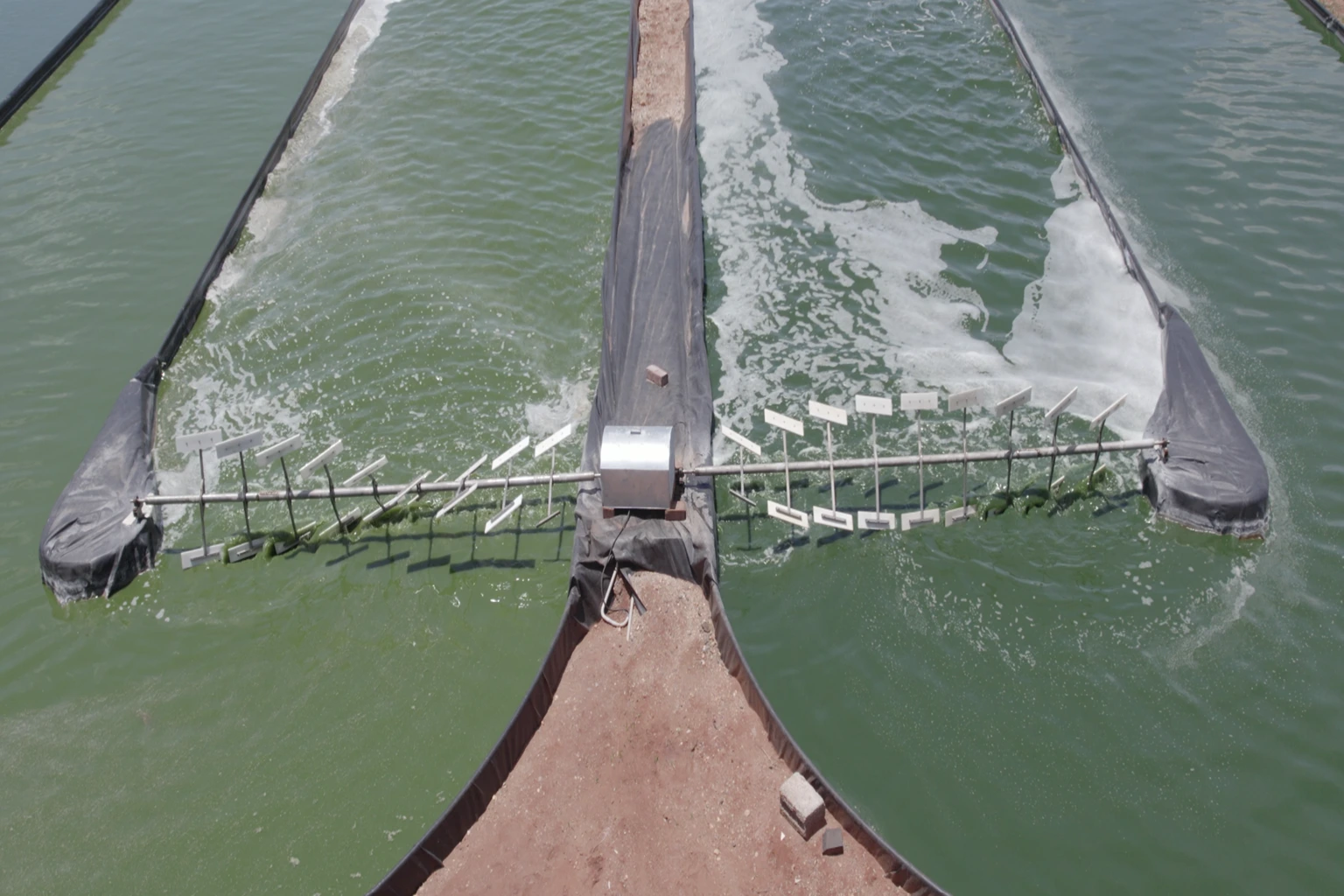
Paddle Wheels
- Most common system in raceway ponds.
- Large paddle blades push culture water in a circular motion.
- Energy-efficient and scalable for large farms.
Air-Lift Systems
- Uses compressed air to circulate culture water.
- Gentle on cells but less energy-efficient.
- Suitable for small tanks or pilot-scale farms.
Pumps & Stirrers
- Submersible pumps or automated stirrers mix culture in tanks.
- Often used in controlled indoor systems.
Manual Stirring
- Using sticks or hand tools to mix water.
- Practical only for very small home setups.
- Inconsistent and contamination-prone for commercial use.
Agitation & Certification Compliance
Certifications such as USDA Organic, HACCP, and GMP demand high standards of consistency and contamination prevention.
- GMP (Good Manufacturing Practices): Requires minimizing human contact. Manual stirring fails this standard. Automated agitators are necessary.
- HACCP (Hazard Analysis and Critical Control Points): Identifies poor mixing as a hazard, since it can cause contamination hotspots. Controlled agitation is a corrective measure.
- USDA Organic/EU Organic: Requires proof of consistent growth conditions, which automated agitation systems can log and validate.
Thus, agitation is not just about better growth-it is about meeting certification audits and enabling exports.
Automation in Agitation Systems
Modern spirulina farms are increasingly turning to IoT and SCADA-enabled agitation systems for precision control.
Features of Automated Agitation:
- Speed Control: Adjust paddle wheel speeds based on culture density.
- Data Logging: Records agitation levels for certification documentation.
- Remote Monitoring: IoT-enabled systems allow farmers to adjust settings via mobile or computer.
- Energy Efficiency: Solar-powered agitators reduce operational costs.
Automation ensures farms can scale while maintaining consistency, which is critical for export buyers and audits. Learn more in Automation in Spirulina Farming.
Challenges with Poor Agitation
When agitation is neglected or poorly implemented, farms face major setbacks:
- Sedimentation: Spirulina biomass settles at the bottom, reducing active culture.
- Temperature Stratification: Surface overheating and bottom cooling stress the culture.
- Uneven Growth: Some cells overexposed to light, others deprived, leading to inconsistent biomass.
- Increased Contamination: Stagnant patches allow bacteria, insects, and other algae to thrive.
- High Labor Costs: Manual stirring requires more labor and reduces efficiency.
Cost of Agitation Systems
The cost of agitation systems varies depending on scale:
- Small-scale Farms: Manual or small pumps, cost between ₹50,000–₹1 lakh.
- Commercial Farms: Paddle-wheel agitators, typically ₹5–10 lakhs per acre.
- Automated IoT Systems: With SCADA integration, costs rise to ₹12–15 lakhs per acre, but ROI is faster due to reduced contamination and higher yields.
For a complete breakdown of turnkey solutions, see Spirulina Farming Turnkey Project Components.
Comparison of Agitation Methods
| Method | Scale | Cost (INR) | Advantages | Limitations |
| Manual Stirring | Home-scale | <₹50,000 | Low cost, easy to start | Inconsistent, labor-intensive, not certifiable |
| Air-Lift System | Small-scale | ₹1–2 lakhs | Gentle mixing, better for tanks | Less efficient for large ponds |
| Pumps/Stirrers | Mid-scale | ₹2–4 lakhs | Compact, usable indoors | Higher power consumption |
| Paddle Wheels | Commercial | ₹5–10 lakhs/acre | Efficient, scalable, export-ready | Requires large ponds |
| Automated IoT Agitators | Large-scale | ₹12–15 lakhs/acre | Precision control, data logging, certification compliance | Higher initial cost |
FAQs
1. Why does spirulina need continuous agitation?
Continuous agitation ensures even nutrient distribution, stable temperatures, gas exchange, and uniform light exposure, all of which maximize yield.
2. Can spirulina grow without agitation in small tanks?
Yes, but growth will be slow and inconsistent. Small tanks without agitation are prone to contamination and nutrient depletion.
3. What’s the best agitation system for large raceway ponds?
Paddle wheels are the most effective and widely used for commercial raceway ponds due to their scalability and efficiency.
4. How does agitation affect certification and export readiness?
Certifications like USDA Organic, HACCP, and GMP require proof of contamination control and consistent growth conditions. Automated agitators help meet these standards.
Conclusion
Agitation is the backbone of spirulina farming. It ensures balanced nutrient distribution, consistent light exposure, controlled temperature, and reduced contamination risks. For commercial farms, automated agitation systems not only boost yields but also enable compliance with strict certification standards required for global exports.
While home setups may get by with manual stirring, serious spirulina businesses must invest in paddle-wheel or automated IoT-based agitators to scale profitably. Ultimately, agitation is not just about mixing water-it is about ensuring spirulina’s biological success, commercial viability, and global acceptance as a premium superfood.
Table Of Contents