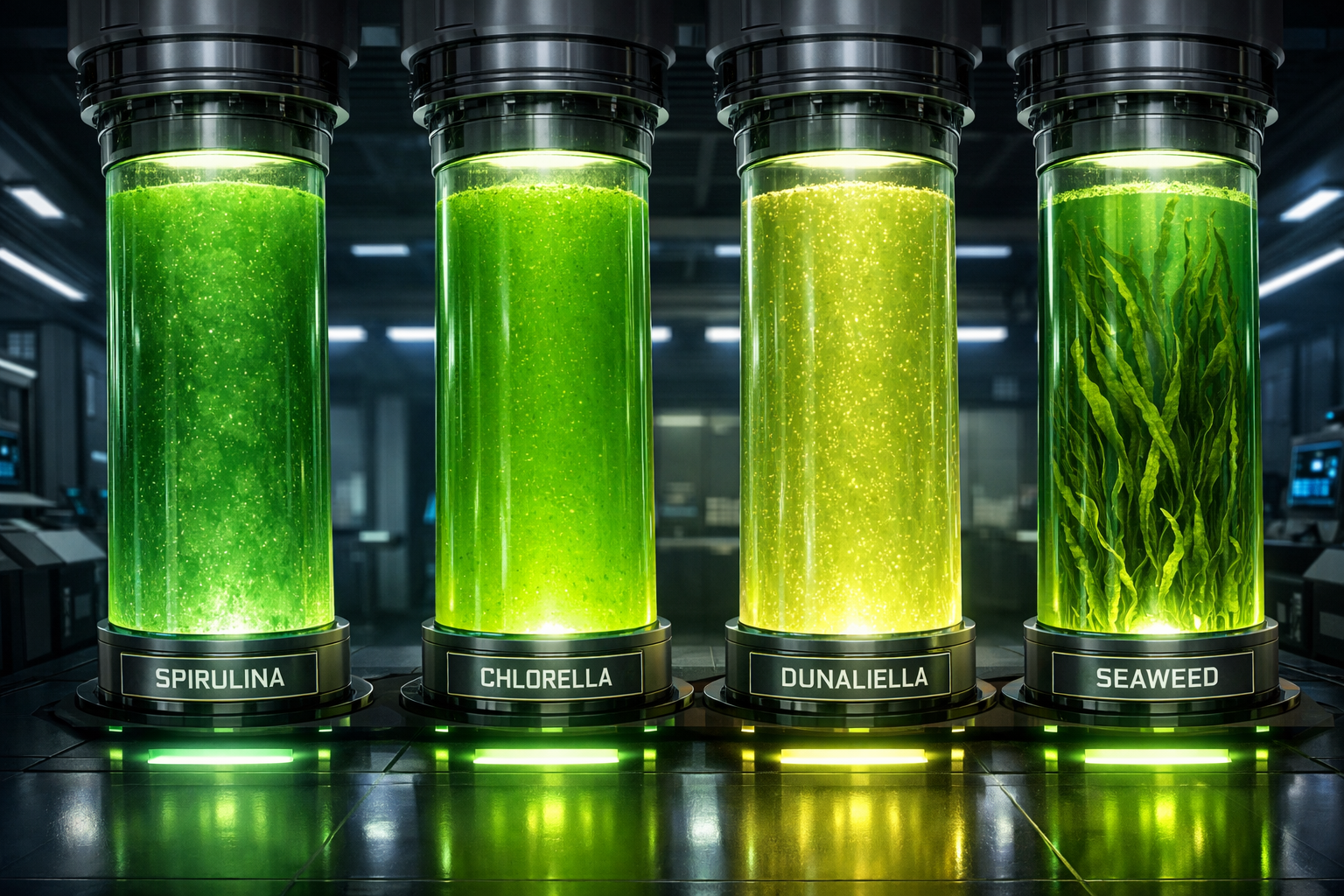
As interest in algae-based businesses grows, many prospective producers face a fundamental decision early on: which algae should you grow? Spirulina often dominates the conversation, but it is not the only commercially cultivated algae. Other species such as chlorella, dunaliella, and haematococcus are also grown worldwide for specific applications.
Choosing the right algae to cultivate is not just a biological decision-it is a commercial, operational, and market-driven one. Each algae species has unique cultivation requirements, risk profiles, capital needs, and market dynamics. This article compares spirulina with other commonly discussed algae to help producers understand which option aligns best with their goals.
Why Spirulina Is Often the Starting Point
Spirulina (Arthrospira) is one of the most widely cultivated microalgae globally. Its popularity is driven by a combination of biological resilience and market familiarity.
Key reasons spirulina is often preferred include:
- Ability to grow in highly alkaline conditions, reducing contamination risk
- Simple open-pond cultivation methods
- Relatively fast growth cycle
- Broad market acceptance across food, nutraceutical, cosmetic, and institutional segments
Because of these factors, spirulina is often considered the most forgiving algae for commercial-scale cultivation.
Overview of Commonly Compared Algae Species
Before comparing them directly, it helps to understand what differentiates these algae at a high level.
| Algae | Primary Use | Typical Cultivation Style |
| Spirulina | Nutrition, supplements, colourants | Open raceway ponds |
| Chlorella | Nutrition, detox products | Mostly open systems |
| Dunaliella | Beta-carotene extraction | High-salinity ponds |
| Haematococcus | Astaxanthin production | Controlled photobioreactors |
Each of these species serves a different market purpose, which strongly influences how and where they are grown.
Spirulina vs Chlorella
Spirulina and chlorella are often compared because both are marketed as nutritional algae. However, their cultivation profiles differ significantly.
| Parameter | Spirulina | Chlorella |
| Cell type | Multicellular cyanobacteria | Unicellular green algae |
| Contamination resistance | High (alkaline pH) | Lower (neutral pH) |
| Cultivation system | Open ponds | Closed tanks/bioreactors |
| Production complexity | Moderate | High |
| Capital requirement | Lower | Higher |
Chlorella requires stricter contamination control and more sophisticated infrastructure, making it less accessible for first-time producers.
Spirulina vs Dunaliella
Dunaliella is primarily cultivated for beta-carotene rather than whole-biomass consumption.
Key differences include:
- Dunaliella thrives in extremely high salinity, limiting contamination but increasing corrosion risk
- Production focuses on pigment extraction rather than bulk biomass
- Downstream processing is more expensive due to very sensitive pigments.
Compared to spirulina, Dunaliella cultivation is more specialised and less flexible in terms of end-use markets.
Spirulina vs Haematococcus
Haematococcus pluvialis is grown mainly for astaxanthin, a high-value antioxidant used in nutraceuticals and aquaculture.
| Aspect | Spirulina | Haematococcus |
| Primary output | Whole biomass | Extracted pigment |
| Growth cycle | Continuous | Two-stage (growth + stress) |
| System type | Open ponds | Photobioreactors |
| Operational risk | Moderate | High |
| Entry barrier | Low–moderate | Very high |
Haematococcus cultivation demands precise stress induction and advanced processing, making it suitable only for highly capitalised operations.
Commercial Risk, ROI, and Scalability Comparison
From a business perspective, scalability, return on investment (ROI), and risk tolerance are critical when choosing which algae to grow. While some algae species promise higher per‑kg prices, they also introduce higher uncertainty and longer payback periods.
| Factor | Spirulina | Chlorella | Dunaliella | Haematococcus |
| Typical capex (relative) | Low–Moderate | High | High | Very High |
| Operating complexity | Moderate | High | High | Very High |
| Time to first revenue | Short | Medium | Medium | Long |
| Market price stability | High | Moderate | Moderate–Low | Volatile |
| ROI predictability | High | Moderate | Low–Moderate | Low |
| Scale-up risk | Low | Moderate | High | Very High |
While specialty algae can deliver high margins in ideal conditions, spirulina offers the most predictable ROI profile for commercial farms aiming for steady cash flow rather than speculative returns.
| Factor | Spirulina | Other Algae |
| Ease of scale-up | High | Limited or complex |
| Market diversity | Broad | Narrow |
| Technical risk | Moderate | High |
| Time to cash flow | Shorter | Longer |
This is why spirulina is often chosen for commercial farming rather than research-driven pigment extraction algae.
Infrastructure and Skill Requirements
Spirulina can be cultivated using relatively straightforward infrastructure such as open raceway ponds, paddlewheel mixing, and standard drying systems. Other algae typically require:
- Closed photobioreactors
- Sterile operating environments
- Advanced monitoring and control
- Higher technical expertise
Professional planning through spirulina farming consultancy helps producers avoid selecting algae species that are misaligned with their capabilities.
Role of Market Demand in Algae Selection
Market demand ultimately determines viability. Spirulina benefits from:
- Established consumer awareness
- Multiple downstream applications
- Stable year-round demand
In contrast, other algae often depend on niche markets or single-industry demand, increasing commercial vulnerability.
Beginner vs Advanced Producer Decision Guide
Choosing an algae species should reflect not only market ambition but also operational maturity, capital access, and risk appetite.
Beginner or First-Time Producers
Spirulina is generally the most suitable choice for beginners due to:
- Lower capital requirements and simpler infrastructure
- Greater tolerance to contamination because of alkaline growth conditions
- Faster learning curve and shorter feedback cycles
- Easier access to domestic and export markets
For new entrants, spirulina allows producers to build operational discipline, quality control systems, and market relationships before attempting more complex algae.
Advanced or Specialised Producers
More complex algae species may be considered when producers already have:
- Strong technical teams and process control capability
- Access to higher capital and longer payback horizons
- Secured off‑take agreements or niche market access
- Experience managing closed systems and contamination risk
Even at advanced stages, many producers retain spirulina as a base crop while experimenting with other algae in parallel R&D or pilot setups.
Which Algae Should You Grow?
The answer depends on your objectives:
- For first-time or medium-scale commercial farming, spirulina offers the best balance of risk, scalability, and market access
- For highly specialised, capital-intensive projects, other algae may offer higher margins but significantly higher risk
In systems-led production models-such as those aligned with Greenbubble frameworks-spirulina is typically positioned as the foundation species before exploring more complex algae.
FAQs
Q1. Is spirulina easier to grow than other algae?
Yes. Spirulina is more resilient and tolerant of contamination compared to most other commercially cultivated algae.
Q2. Are other algae more profitable than spirulina?
Some can be, but they involve higher capital, technical complexity, and market risk.
Q3. Can multiple algae be grown on the same farm?
In most cases, few can be. Different algae require very different cultivation conditions.
Q4. Is spirulina suitable for export markets?
Yes. Spirulina has established global demand across multiple industries.
Q5. Should beginners start with spirulina?
Yes. Spirulina is generally the most practical starting point for commercial algae farming.
Conclusion
While multiple algae species have commercial value, spirulina remains the most practical and scalable option for most producers. Its resilience, simpler infrastructure requirements, and broad market acceptance make it a logical entry point into algae farming.
Producers who adopt structured, quality-focused systems-such as those seen in Greenbubble aligned spirulina projects-are better positioned to build sustainable operations before considering more complex algae species.
Table Of Contents