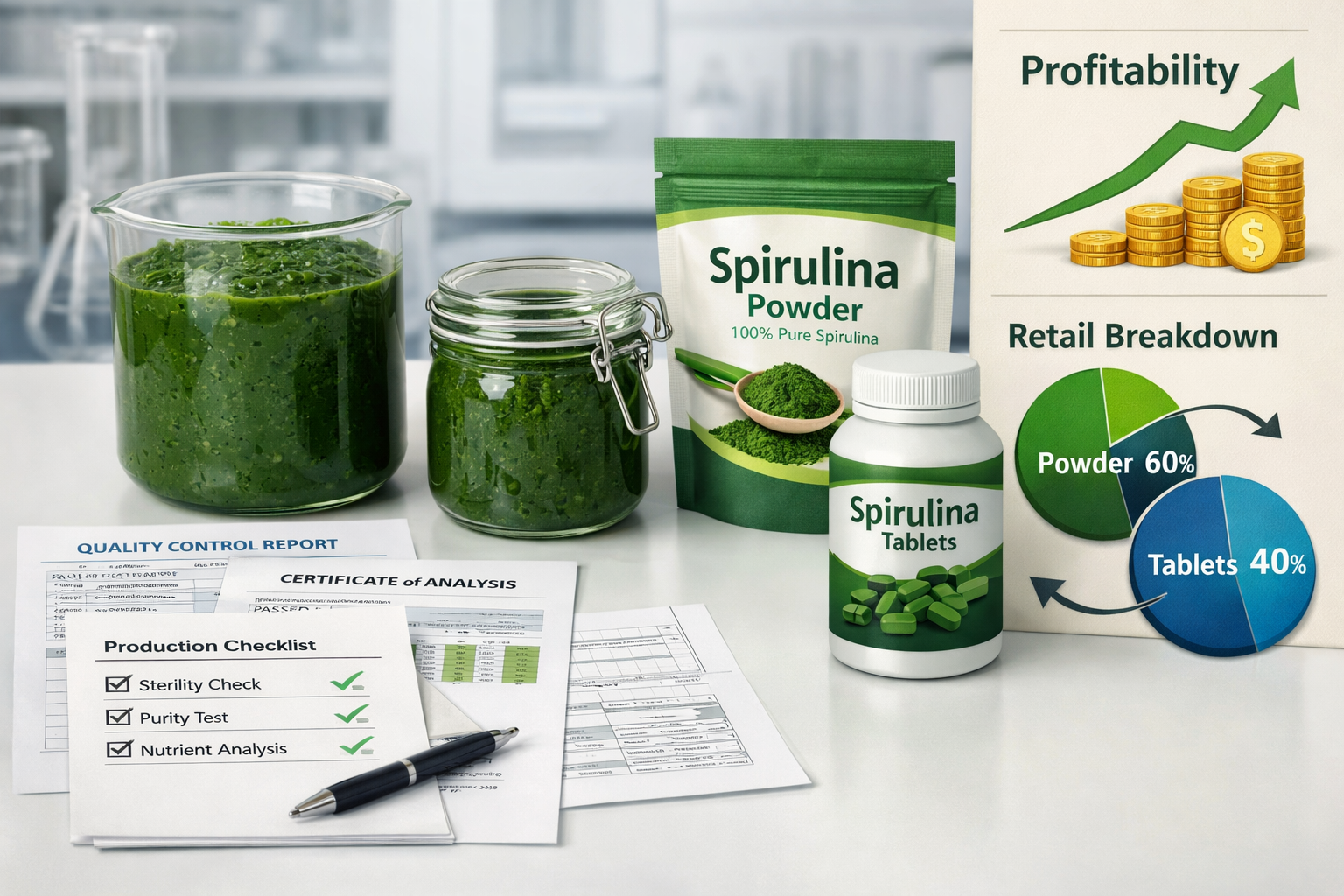
One of the most common questions spirulina producers face after stabilising cultivation is whether to sell spirulina as a powder or convert it into tablets. On the surface, tablets appear more profitable because of higher retail prices, while powder seems simpler and faster to sell in bulk. In reality, profitability depends on far more than selling price alone.
The choice between spirulina powder and tablets affects capital investment, processing complexity, quality risk, market access, compliance requirements, and scalability. This article breaks down the economics, operational considerations, and market realities to help producers decide which form makes the most commercial sense.
Understanding the Two Formats
Spirulina powder is dried, milled biomass sold either in bulk or retail packs. Spirulina tablets are produced by compressing powder into uniform doses, often with additional processing, tooling, and compliance.
While both originate from the same biomass, the value chain diverges significantly after drying.
Cost Structure: Powder vs Tablets
Powder has a relatively straightforward cost structure. Tablets introduce additional cost layers that must be justified through pricing and volume.
| Cost Component | Powder | Tablets |
| Drying & milling | Required | Required |
| Tableting equipment | Not required | Required |
| Tooling & dies | None | Required |
| Labour intensity | Low | Moderate–High |
| Quality rejection risk | Low | Moderate |
| Compliance & testing | Moderate | Higher |
While tablets command higher prices, they also lock producers into higher fixed and operating costs.
Price Realisation and Margin Reality
Selling price alone does not determine profitability. Margin depends on how much additional value remains after processing, compliance, labour, and rejection losses.
Per-Kg Margin Snapshot (Indicative)
The table below illustrates a simplified, indicative comparison of net margin behaviour per kg for powder vs tablets. Actual numbers vary by market and scale, but the pattern is consistent.
| Parameter | Powder | Tablets |
| Typical bulk selling price (₹/kg) | Moderate | High |
| Processing & handling cost (₹/kg) | Low | High |
| Rejection / rework loss | Low | Moderate–High |
| Net margin stability | High | Variable |
| Cash-flow speed | Faster | Slower |
Powder generally delivers lower but more predictable margins, while tablets offer higher upside only when systems run without friction.
Typical observations:
- Powder margins are thinner per kg but more predictable
- Tablets offer higher per-unit pricing but lower margin certainty
- Rejection or rework in tablets directly erodes profit
Selling price alone does not determine profitability. Margin depends on how much additional value remains after processing costs.
Typical observations:
- Powder margins are thinner per kg but more predictable
- Tablets offer higher per-unit pricing but lower margin certainty
- Rejection or rework in tablets directly erodes profit
For many producers, powder delivers more stable net margins, especially at scale.
Processing Flow Comparison: Powder vs Tablets
Understanding how the processing flow diverges helps explain cost and risk differences.
| Stage | Powder Flow | Tablet Flow |
| Harvesting | Biomass collection | Biomass collection |
| Dewatering | Required | Required |
| Drying | Controlled drying | Controlled drying |
| Milling | Fine milling | Fine milling |
| Compression | Not required | Tablet compression |
| Packaging | Bulk or retail packing | Blister / bottle packing |
| Compliance | Food-grade | Supplement-grade |
Each additional stage in the tablet flow introduces cost, time, and failure risk.
Market Demand Differences
Powder Markets
Powder is preferred by:
- Bulk buyers
- Exporters
- Food, beverage, and cosmetic formulators
- Aggregators and contract manufacturers
Powder markets reward consistency, volume, and documentation.
Tablet Markets
Tablets are favoured in:
- Retail nutraceutical segments
- Direct-to-consumer brands
- Institutional supply with dosing requirements
Tablet markets are more branding- and compliance-driven, with higher expectations around packaging and labelling.
Scalability and Risk Profile
| Factor | Powder | Tablets |
| Ease of scale | High | Moderate |
| Capital risk | Lower | Higher |
| Inventory flexibility | High | Low |
| Market switching | Easy | Difficult |
Powder offers greater flexibility when demand shifts. Tablets lock producers into specific formats and buyers.
Export Considerations
In export markets, powder is often easier to place, especially for first-time exporters. Tablets introduce additional regulatory scrutiny, especially in the US and EU, where supplements are tightly regulated.
Producers targeting exports often stabilise powder sales before considering tablets.
Where Tablets Make Sense
Tablet production introduces mechanical and compliance complexity that must be justified commercially.
Tablets can be profitable when:
- Brand ownership exists
- Volumes are predictable
- Compliance systems are mature
- Processing downtime is minimal
Producers considering tablets often require specialised guidance through professional spirulina farming consultancy to avoid costly missteps.
Without these conditions, tablet operations often struggle to sustain margins.
Tablets can be profitable when:
- Brand ownership exists
- Volumes are predictable
- Compliance systems are mature
- Processing downtime is minimal
Without these conditions, tablet operations often struggle to sustain margins.
Powder as the Foundation Product
Most scalable operations treat powder as the base product because it integrates cleanly with export, B2B supply, and further processing.
Stable powder production depends heavily on controlled drying and hygienic handling. Systems such as RWD drying systems and hygienic packing systems help producers preserve colour, moisture balance, and shelf life.
In many Greenbubble-aligned production models, powder is treated as the foundational product. Once drying, packing, and quality systems are stable, tablets may be introduced selectively rather than universally.
This sequencing reduces risk while preserving optionality.
In many Greenbubble-aligned production models, powder is treated as the foundational product. Once drying, packing, and quality systems are stable, tablets may be introduced selectively rather than universally.
This sequencing reduces risk while preserving optionality.
Decision Checklist: Powder or Tablets?
| Question | Powder | Tablets |
| Do you want faster cash flow? | Yes | No |
| Do you have branding capability? | Not required | Essential |
| Are volumes predictable? | Helpful | Critical |
| Is compliance infrastructure strong? | Moderate | High |
The form that aligns best with your current systems-not aspirational pricing-will usually be the more profitable choice.
FAQs
Q1. Are spirulina tablets always more profitable than powder?
In bulk sales of tablets, yes. But in retail, No. Higher selling price does not guarantee higher net margins.
Q2. Can I start with powder and add tablets later?
Yes. Many producers follow this staged approach.
Q3. Do tablets have higher rejection risk?
Yes, due to breakage, weight variation, and compliance failures.
Q4. Which format is better for exports?
Powder is generally easier for first-time exporters.
Q5. Should small farms make tablets?
Usually no, unless branding and compliance are already in place.
Conclusion
The decision between spirulina powder and tablets is ultimately a business strategy choice, not a processing preference. Powder offers simplicity, flexibility, and predictable margins, making it the foundation for most scalable operations. Tablets can be profitable, but only when supported by strong systems, branding, and compliance.
Producers who approach format selection with a systems-driven mindset-similar to those seen in Greenbubble-aligned spirulina operations-are more likely to choose the option that delivers sustainable profitability rather than short-term appeal.
Table Of Contents